




Almost every contact center analytics platform can now record every call, transcribe it, and analyze it. Ingesting and analyzing every call used to set platforms apart. Now it’s table stakes.
In other words, the factors that set a conversation performance platform apart have changed. ReflexAI brings the industry forward with conversation intelligence: how agents perform on the outcomes that matter most, and why.
Conversation Intelligence is the step beyond simple analytics such as counting how many times a topic has occurred. It connects the outcome of the call, the agent’s responses, and the context in which they said it, across every conversation.
Why call recordings alone don’t explain outcomes
Your recordings already hold the answers to the questions leadership asks every quarter: why enrollment slipped, which customers are hardest to keep, and what the best agents do that the rest don't. The answers to these questions are hidden in the everyday conversations that contact center agents are having. The gap is the ability to extract data from these conversations and the analysis to connect outcomes, behavior, and context.
How does conversation intelligence work?
The way the ReflexAI platform analyzes conversations builds on decades of research in linguistics and clinical communication, even before modern LLMs came into play.
Intent detection
Intent detection identifies what a speaker is trying to accomplish, and grew out of spoken language understanding research in the 1990s, when benchmarks built from people asking an automated system about flights, along with early call-routing systems, taught machines to recognize why someone was calling. Later work extended the same idea to outcomes, predicting how a conversation will end from what happens along the way.
Aspect-based sentiment analysis
Aspect-based sentiment analysis goes a level deeper than traditional sentiment analysis. It measures how someone feels about each specific thing they mention. For example, a member might feel negatively about a premium but positively about the provider network. The field took shape in the mid-2000s through research on mining opinions from product reviews, and shared benchmark competitions in the 2010s made it a standard research task.
Dialog act classification
Dialog act classification labels each turn in a conversation by its function, whether that turn asks a question, answers one, acknowledges a concern, or makes a commitment. Its roots go back to speech act theory, and in the late 1990s, annotation schemes like DAMSL gave researchers a shared way to tag real telephone conversations at scale.
What the calls show
Combine these methods on every call, and a different kind of insight appears.

Consider a contact center that runs enrollment and member services for a health plan. Run every one of its calls through the ReflexAI platform, and three patterns stand out.
Each call type succeeds differently
An enrollment call succeeds when the member enrolls. A billing call succeeds when the bill is resolved. A cancellation call succeeds when the member stays, or leaves knowing exactly what happens next.
A single success rate blends all of them together, so a shift in the mix of calls looks like a shift in performance. A week with more cancellation calls looks like a bad week, even if every agent handled their calls well. Measuring success within each call type is what makes the metric mean something.
Agent responses matter more than topic mentions
On this health plan’s enrollment line, the same concerns come up again and again: premiums, prescriptions, and whether members can keep their doctors. Knowing that a concern came up is half the picture. The other half is what the agent did about it.
Here’s what that might look like on two enrollment calls. In both calls, a member stops halfway through to say she has seen the same cardiologist for eleven years and wants to know whether switching plans means losing access to him.
- The first agent tells her not to worry, that most members keep their doctors, and moves on. The member says she will think about it and hangs up without enrolling.
- The second agent walks her through how to check the new plan's provider network, finds her cardiologist in it, and the member enrolls before the call ends.
The difference is the response. The first agent offers premature reassurance. The second checks the provider network with the member and confirms her doctor is in it. Only one call ends in an enrollment.
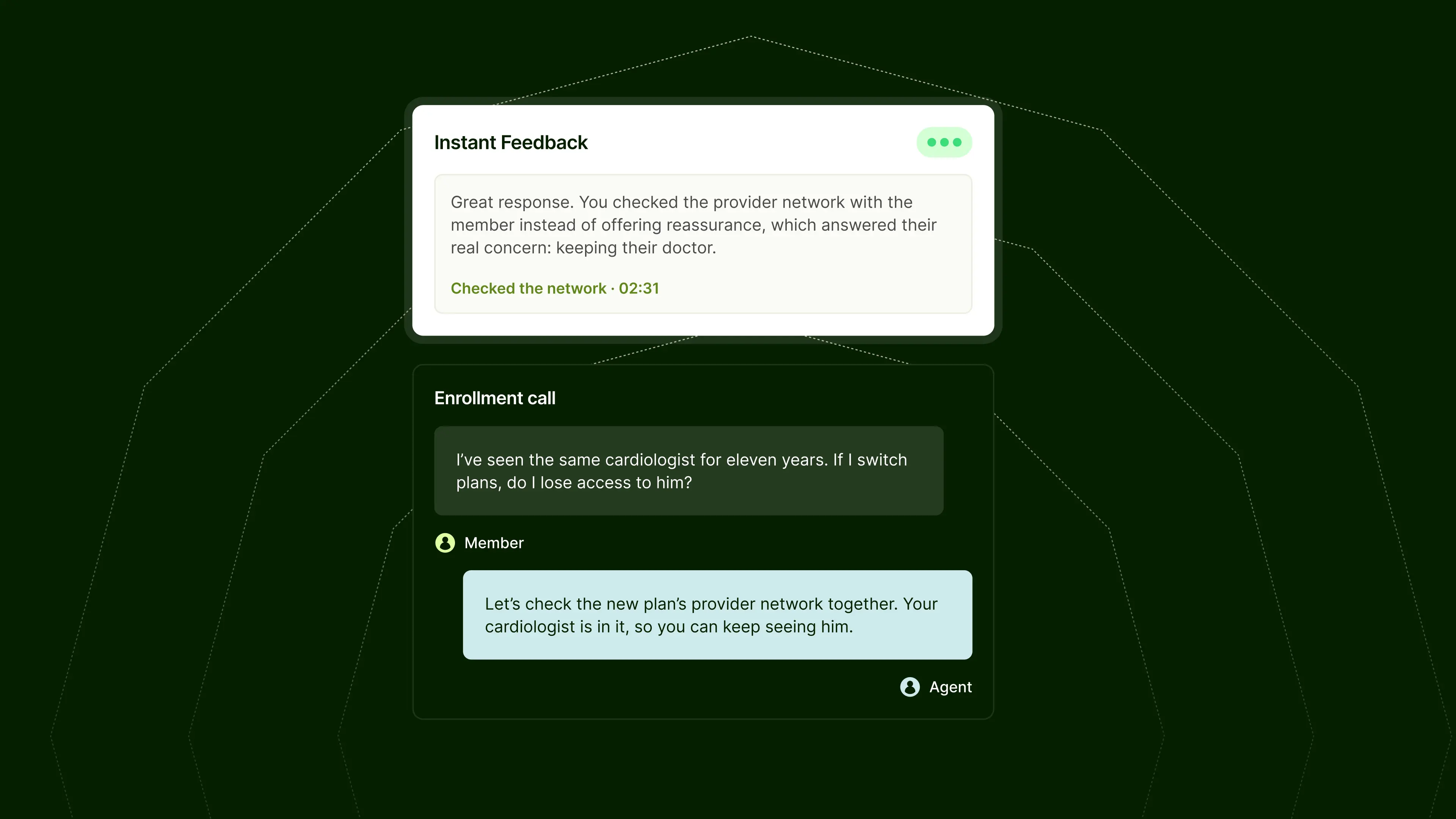
Across many calls, this pattern might hold: when members worry about keeping a doctor, agents who explain how to check the network tend to see more enrollments than agents who only reassure. A response that moves enrollments is worth coaching, and identifying those responses is the first step to building a winning team.
Some answers sit outside the agent’s control
Not every pattern points to coaching. Some calls fail for reasons outside the agent’s control.
Return to the cardiologist question. If most agents reassure instead of checking the network, the reason may not be skill. The provider directory may simply be hard to reach in the middle of a call. No amount of coaching will solve that. ReflexAI surfaces the pattern across every call, so a single change to the provider directory can lift enrollments for the whole team.
These insights carry the value of every call to the teams that shape products, policies, and messaging, not just the team that takes the calls.
Conversation intelligence examples by industry
The pattern holds wherever a conversation decides an outcome, because every industry has its own version of the cardiologist question.
Leasing Conversation Intelligence
A prospective renter calls about an apartment and asks whether a past eviction or a low credit score will disqualify her. An agent who says most applicants are approved has reassured her. An agent who explains the screening criteria and the options for a co-signer has given her a reason to apply. The outcome to measure is a submitted application or a booked tour.
Lending Conversation Intelligence
A borrower comparing loan offers asks whether starting an application will hurt his credit score. An agent who tells him it's nothing to worry about leaves him to look it up elsewhere. An agent who explains the difference between a soft and a hard credit check, and when each happens, keeps him in the application. The outcome to measure is a completed application.
Crisis support conversation intelligence
On a crisis line, success isn't a sale. It is a caller who leaves the conversation safer, with a plan and a connection to care. When a caller expresses ambivalence about getting help, a counselor who reassures too quickly can close the very conversation the caller needed to have. A counselor who reflects the ambivalence back and explores it keeps that conversation open. The outcomes to measure are defined by clinical protocol, and they are different from the outcomes on any sales line.
The call types, topics, and outcomes change from one industry to the next. The question stays the same: when this moment comes up, which responses lead to the outcome that matters?
From insight to action
The ReflexAI platform gives teams what they need to find these patterns and act on them.
- Insights come first. What are customers raising on each type of call, and which agent responses lead to the business outcomes you want? Your team sees the concerns that cost enrollments and the responses that win them back.
- Then, action. Once you find the gap, you build coaching around the exact moment and the response that works. The next round of insights shows whether the coaching took hold, measured on the calls where that moment came up.
Hearing every call is table stakes. Knowing what works on every call is the difference.
With ReflexAI, the responses that win the call become lessons your whole team can put into practice.