


Call center sentiment analysis software evaluates customer conversations and labels their emotional tone as positive, negative, or neutral. Contact centers use it to sort conversations that went well from those that went badly and to identify where the tone changed. The most useful tools score every part of a call, which lets users understand how a customer's mood changed from start to finish. Below, we explain how the software reads caller sentiment and where EU law limits its use.
Summary
- Averaging sentiment scores provides limited insight. A single score for an entire call is an average, which can't tell a reviewer if the call improved or got worse. When each part of a call gets its own score, reviewers can see when the customer's mood changed and identify what the agent said to shift it.
- A customer's emotions strongly predict loyalty. Forrester's 2026 Customer Experience (CX) Index found that emotion is often the strongest predictor of customer loyalty and retention. The Index also found that emotion was often the hardest part of the experience to improve.
- The EU bans AI that infers agents' emotions. Since February 2025, the EU AI Act has banned AI systems that infer workers' emotions from biometric data, such as their voices, according to the Future of Privacy Forum and CX Today. The ban doesn't cover analyzing customers' emotions or written text.
- AI sentiment scores need human review. AI models can misread sarcasm and the way tone of voice differs across languages. This is why human reviewers should check AI readings before managers use them to coach agents.
- Simulation practice is linked to better compliance. In a study of 174 call center agents that ReflexAI reports, agents with high simulation use improved their protocol compliance scores by 18%.
What is call center sentiment analysis?
Call center sentiment analysis is the process of scoring the tone of customer conversations as positive, negative, or neutral, using software that analyzes call recordings and chat transcripts. Sentiment analysis is closely related to emotion recognition, and vendors often blur the two. Here's the distinction:
- Sentiment analysis judges the attitude expressed in language, like a customer calling a delay "ridiculous" or thanking an agent for a quick fix.
- Emotion recognition tries to infer what a person is feeling, like stress or anger. It often does this by using biometric signals, like the pitch and pace of a voice.
The specific definition is important because the EU AI Act bans emotion recognition in the workplace, including inferring agents' emotions from their voices, except for medical or safety reasons. Sentiment analysis of written text isn't covered by the ban.
How call center sentiment analysis works
Sentiment analysis software processes speech and text differently. The software converts a voice call to text first, then analyzes the words and the sound of the speaker's voice. It gives the conversation, or each part of it, a positive, negative, or neutral score. Sentiment analysis software uses three methods to score the tone of a conversation.
- Speech-to-text converts a voice call into a written transcript that labels who said what.
- Text analysis evaluates the words a customer chooses in text, email, or voice interactions. Repeated phrases like "third time I've called," negations like "not happy," and the context around each statement are signals used to label a call.
- Acoustic analysis measures how something was said on a voice call, including pitch, speaking rate, volume, and pauses. A long silence after an agent explains a fee, or a voice that gets faster and louder, can signal frustration.
On a voice call, tools that analyze both the transcript and the sound of the caller's voice have more information for scoring the call. Voice analysis is also the method EU regulators treat most cautiously.
Rule-based and machine learning approaches
Rule-based sentiment analysis systems score a conversation using a list of words and phrases that have a point value. This is called a sentiment lexicon. For example, "great" adds points while "cancel" subtracts them. The system totals the points and adjusts for words like "not" and "very," so "not happy" counts as negative and "very happy" scores higher than "happy." A team can see which words produced a score, but the system can't tell when a word means something different in context. "Great" adds points even when a customer says "Great, another delay."
Machine learning models learn from large sets of conversations that people have already labeled as positive, negative, or neutral. They read each word in context, so they can tell that "fine" after a long complaint means something different from "fine" in a greeting. Some of these models also analyze tone of voice along with the words.
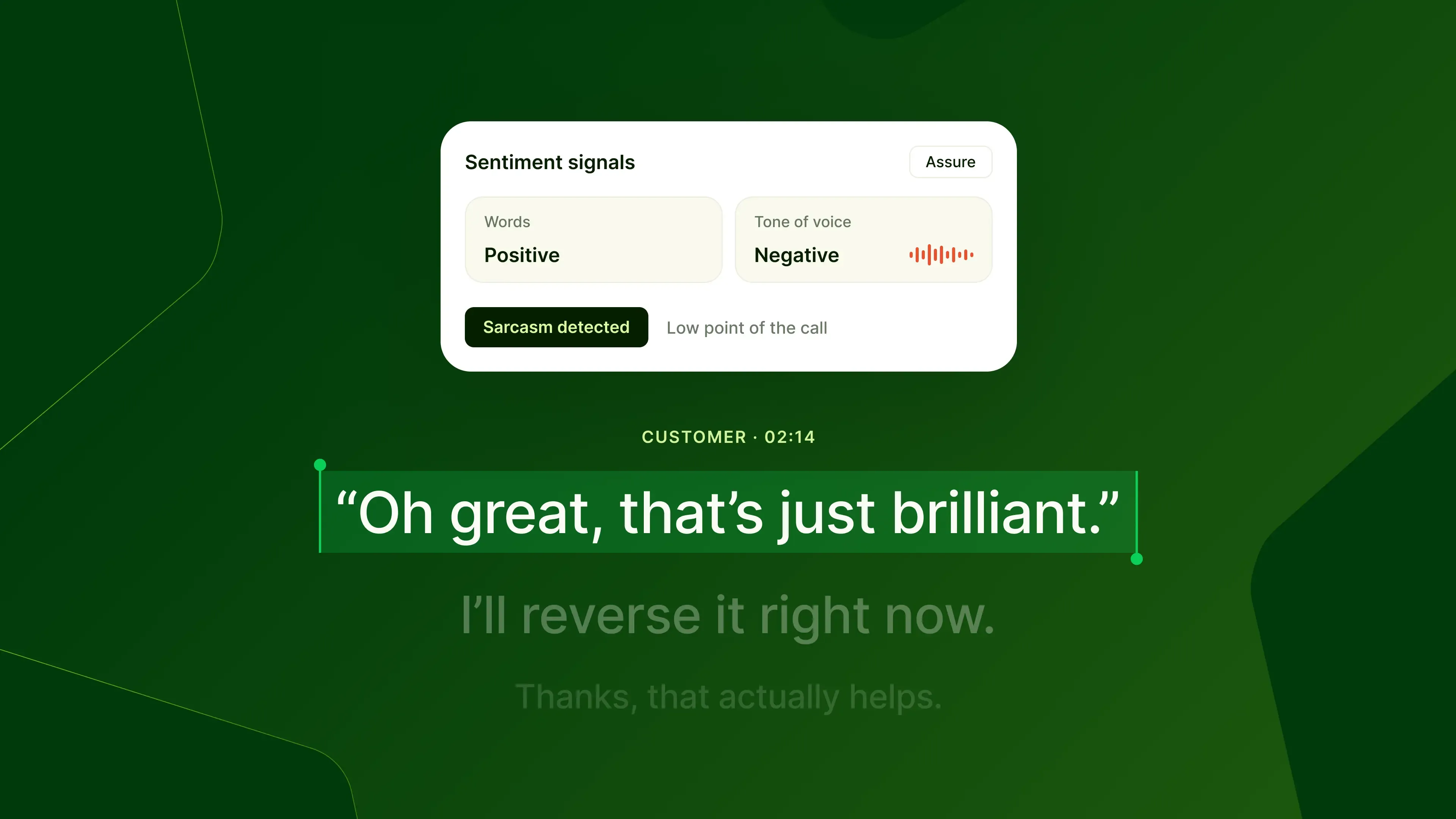
The difference between rule-based systems and machine learning models is starkest with sarcasm. When a customer hears that a refund will take another two weeks and replies, "Oh, brilliant. That's exactly what I needed," a rule-based system sees "brilliant" and "exactly what I needed" and scores the line positive. A machine learning model trained on similar exchanges is more likely to score it negative.
A September 2025 systematic review on arXiv describes sarcasm as a significant challenge for sentiment analysis because its meaning goes beyond the literal words. The review finds that detecting sarcasm depends on prosodic cues, the rhythm and melody of speech, such as changes in pitch, speaking rate, and intonation. A written transcript loses those cues.
Measure sentiment trajectory across the whole call
Sentiment analysis is most useful when it tracks the customer's mood moment by moment (the sentiment trajectory) and identifies where it changed. Many sentiment dashboards instead give one average score for the whole call, which hides the moments that made the customer calmer or angrier. Trajectory metrics score sentiment at each stage of a call. This lets a quality assurance (QA) leader see if the call got better or worse and find the exact point where that happened.
Why an average sentiment score can be misleading
To understand what happened on a call, a manager needs to see how sentiment changed from start to finish. The following example illustrates why an average score can make two very different calls look alike, as far as sentiment goes.
- In call 1, a customer is furious about a double charge. The agent explains the error and reverses the charge, and the customer ends the call relieved.
- In call 2, a customer calmly asks to change an address. The agent can't explain a policy that blocks the change, and the customer hangs up frustrated.
Without the sentiment trajectory, that moment by moment analysis, the call outcomes can look nearly the same, with similar average scores, even though the first agent handled a hard call well and the second agent needs help with one specific moment.
ReflexAI's AI QA buying guide explains that a trajectory reveals if a customer was upset at first and calmed down, or was calm at first and grew frustrated. An average score can't capture that difference or tell a reviewer where the call changed, so the reviewer has to listen to the full recording to find the moment (or moments) when a call goes off the rails.
Sentiment, recovery, and baseline
QA leaders use three metrics to analyze a call's sentiment trajectory and find where the customer's tone changed:
- Sentiment measures the change from the moment the customer first states the problem to the end of the call. This allows a team to understand if the situation got better or worse.
- Recovery measures how far sentiment rebounded from the lowest point of the call. A strong recovery is a signal that the agent calmed the customer down after the worst moment.
- Average sentiment is the baseline for the entire call. A team can compare it across calls, agents, and queues.
ReflexAI's Assure quality assurance product tracks all three metrics across each conversation. Assure plots scored segments of each conversation on a visual timeline and attaches the quotes behind each change in tone, closing the loop between insight and action. Managers can also connect these findings to training with Prepare, ReflexAI's simulation product, which scores practice conversations with the same scorecards Assure uses for live calls.
Trajectory on escalated, crisis, and healthcare calls
In a Gartner survey of 3,566 customers, 87% said it is essential for companies using generative AI in customer service to offer a way to reach a human agent. Only 50% said generative AI makes their interactions easier. So customers who reach an agent after self-service fails are often frustrated.
A low score at the start of that call comes from the failed self-service attempt. The agent controls what happens after that, including how much the customer's mood improves from its lowest point. On crisis lines, a counselor expects the caller to be in distress from the first minute. Likewise, a nurse calling a patient about difficult test results expects the patient to be worried.
A "positive" label at the end of these calls may never be realistic or appropriate. A successful call ends with a caller who is calmer or safer than at the start. The only way to see that change is to score each stage of the call.
What are the benefits of call center sentiment analysis?
Call center sentiment analysis can score far more conversations than a QA team could review manually. Managers can see how customers feel across thousands of calls and find where agents need help. It also gives managers a read on customer emotion, which affects loyalty.
Forrester's 2026 CX Index, which surveyed more than 224,000 customers about 462 brands, measures how well a brand's customer experience builds loyalty. It scores three factors: how well the brand meets customers' needs, how easy it is to work with, and how the experience makes customers feel. Forrester notes that emotion is often the strongest predictor of customer loyalty, advocacy, and retention. Sentiment analysis lets a contact center measure that emotional factor call by call, so managers can find and fix the conversations that leave customers frustrated.
Proactive issue resolution during and after the call
During a call, real-time sentiment analysis can help prevent escalations by alerting a supervisor when sentiment drops sharply. The supervisor can then listen in or message the agent before the customer asks for a manager or hangs up.
After the call, analysis across many interactions helps supervisors find the topics that keep coming up when sentiment drops. For example, the analysis might link a confusing cancellation policy or an unexplained billing change to calls with low sentiment. Fixing that policy or billing problem can reduce the number of frustrated calls.
Agent coaching and performance visibility
Managers can use sentiment scores to pick which calls to review with an agent. A manager can play back the moment sentiment dropped and talk through what the agent might have said instead. Recovery scores also reveal strengths, such as the agent who consistently calms angry callers. Those calls can become examples for the whole team.
QA feedback identifies what went wrong on a past call, but the best way for agents to improve a response or de-escalation technique is by rehearsing it. That's why teams usually find they need both QA and simulation training.
Coverage beyond the manual QA sample
Many of the escalations and recoveries a team needs to see don't reach a reviewer, because QA teams listen to only a small sample of calls. In GLG research commissioned by ReflexAI with 109 contact center directors, VPs, and executives, most organizations said their QA sampling works from fewer than 10% of total interactions.
Assure can score up to 100% of interactions, well beyond the sub-10% manual sample. Reviewers can then go straight to the calls that need their attention. This helps reviewers spot compliance and performance issues before they escalate.
Sentiment analysis, emotion recognition, and the EU AI Act
What a sentiment tool infers, and from which signal, has legal consequences in the European Union. CX Today reports that a tool branded as "sentiment analysis" does not automatically fall outside emotion-AI rules. The points below are general information drawn from the Future of Privacy Forum (FPF) and CX Today.
Text signals, voice signals, and what each can reliably support
According to FPF's analysis, Article 5(1)(f) of the EU AI Act bans AI systems that infer a person's emotions from biometric data in the workplace or in schools, except for medical or safety reasons. FPF reports that the European Commission's guidelines set limits on that ban. It covers inferring an employee's emotions from biometric data, such as an agent's tone of voice. It doesn't cover:
- Inferring emotions from written text, such as chats and emails
- Detecting customers' emotions
The guidelines say little about a system that analyzes both customers and employees, such as a tool that scores a recorded call. They say only that operators should make sure "no employees are being tracked and there are sufficient safeguards."
Voice analysis can pick up sarcasm from changes in pitch and pace, but it's also the type of analysis the EU restricts most. Its accuracy has limits, too. The arXiv review cites studies showing that sarcasm sounds different across languages. English speakers often signal sarcasm with a slower pace and a lower pitch, while Cantonese speakers raise their pitch. A model trained on English calls can misread sarcasm in another language.
Agent scoring and calibration against human reviewers
Scoring agents' emotions creates the clearest legal risk for contact centers in the EU. CX Today reports that since the ban took effect in February 2025, it puts pressure on tools that:
- Score agents for "negative tone" or flag possible stress
- Rate an agent's emotional delivery
- Use inferred emotions in QA, coaching, promotion, or performance decisions
Stricter rules for high-risk AI systems, including emotion recognition systems, are scheduled to apply from December 2, 2027, according to CX Today.
Accuracy is a concern even outside the EU. CX Today cites a University of Michigan review of emotion AI that raises ongoing questions about its validity and bias.
Calibration helps teams catch these errors. In calibration, QA reviewers score a shared set of calls, then compare their scores with the AI's sentiment readings. When the AI readings and human readings disagree, reviewers find out why and adjust the scorecard or the model until they match.
QA teams should calibrate calls before using any sentiment reading in coaching, with a human team member reviewing the AI's output before it affects a decision about an agent's performance.
Turn sentiment findings into targeted practice
Finding a pattern in sentiment scores is only meaningful if it helps agents improve their interactions with customers. If calls about a new billing policy clearly show that customers are upset, for example, agents need to practice explaining that policy before the next customer calls.
Many contact centers already have AI tools but aren't seeing that kind of change:
- In GLG research commissioned by ReflexAI, 85% of contact centers had deployed at least one AI tool for training or QA, but only 29% of leaders said they were using AI effectively.
- Gartner found that AI spending among customer service leaders rose 38% while overall service and support budgets grew 2%.
When Assure, ReflexAI's QA software, flags a call that went badly, a manager can turn it into a practice scenario in Prepare, ReflexAI's simulation training software. The agent can then rehearse that conversation until the better response comes naturally. Agents who practice more often tend to perform better. In a healthcare contact center compliance study of 174 call center agents reported by ReflexAI, agents with high simulation use:
- Improved their protocol compliance scores by 18%
- Met the highest organizational standards in 17% more conversations
- Showed stronger rapport in 16% more conversations
What to look for in a call center sentiment analysis tool
When evaluating sentiment analysis tools for your call center, bring these questions to the table:
- Which signal does the tool read? Ask whether it works from text, acoustic features, or both, and what each contributes to a score.
- Whose emotions does it score? Find out whether any reading infers an agent's emotional state, and what safeguards exist when one system hears both sides of a call.
- What decisions will its output feed? A reading used to alert a supervisor has different consequences from one that enters a coaching record or performance review.
- Does it report trajectory? Ask for drift, recovery, and the transcript quotes tied to each turn, beyond one average per call.
- What happens to a flagged pattern? Ask how a finding reaches coaching and whether it can become a practice scenario.
- How is it calibrated? Ask how often human reviewers check the AI's readings and what happens when they disagree.
- What integrations does it support? Ask which contact center platforms and CRMs the tool integrates with, and if sentiment scores appear in the dashboards and coaching tools your supervisors already use.
Ask the same questions when choosing a contact center QA platform, because most QA platforms include sentiment analysis as a built-in feature.
Sentiment analysis pays off when a team reads the arc of each call and checks those readings against human judgment, then turns what it finds into practice. ReflexAI is the conversation performance platform for high-stakes work, built to help teams improve their most important conversations through practice and measurement. Assure shows the sentiment trajectory and QA insights behind each conversation, and Prepare turns a difficult call into a scenario an agent can rehearse before the next one.
Schedule a demo to see how a call flagged in Assure becomes a Prepare practice session for your agents.
Frequently asked questions about call center sentiment analysis
Can I use ChatGPT for sentiment analysis?
Yes, for small jobs. A general-purpose model such as ChatGPT can label the tone of a transcript or chat and explain its reasoning. It works only from text, so it misses tone of voice, and its labels can vary from one prompt to the next. A contact center also has to consider how customer data is handled before pasting conversations into any outside tool.
What are the key performance indicators (KPIs) for a call center?
Common contact center KPIs include customer satisfaction (CSAT), first contact resolution, average handle time, Net Promoter Score (NPS), service level, and QA scores. Sentiment scores add a measure of the customer's mood during each call, which the other KPIs don't capture. Scoring sentiment at each stage of a call also shows if the customer's mood improved by the end, which pairs well with outcome measures like CSAT and resolution.
Can you give me an example of sentiment analysis?
A retailer's chat about a late order shows how sentiment can be measured. The customer may type, "My order was supposed to arrive Tuesday and it still hasn't shipped," which scores negative. Midway, the customer writes "Okay, the tracking link works now," which scores neutral. The chat closes with "Thanks, that's a relief," which scores positive. An average of the three scores makes the chat look neutral, but scoring each message shows the customer went from frustrated to relieved.
Is AI going to replace call centers?
It is unlikely that AI will ever replace call centers, particularly for the kind of complex and emotionally charged issues that customers want a person to handle. In Gartner's 2026 survey, 87% of customers said companies using generative AI for service must offer a way to reach a human agent. Customers still expect a person when self-service cannot resolve their problem.
Does call center sentiment analysis work on chat and email?
Yes. Chat, email, and messaging go straight to text analysis, with no speech-to-text step. Without a voice to analyze, the system reads tone from word choice, phrasing, and context. This means that written sarcasm remains harder to catch.