










QA in call centers is supposed to catch problems before they compound. For most teams, it catches them after the customer already felt them.
The reason is straightforward: QA is retrospective. It scores what already happened. When a team treats it as a training tool, skill gaps don't surface until they've already affected real calls. By then, the cost is already on the board.
Traditional QA programs reviewed only 1–3% of total interaction volume. Even with automated QA covering 100%, a flagged score without a structured correction path is just documentation.
Simulation training is the other half of that equation. It gives agents a place to practice the exact scenario they failed before they handle it again on a live call.
This article breaks down how QA and simulation training work, where each one belongs, and what it looks like when they share data instead of operating in separate silos.
What is call center QA?
Call center quality assurance is the process of evaluating completed agent conversations against a scoring rubric to measure whether service standards were met. It is retrospective by design: every score, every coaching flag, every trend report is built from calls that already happened. Traditional QA programs reviewed a small random sample of interactions, commonly 1–3% of total volume, because human evaluation does not scale. Automated QA evaluates every interaction.
QA produces two types of output: individual agent scores and team-wide performance patterns. The first tells you who needs coaching; the second tells you where your operation is breaking down at scale.
What is call center simulation training?
Simulation training is structured practice that replicates real customer conversations before agents handle live calls. Unlike passive e-learning or classroom instruction, simulations require the agent to respond, adapt, and make decisions in real time. Simulations can be facilitated by a human trainer in a roleplay format, or by an AI persona that responds dynamically to what the agent says, tone and all.
Simulation training is prospective: it prepares agents for conversations they have not had yet. When an agent practices a difficult objection or a compliance-heavy disclosure in simulation, the first time they encounter it on a live call is not the first time they have said the words out loud.
Modern AI simulation platforms go further than scripted roleplay:
- Configurable personas: AI personas adapt to an agent's tone, hesitation, and word choice in real time
- Voice and chat: Simulations run across both channels and in 25+ languages
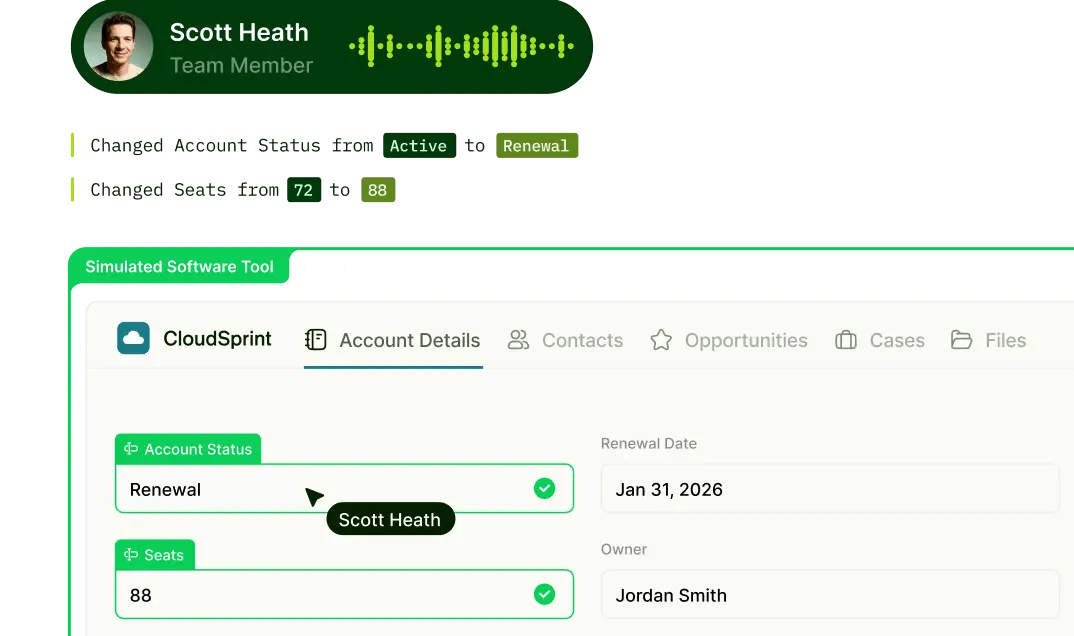
- Software overlays: Agents practice the conversation and the tool navigation simultaneously, inside a simulated CRM or ticketing system
What is the difference between QA and simulation training?
QA tells you what happened. Simulation training determines whether agents are ready before a problem shows up in a QA score. Confusing the two leads teams to use QA as a training substitute, which means problems only surface after they have already affected customers.
Dimension | QA | Simulation training |
When it happens | After live calls | Before live calls |
Input | Real conversation recordings | Scripted or AI-generated scenarios |
What it measures | Whether standards were met | Whether agents are ready to meet standards |
Primary output | Scores, trends, coaching flags | Practiced skills, confidence, readiness data |
Who benefits first | Supervisors and QA teams | Agents and trainers |
Key metrics affected | CSAT, FCR, compliance rate | Ramp time, 90-day retention, first-call confidence |
Scorecards do not create skill. Agents do not get better by being graded two weeks after a call. QA identifies the gap; simulation training gives agents a structured way to close it before the next customer interaction.
When does each happen in the agent lifecycle?
Simulation training belongs at the front of the agent lifecycle: onboarding, new product launches, new call types. QA runs continuously across the full tenure of every agent. A new hire completes simulation training during their first two weeks, then goes live; QA begins scoring their calls from day one on the floor. Neither replaces the other because they operate at different points in time with different purposes.
What data does each tool produce?
Simulation training produces readiness data: how an agent performed on a practice scenario, where they hesitated, whether they followed protocol, how their tone and empathy scored. QA produces performance data: how an agent scored on a real customer call, whether they met compliance requirements, how their scores trend over time. Readiness data predicts future performance; performance data diagnoses past behavior.
What metrics does each affect?
Simulation training and QA affect different operational metrics because they intervene at different stages of the agent lifecycle:
- Simulation training affects: Ramp time, 90-day retention, first-call confidence, time to proficiency
- QA affects: CSAT, first call resolution, average handle time, compliance rate, escalation rate
These metric sets are complementary. Simulation training improves the inputs that QA later measures. If your QA scores show agents struggling with a specific objection, simulation training gives them a place to practice that objection before it costs you another customer.
When should call centers use QA, simulation training, or both?
Most contact centers already use QA in some form, but many treat simulation training as optional or reserve it only for new hires. That approach leaves performance gaps unaddressed until they show up in live customer interactions.
Use QA when you need visibility into live performance. Without QA, you do not know who is missing disclosures, which call types generate the most escalations, or where compliance gaps exist. QA is the diagnostic layer. With QA but no follow-up action, you are documenting failure without fixing it.
Use simulation training when agents are not ready yet. New hires, agents moving to a new queue, teams facing a product change or policy update: these are the moments where simulation practice reduces the cost of learning on live customers. ICMI research shows time to proficiency has stretched since 2019, with 31% of agents now taking 3–6 months to reach full productivity and another 11% taking 7–12 months. The goal is to move the learning curve before it touches real conversations.
Use both when coaching needs to be tied to proof. The most common failure mode is using QA scores to identify a problem and then coaching verbally with no structured practice. When QA flags a skill gap, simulation training gives agents a place to practice the correction in a low-stakes environment, and gives managers data to confirm the improvement happened.
Let's say QA flags that agents on your billing queue are missing a required disclosure on 23% of calls. A verbal coaching session tells them to do better. A targeted simulation puts them through that exact scenario ten times, scores their performance, and gives them immediate feedback on what changed. The manager sees the improvement before the next live call.
How do QA and simulation training work together?
QA and simulation training are most effective when they share data and operate as a closed loop, not as separate programs managed by different teams with different tools. The integration happens at three levels.
QA findings become simulation inputs. When QA identifies a recurring gap, that pattern can be turned into a targeted simulation scenario. The agent practices the exact situation they failed, in a safe environment, before it happens again on a live call. Without this connection, simulation content drifts toward generic best-practice roleplays rather than the center's real failure modes.
Scorecards should be consistent across both tools. If QA evaluates agents on empathy, protocol adherence, and tone, simulation training should score on the same dimensions. Misaligned rubrics create a specific and common problem: an agent scores well in simulation but poorly in QA because the criteria do not match. SQM Group research found that 81% of agents' QA scores do not correlate with CSAT or first call resolution, which points to QA programs measuring the wrong things. Aligning training and QA scorecards closes that gap.
Cohort tracking connects training outcomes to QA results. Teams that track simulation performance by cohort and then compare those cohorts' QA scores after going live can show whether simulation training actually moved the metrics. Without that connection, training and QA operate as separate programs with no feedback loop between them.
Let's say a new-hire cohort completes 20 simulation scenarios during onboarding and scores an average of 85% on protocol adherence. If that same cohort's live QA scores in their first 30 days show 78% protocol adherence, the simulation training did not transfer. If they score 88%, it worked. That is the kind of evidence that justifies the investment and tells you where to adjust the training.
FAQ
Does simulation training replace QA?
No. Simulation training and QA serve different purposes and operate at different points in the agent lifecycle. Removing either creates a gap: agents go live unprepared, or performance problems go undetected.
Can QA data trigger simulation training assignments?
Yes, when QA and simulation platforms are connected, a score that falls below a threshold on a specific skill dimension can automatically assign the agent a targeted simulation for that scenario, closing the loop between diagnosing a problem and correcting it.
What is the difference between simulation training and roleplay?
Roleplay is a manual version of simulation training where a trainer or peer plays the customer. AI-powered simulation replaces the human roleplayer with a dynamic persona that adapts to the agent's responses in real time, making practice available at scale without pulling a trainer off other work.
What metrics show that simulation training is working?
Track ramp time, 90-day retention, and first-call quality scores. If simulation-trained cohorts reach proficiency faster and score higher on QA in their first 30 days than cohorts that did not use simulation, the training is working.
What metrics show that QA is working?
Track CSAT, first call resolution rate, compliance pass rate, and escalation rate over time. A QA program that is working surfaces specific, coachable patterns, not just scores, and shows measurable improvement in those patterns after coaching interventions.
How ReflexAI connects QA and simulation training
Most call centers run QA and simulation training as separate programs with no data connection between them. QA identifies problems weeks after they happen; simulation training runs on generic scenarios that may not reflect the center's actual failure modes. ReflexAI brings both into one conversation performance platform so that QA findings directly inform simulation assignments, scoring dimensions are shared, and improvement is measurable.
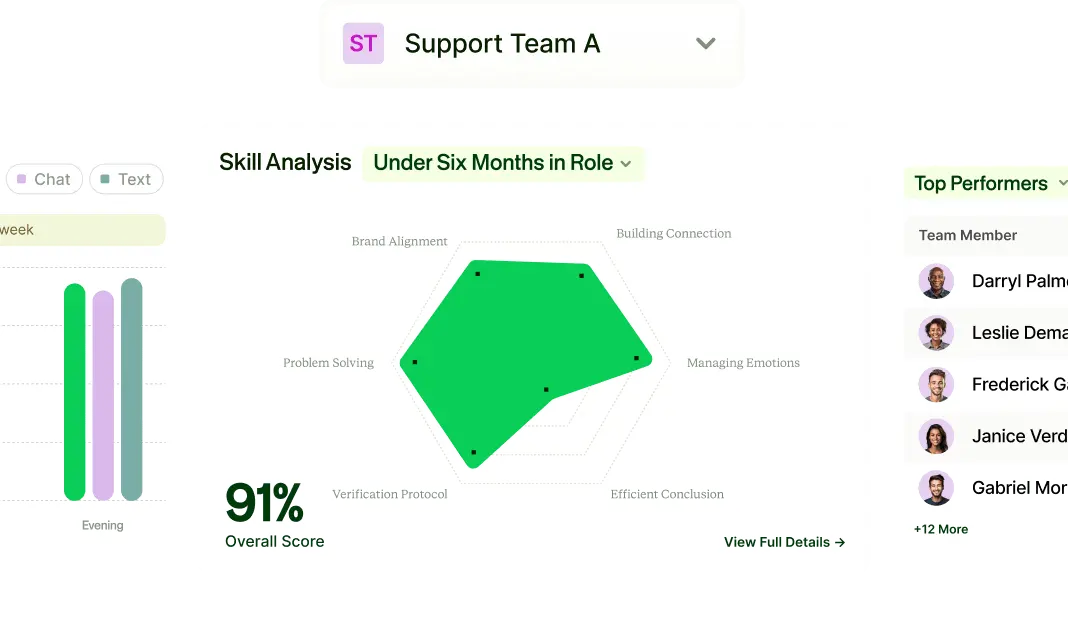
Assure evaluates 100% of conversations and surfaces performance gaps by agent, cohort, and call type. When Assure flags a pattern, such as an agent missing a compliance disclosure or struggling with a specific objection, ReflexAI Prepare builds an AI simulation from that exact scenario. The agent practices the conversation they failed, gets immediate feedback, and the manager gets data showing the skill gap closed before the next live call.
Scoring dimensions are configurable and aligned across QA and simulation. If Assure evaluates agents on empathy, protocol adherence, and tone, Prepare scores practice scenarios on the same dimensions. Agents are never surprised by a QA rubric they have not practiced against.
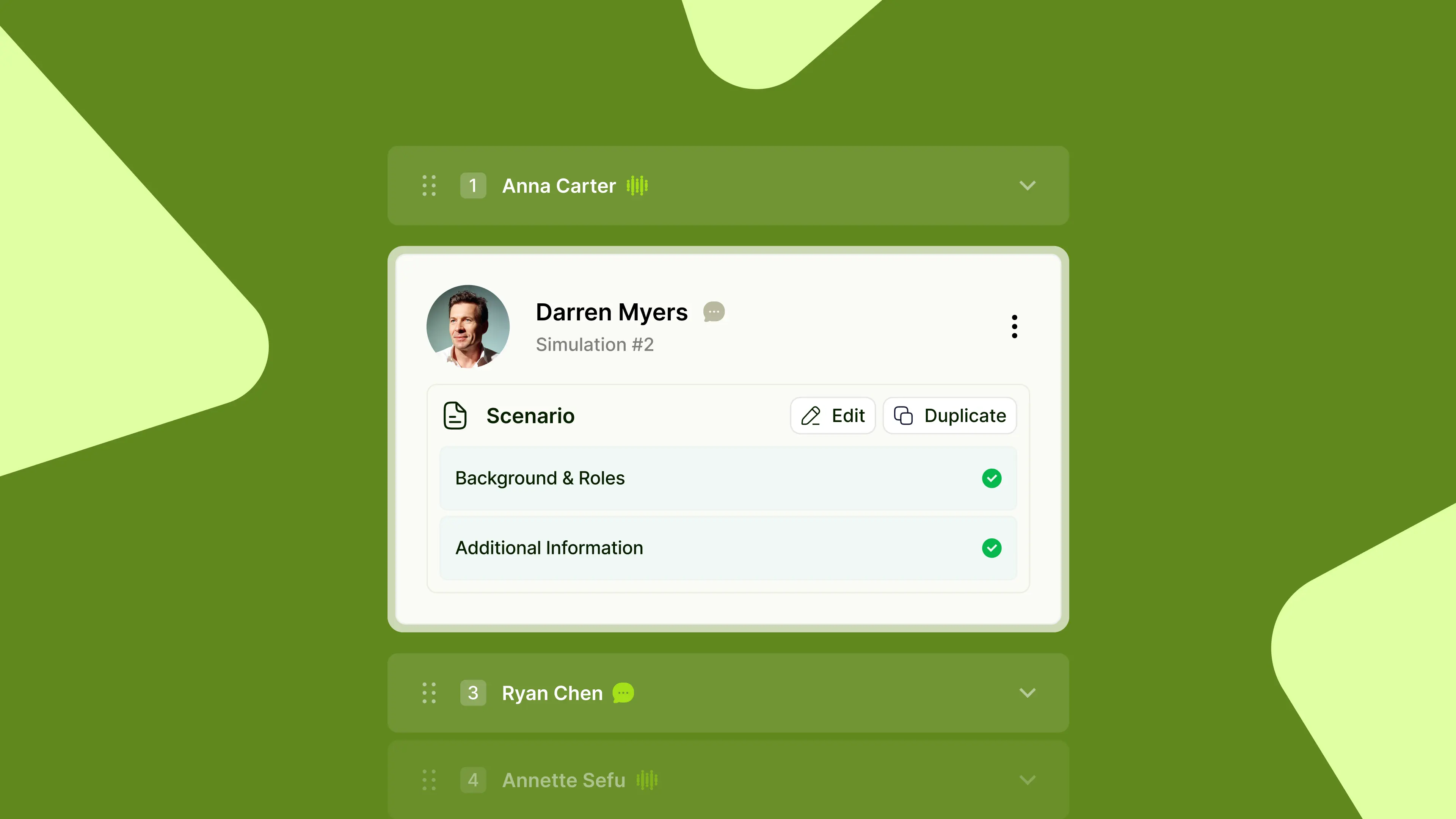
ReflexAI Studio powers both products from a single self-serve interface. Teams build simulations from any script, scenario, or prompt in minutes, including software overlays so agents practice the conversation and the tool navigation simultaneously. For organizations subject to HIPAA, HITRUST, GDPR, or ISO 27001, ReflexAI meets the highest global compliance standards because your data and your conversations need strong protections.