


Contact center quality assurance metrics measure how well agents handle individual conversations. A reviewer or automated scoring system checks a call or chat for the specific behaviors and actions the team expects from agents. Each metric adds to the interaction's QA score. Across many calls, the scores show the patterns of behavior an agent needs to work on. A manager can check the agent's live calls a few weeks after the agent starts practicing to see if the QA score improved. The sections below cover the four standard categories of QA metrics and their formulas, then walk through building a scorecard that leads to coaching.
Summary
- Customers want human agents for complex calls. In an August 2026 Gartner survey, 87% of customers said companies using generative AI for customer service must provide access to a human agent. A separate Gartner survey found that service leaders expect routine tasks to be automated, while complex or emotionally sensitive calls still need human expertise.
- Score enough calls to see real patterns. ReflexAI research conducted through GLG found that most contact centers score fewer than 10% of their interactions, so an average quality score usually reflects only a small share of an agent's calls.
- Make compliance items pass-or-fail and weight them most. Score disclosures and identity verification as pass-or-fail items with the heaviest weight. Save scaled ratings for behaviors like empathy and clarity.
- Fewer than a third of contact centers say they use AI effectively. In the ReflexAI and GLG research, 85% of contact centers had deployed at least one AI tool for training or QA, but only 29% said they use AI effectively in their operations.
- Score practice and live calls against the same criteria. ReflexAI's Prepare and Assure share a common scoring framework, so a manager can compare an agent's practice scores with live-call scores and see if coaching worked.
The business case for contact center quality assurance metrics
In an August 2026 Gartner survey, 87% of customers said companies using generative AI for customer service must provide access to a human agent. Customers still contact the company when they need to resolve a complex issue or make a transaction. When a conversation goes badly, the cost can be a lost renewal or a regulatory finding.
Gartner's survey of 321 customer service and support leaders found that nearly 80% plan to transition some agents into new roles. Leaders expect routine tasks to be automated, while complex or emotionally sensitive conversations still need human expertise.
Managers use QA metrics to see how agents handle those conversations. But in ReflexAI research conducted through GLG, most of the 109 contact center leaders surveyed said their organizations score fewer than 10% of their interactions. With a sample that small, a team's quality score may not reflect how most of its calls go.
What are contact center quality assurance metrics?
In a contact center, QA metrics measure how well an agent handles a specific call or chat. They differ from key performance indicators (KPIs), which track an outcome across a team or an entire operation. Common contact center KPIs include:
- Customer satisfaction (CSAT)
- First contact resolution (FCR)
- Average handle time (AHT)
- Net Promoter Score (NPS)
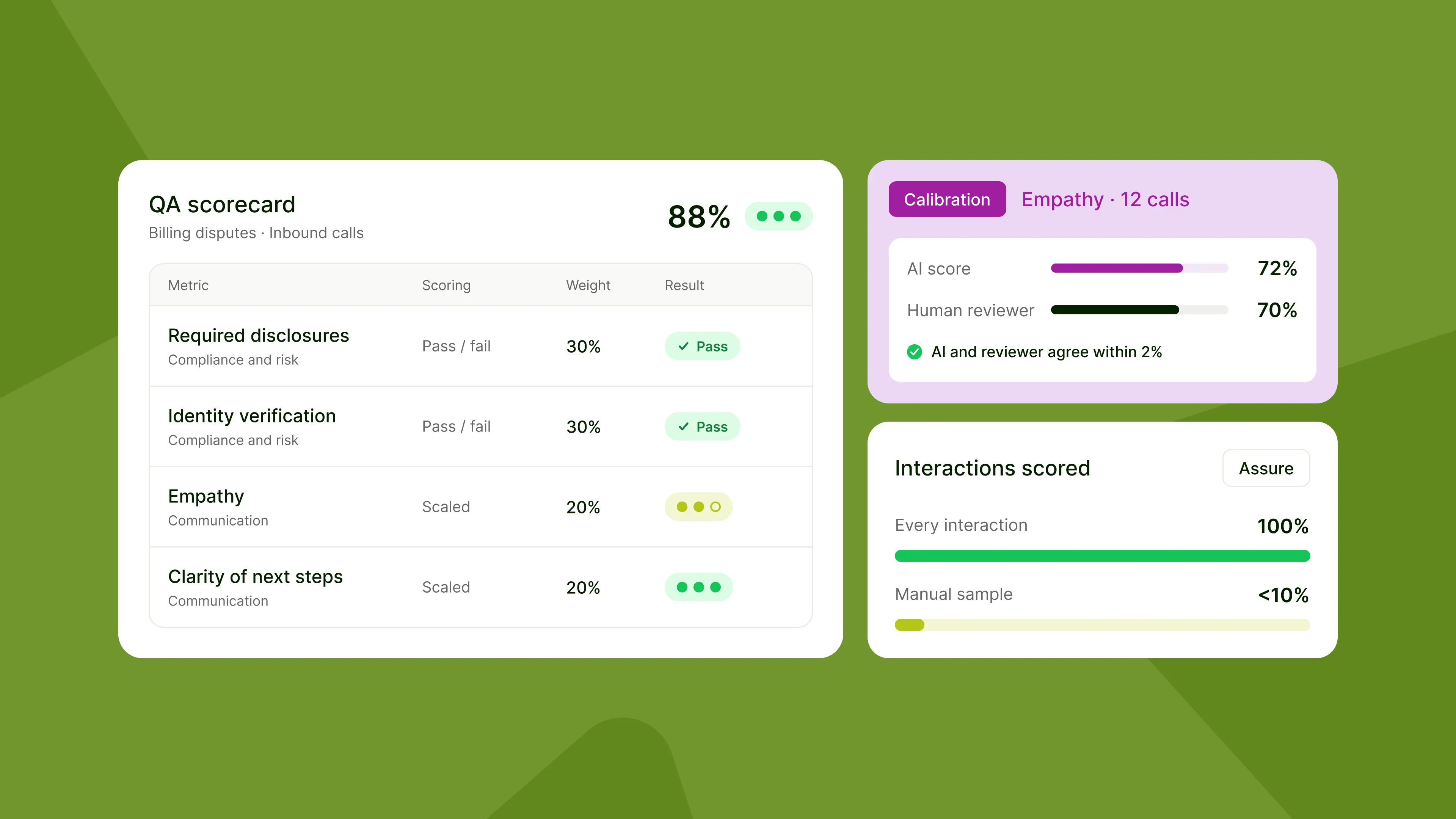
Reviewers record QA results on a scorecard, which lists the QA metrics that apply to a type of interaction and the criteria for each one. Each metric also has a weight that sets how much it counts toward the total QA score, which is usually a percentage such as 88%. A manager averages the total QA scores from an agent's interactions to get their quality score, and across the team to get a team score.
When a KPI changes, managers use scorecard results to find the cause. If FCR drops one month, a manager can check that month's scorecards and might see that agents skipped a troubleshooting step, which led to callbacks.
Contact center quality assurance metrics by category
Most QA programs sort their metrics into the categories represented in the middle column of the following table. The last column gives the formula for each metric.
Metric | Category | Formula |
Required disclosure compliance | Compliance and risk | Interactions with every required disclosure delivered ÷ evaluated interactions that required them × 100 |
Verification accuracy | Compliance and risk | Interactions with identity correctly verified ÷ evaluated interactions that required verification × 100 |
Script and policy adherence | Compliance and risk | Required steps completed ÷ required steps that applied, averaged across evaluated interactions |
Critical error rate | Compliance and risk | Interactions with at least one critical error ÷ evaluated interactions × 100 |
FCR indicator rate | Resolution and effectiveness | Interactions a reviewer marks fully resolved with no follow-up needed ÷ evaluated interactions × 100 |
Correct escalation rate | Resolution and effectiveness | Escalations that met the team's escalation criteria ÷ total escalations × 100 |
Since each formula divides by the number of interactions reviewers scored, a rate based on a few calls may not be a reliable measure of what's happening on live calls. Communication and revenue metrics aren't in the table because reviewers usually rate them on a scale, which the scorecard section covers.
Compliance and risk metrics
Compliance and risk metrics track the steps an agent must follow because of a law or company policy. In regulated industries like healthcare and financial services, a missed step can lead to a regulatory penalty or expose a customer's private information. Common compliance and risk metrics include:
- Required disclosure compliance. Tracks if the agent delivered every required statement, like a recording notice or a fee explanation.
- Verification accuracy. Tracks if the agent confirmed the caller's identity correctly before sharing account or patient details.
- Script and policy adherence. Checks that the agent completed every required step.
- Critical error rate. Counts interactions with at least one failure serious enough to fail the whole evaluation.
Compliance misses are rare, so a team that reviews only a small sample of calls may not catch them. In a study of 174 call center agents that ReflexAI published, agents with high simulation use improved their protocol compliance scores and met the highest organizational standards in more conversations.
ReflexAI's Assure QA platform flags adherence issues against policy or regulatory requirements and shows compliance trends across agents and teams. Assure can score up to 100% of interactions and automates scoring well beyond the sub-10% sample typical of manual QA.
Communication and behavioral metrics
Communication and behavioral metrics rate how an agent treated the customer during an interaction, such as showing empathy and listening carefully. These metrics are hard to score consistently because "showed empathy" means something different to every reviewer. Reviewers score them more consistently when the team defines each metric as a behavior reviewers can see or hear on the call, for example:
- Empathy. The agent restated the customer's concern in their own words before moving to the process.
- Active listening. The agent asked a clarifying question and never made the caller repeat information.
- Clarity. The agent summarized next steps and confirmed the customer understood them.
Give these metrics more weight on calls where the agent's tone and empathy affect the outcome, such as a crisis counselor talking with someone in distress or a nurse explaining a care plan to a worried family member. On those calls, how the agent listens and responds counts for more than how long the call takes.
Resolution and effectiveness metrics
Resolution metrics show if the agent solved the customer's problem during the interaction, so the customer doesn't need to contact the team again. On a scorecard, the reviewer marks each call resolved or unresolved based on the conversation itself. The FCR KPI is measured later, by counting repeat contacts about the same issue.
Correct escalation rate is the percentage of escalated calls that met the team's rules for when to escalate. A low correct escalation rate means agents are sending calls to a supervisor or clinician that they could have resolved themselves. The rate doesn't show calls agents should have escalated but didn't, so reviewers need a separate scorecard item for those. Write the team's escalation rules into the scorecard criteria, such as sending any refund request above the agent's approval limit to a supervisor.
Revenue and retention metrics
Revenue and retention metrics rate how well an agent handles calls meant to win or keep business, such as sales calls and cancellation requests. They include:
- Needs discovery. Checks if the agent asked enough questions to understand what the customer needed before recommending anything.
- Offer presentation. Checks if the recommendation fit the customer's needs and the agent explained it accurately.
- Objection handling. Rates how the agent responded to hesitation or pushback.
- Save attempt compliance. Checks if the agent followed the retention process on a cancellation call.
Leave these metrics off support and crisis line scorecards, because agents on those lines are there to resolve an issue or help someone in distress, and selling isn't part of the job.
How to build a QA scorecard
Managers need time to coach agents on the problems that QA scorecards reveal. In ReflexAI research conducted through GLG, contact center leaders reported shortfalls in both time and tools:
- 77% don't have enough time for value-add work such as coaching and calibration.
- 61% say their QA tools aren't fully meeting their needs.
- 85% have deployed at least one AI tool for training or QA, but only 29% say they use AI effectively.
Because managers have so little time, a scorecard works best with fewer items and criteria clear enough that reviewers don't have to guess.
Weight metrics by risk and business impact
When assigning weight to a scorecard item, start by ranking it by its impact on the business. Compliance items like disclosures and identity verification get the heaviest weight, because a miss can create legal or regulatory exposure. The table shows how much each type of item counts toward the total QA score.
Item type | Weight | Examples |
Critical errors | Automatic fail | Sharing account details with an unverified caller, giving unsafe medical guidance |
Compliance items | High | Required disclosures, required script and policy steps |
Behavioral and resolution items | Medium | Empathy, correct escalation |
Polish items | Low | Using the customer's name, following the greeting script |
Create separate scorecards for interaction types with different purposes since they require different behaviors from agents.
Choose binary or scaled scoring criteria
There are two types of scoring criteria reviewers can use when evaluating agents. Binary criteria are pass-or-fail and fit items with a clear right answer, such as reading a required disclosure. Pass-or-fail scoring takes reviewer interpretation out of the result.
Scaled criteria rate behaviors that vary in quality, such as empathy and objection handling, on a three- or five-point scale. Each point on the scale needs a written description of what that level sounds like on a call. Without those descriptions, a 4 from one reviewer and a 4 from another can describe two very different calls.
Calibrate scores across evaluators
Calibration is the process of checking that different reviewers give a given call the same score. Reviewers score the same recorded calls separately, then compare results and agree on how to read any criterion they scored differently. If reviewers keep disagreeing on one criterion, rewrite its definition.
AI-assisted scoring needs calibration too. On a regular schedule, have human reviewers score a set of AI-scored calls without seeing the AI result, then compare the two. Where they differ, adjust the criterion's wording or the scoring setup. Like human reviewers, AI scoring makes occasional errors, so track how often AI and human scores agree over time.
How AI and automation change QA coverage
With automated scoring, a team can score far more of its calls, so a bad week has less impact on an agent's QA score.
McKinsey's State of Customer Care survey of 440 customer care leaders and executives, published in February 2026, lists quality assurance among its "foundational" AI use cases. The survey's leaders are well ahead of its laggards:
- 67% of leaders have invested in foundational AI use cases at scale, compared with 16% of laggards.
- 40% of leaders reported significantly improved customer experience scores in the past 12 months, compared with 12% of laggards.
McKinsey reports these as differences between groups. The survey doesn't show that automated QA caused the improvement. Once routine scoring is automated, reviewers have more time for calibration and for coaching agents on the issues the scores reveal.
Turn QA scores into coaching a team can re-measure
In ReflexAI research conducted through GLG, only 52% of contact center leaders said they can measure if their actions had any effect. Here's a four-step approach to building a plan to fix QA issues and measure the results:
- Identify the undesired behavior. Use QA trends to spot a specific criterion that's slipping for an agent or team, such as empathy on billing disputes or verification on inbound patient calls.
- Assign targeted practice to agents. Give the agent simulated conversations built around that behavior and scored on the same criterion.
- Review the practice scores. Confirm the agent can meet the standard in practice before expecting it on live calls.
- Re-measure live interactions. Score the same criterion on the agent's live interactions over the next few weeks and compare the results with the starting baseline.
ReflexAI's Prepare simulation training lets agents practice realistic conversations, such as de-escalating an angry caller or verifying a patient's identity, without a trainer present. The AI personas react to what the agent says and how it's said. Each simulation is scored on empathy, accuracy, tone, and protocol adherence, and the agent gets detailed feedback right after it ends.
Prepare and Assure share a common scoring framework, so a manager can compare an agent's practice scores with live-call scores on the same criteria. ReflexAI is building toward a platform where live performance shapes practice and evaluation feeds directly into what teams practice next.
Because QA scores calls after they happen, pairing it with simulation training lets agents rehearse sensitive conversations before their next live call. Verstela, a staffing services firm, worked with ReflexAI to train its outbound sales reps in Prepare. Each rep completes 15 to 20 simulations during training and gets feedback right after each one, and the simulations have replaced more than 1,000 hours of manager time spent running roleplays.
Build QA metrics your team can act on
Contact center quality assurance metrics help most when managers use the scores to change how agents handle calls. ReflexAI helps teams practice and improve their most important conversations.
On ReflexAI's Conversation Performance Platform, Assure turns scored interactions into QA insights about what to coach, and Prepare gives agents a place to practice the behaviors Assure flags before they face them on a live call. Schedule a demo to see how Assure's QA insights and Prepare's practice scores line up for the conversations your team can least afford to get wrong.
Frequently asked questions about contact center quality assurance metrics
How do you measure quality assurance in a contact center?
Reviewers or automated scoring tools score recorded calls and chats against a written scorecard. Managers then average the scores by agent and by team, and they hold regular calibration sessions so every reviewer scores the same way.
What is a good QA score, and what should you benchmark it against?
No single QA score counts as good for every contact center, because each scorecard weights different items. Managers should compare an agent's score with the team's own baseline for that interaction type and check it against KPIs such as first contact resolution (FCR) and customer satisfaction (CSAT). A high average from a few calls tells a manager less than a slightly lower average from many more. On compliance items, teams should aim for a pass on every scored interaction.
How does quality assurance differ between a call center and a contact center?
A call center handles voice calls, while a contact center also handles chat and email. Reviewers use the same metric categories in both, but a contact center adjusts its criteria for each channel. In chat, for example, reviewers judge tone from word choice and formatting. Many teams keep compliance items the same across channels and adapt behavioral criteria to each one.
What skills does a QA analyst or reviewer need?
A QA analyst needs to listen carefully and apply written criteria the same way on every call. Strong analysts explain findings in ways an agent can act on. In calibration sessions, an analyst should be able to explain scoring differences instead of defending their own scores. In regulated settings such as healthcare or financial services, analysts need working knowledge of the relevant protocols.