










What would you do differently if you knew your QA process was structurally blind to 98% of what your agents actually do?
Most QA teams aren't ignoring that question. They just don't have a good answer for it. Human review at scale doesn't work - studies show reviewer-related effects account for over 49% of variance in performance ratings. There aren't enough hours, and even when reviewers are careful, who's scoring matters as much as what happened on the call.
The math is uncomfortable. Sample 2% of interactions, and if 100 violations happen in a month, there's roughly a 13% chance you catch none of them.
This article breaks down why AI QA scoring - even with occasional errors - produces better organizational intelligence than human sampling, and how ReflexAI's Assure and Prepare turn that coverage into concrete coaching.
Why can AI QA scoring be better even when it makes errors?
Most QA leaders assume that if AI makes errors, it must be worse than a human reviewer. That assumption misses the real comparison. The question is not whether AI scores every call perfectly. The question is whether AI produces better organizational intelligence than a system that reviews 1% to 3% of interactions with high variability between reviewers.
AI QA scoring applies the same rubric to every interaction, every time, regardless of volume, time of day, or reviewer fatigue. Human QA reviews a small sample with inconsistency baked in. A system that scores 100% of calls with even 80% accuracy surfaces more real problems than a system that scores 2% of calls with 95% accuracy - mathematically, 80% of all issues detected vs. roughly 1.9% of all issues detected.
Three reasons AI QA outperforms human QA at the system level:
- Consistency: The same rubric is applied the same way to every interaction, removing reviewer-to-reviewer drift
- Coverage: Every interaction is scored, not just a random sample
- Speed: Scores are available immediately after the interaction closes, not days or weeks later
How does AI compare with real human QA?
In practice, most contact center QA teams manually review a small sample of interactions per agent per month. According to a 2019 ICMI and NICE industry study, one-third to nearly one-half of contact centers monitor only 1% to 3% of total interactions for quality. The rest are never seen.
Human reviewers bring subjectivity and inconsistency to the small sample they do review. A 2022 study found that rater-related effects accounted for more than 49% of variance in supervisor performance ratings, meaning who the rater is often matters more than what the agent actually did.
Let's say two reviewers score the same call. One gives it a passing mark; the other flags it for tone. That disagreement is invisible in your reporting, though it shapes how agents are coached. AI eliminates that variability by applying a single, stable model to every interaction. How much hidden inconsistency exists in your current QA process?
Why does scoring consistency matter more than perfect judgment?
A consistent score can be calibrated and improved. An inconsistent score produces noise that cannot be corrected.
- Consistency enables calibration: If AI scores every interaction the same way, teams can identify systematic gaps and adjust the scoring model. If human reviewers score inconsistently, there is no stable baseline to improve from.
- Consistency enables trend detection: Patterns in agent behavior, escalation risk, or protocol adherence only become visible when every interaction is scored. Inconsistent human sampling hides these trends entirely.
AI scoring errors tend to be systematic rather than random. If the AI consistently misses a specific protocol step because the rubric definition is ambiguous, that pattern will show up in calibration sessions. You can refine the rubric and improve future scores. Random human inconsistency does not offer that feedback loop.
What errors does human QA already make?
Human QA is not error-free. Reviewers make predictable, well-documented mistakes that distort scores and coaching decisions.
- Fatigue and attention drift: Longer rating periods tend to yield lower rating quality, productivity, and consistency, even with short breaks between sessions.
- Familiarity bias: Supervisors can become predisposed to overlook substandard performance as personal relationships develop with agents they know well.
- Recency bias: A 1989 study in the Journal of Applied Psychology experimentally demonstrated that overall performance ratings shift depending on whether good or poor performance occurred at the end of the call, not across the whole interaction (Steiner & Rain, 1989).
- Sampling error: Because humans can only review a small fraction of interactions, the sample may not represent actual agent performance. A lucky or unlucky draw can define an entire coaching cycle.
If your human QA process is already imperfect, is the goal to protect it or to replace its weakest parts?
Why does QA coverage change the accuracy question?
Your QA team reviews two calls per agent per month. An agent who mishandles distressed callers on roughly one in ten calls may never have that pattern surface in your data. That is not a coaching failure. It is a coverage failure.
Coverage and accuracy are both variables, and coverage has been severely underweighted in traditional QA thinking. The math is straightforward:
- 2% sample rate: Any single bad interaction has only a 2% chance of being reviewed
- 100 violations per month: The probability you catch none is roughly 13%
What does random sampling miss?
Random sampling creates three categories of blind spots that compound over time.
Performance blind spots. An agent may handle most calls well but consistently struggle with a specific scenario: escalations, billing disputes, distressed callers. Random sampling may never surface that pattern until it becomes an escalation.
Compliance gaps. A protocol violation that occurs in a small percentage of calls will almost never appear in a small random sample. Verint's Total Quality ebook warns that when only 1% to 3% of calls are reviewed, potential regulatory compliance or legal issues may exist in the unseen majority.
Coaching misalignment. When only a few calls per agent are reviewed, coaching is based on anecdote rather than pattern. An agent who struggles with a specific call type but performs well on others may receive generic feedback that does not address the real gap.
How does AI find trends faster?
Scoring every interaction unlocks aggregate analysis that sampling cannot support. AI QA moves from evaluation to intelligence.
Topic-level analysis. AI identifies which conversation topics correlate with low scores, escalations, or customer dissatisfaction across the entire team, not just reviewed calls. If billing disputes consistently produce lower empathy scores, that pattern becomes visible immediately.
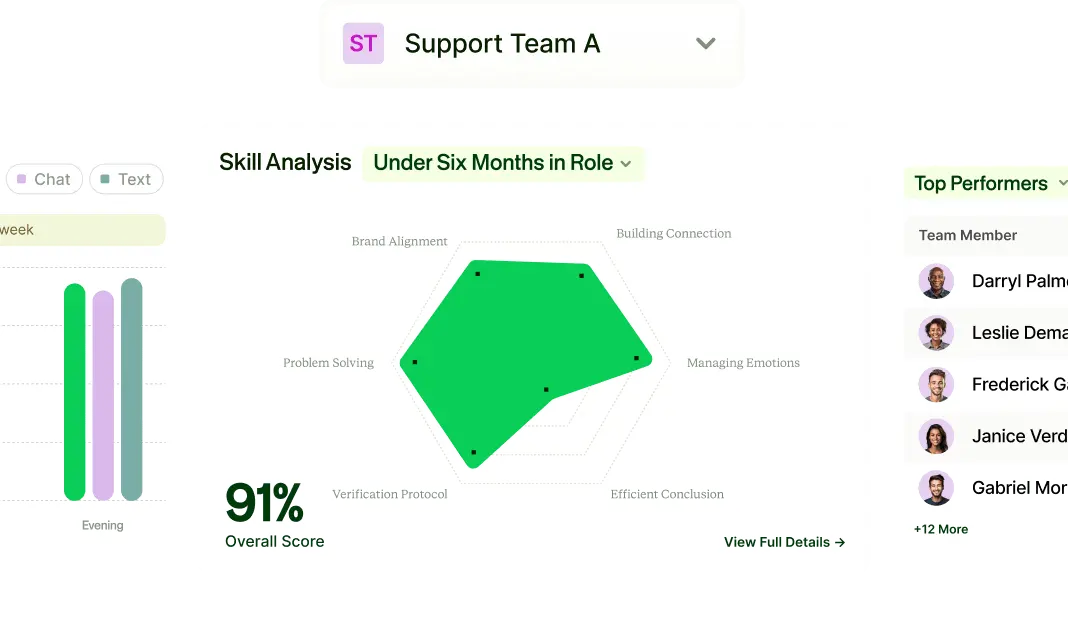
Cohort comparison. Teams can compare performance across agents, shifts, channels, or time periods using complete data rather than sampled estimates. Automated QA that scores every interaction, rather than a sample, enables far more granular performance tracking by definition.
Real-time alerts. Because AI reviews interactions as they close, it can flag emerging trends before they compound. A spike in a particular complaint type or a protocol gap appearing after a training rollout surfaces immediately rather than weeks later when manual reviews catch up.
What patterns might be hiding in the 98% of interactions you're not reviewing?
Why does 100% QA reduce hidden risk?
For teams operating in regulated or high-stakes environments, the gap between sampled and full coverage creates real exposure.
Compliance exposure. Interactions that violate regulatory requirements are only discoverable if they are reviewed. A 2019 ICMI and NICE study found that four-fifths of contact centers randomly sample interactions for evaluation, creating both missed issues and inconsistent selection.
Escalation prevention. Patterns that predict escalation (certain language, emotional trajectories, unresolved issues) can only be caught systematically when every interaction is scored. If an agent consistently uses language that frustrates customers on a specific topic, that pattern will not surface in a 2% sample until it becomes a complaint.
Defensibility. Organizations in regulated industries need to demonstrate that quality oversight is comprehensive, not anecdotal. When an auditor asks how you ensure protocol adherence, "we review every interaction" is a stronger answer than "we review a random sample."
How would your organization respond to an audit of your QA coverage today?
Which AI QA scoring errors matter most?
Not all AI errors carry equal weight. Understanding the difference between error types determines whether the AI's error rate is operationally acceptable.
A false positive means the AI flags an interaction as problematic when it was not. A false negative means the AI misses a real problem. These two error types have very different operational consequences.
When is a false positive manageable?
A false positive is when AI scores an interaction as failing a criterion that a human reviewer would have passed, for example, flagging an agent for not following a protocol step that was actually completed in a non-standard way.
False positives surface interactions for human review. A reviewer can override the score, and the override can be used to calibrate the model. A 2006 IBM study on automated call-center quality monitoring found that an automated call-ranking system achieved 80% precision, meaning roughly one in five flagged items could be a false positive, though the system still surfaced risk candidates instead of leaving them invisible (IBM, IEEE ICASSP 2006).
Consider this scenario:
- 100 calls flagged for protocol violations
- 20 flags incorrect (false positives requiring unnecessary review)
- 80 real violations caught that would have been invisible in a 2% sample
When is a false negative unacceptable?
A false negative is when AI scores an interaction as passing when a human reviewer would have flagged it, for example, missing a compliance violation or a distressed caller who was not handled appropriately.
False negatives create invisible risk. The interaction is not reviewed, the pattern is not caught, and the agent is not coached. Compare the detection rates:
- Human sampling: 2% sample means 98% of interactions are structural false negatives
- AI scoring: A 10% false negative rate still catches 90% of issues - far outperforming the baseline
How should teams review edge cases?
Edge cases are interactions that fall outside the patterns the AI was trained on: unusual conversation types, novel scenarios, or complex emotional dynamics.
Identify high-risk categories. Teams should define which interaction types carry the highest stakes (crisis calls, compliance-sensitive topics, high-value customer contacts) and apply targeted human review to those categories regardless of AI score.
Use AI to route, not to decide alone. AI can flag interactions for human review based on topic, sentiment trajectory, or score threshold. Even well-performing models can flip their judgment when the same interaction is reframed with different context, which is part of why human review of edge cases remains essential.
Run calibration sessions. Regular sessions where human reviewers and AI scores are compared on the same interactions identify where the model diverges from human judgment and why, producing the data needed to refine scoring models over time.
Have you defined which interaction types in your organization require human review regardless of AI score?
Where should humans stay in the loop?
AI QA does not remove humans from the process. It changes where human judgment is applied. Humans shift from volume reviewers to calibrators, coaches, and edge case evaluators.
The goal is to apply human judgment where it adds the most value. AI handles the volume work of scoring every interaction consistently. Humans handle the judgment work of interpreting scores, coaching agents, and refining the system.
Which interactions need human review?
Not every interaction requires human review, though certain categories always should.
- High-stakes categories: Crisis contacts, compliance-sensitive interactions, escalations, and high-value customer conversations should always include a human review layer.
- AI-flagged outliers: Interactions that score significantly below threshold, show unusual sentiment trajectories, or involve topics the model has flagged as uncertain should be routed to human reviewers.
- Disputed scores: When an agent disputes an AI score, a human reviewer should adjudicate, and the outcome should feed back into model calibration.
Let's say your AI flags a call as a protocol miss. The agent believes the flag is wrong. A human reviewer examines the call, agrees with the agent, and the override is logged, improving the model for future calls on that topic. Does your current QA process have a clear path for agent disputes to improve the system?
How should teams calibrate AI QA scores?
Calibration is the process of comparing AI scores to human scores on the same interactions to identify systematic gaps. A subset of interactions is scored by both the AI and a human reviewer. Where scores diverge, teams examine why: was the rubric ambiguous? Did the AI miss context? Did the human apply the rubric inconsistently?
Key calibration benchmarks:
- 90% of executives consider their QA calibration process effective, per COPC's Global Benchmarking Series, 2022
The same discipline applies to AI QA systems, especially after protocol changes, training rollouts, or when new interaction types emerge.
How can teams build agent trust?
Agents who distrust AI scores will disengage from coaching, dispute scores unproductively, and undermine the value of the system.
Transparency. Agents should know what the AI is scoring, which criteria are applied, and how scores are used in coaching and performance reviews. Opacity breeds distrust.
Explainability. AI QA systems should surface the specific moments in a conversation that drove a score, not just a number. If an agent receives a low empathy score, they should see the exact phrases or tone shifts that triggered it, along with examples of what better language would have looked like.
Dispute pathways. A clear process for agents to flag disagreements with AI scores, and see those disputes taken seriously, builds confidence that the system is a tool, not a trap.
How transparent is your current QA scoring process to your agents?
How can teams reduce AI QA scoring errors?
The quality of AI QA output is directly tied to the quality of the scoring model it operates from. Vague or generic rubrics produce vague or inconsistent scores, whether the reviewer is human or AI.
Start with clear scorecards
Scorecards should reflect the specific criteria your organization uses to evaluate agent performance, not a generic industry template.
Mirror your actual standards. If your organization prioritizes empathy in crisis calls, your scorecard should define what empathetic language looks like with examples. If protocol adherence matters more than tone in compliance-sensitive interactions, the scorecard should weight those dimensions accordingly.
Define criteria precisely. "Agent demonstrated empathy" is too vague. "Agent acknowledged the caller's distress using phrases like 'I understand this is frustrating'" is specific enough for both AI and human reviewers to apply consistently.
Review scorecards regularly. If your team rolled out a new de-escalation protocol last quarter, your scorecard should include criteria that evaluate whether agents are using it. Outdated criteria produce scores that no longer reflect organizational priorities.
When was the last time your QA scorecard was updated to reflect current organizational priorities?
Start with a focused QA pilot
Teams that try to automate everything at once often struggle with implementation. A focused pilot on a specific interaction type or scoring dimension produces faster learning and builds team confidence.
Choose a high-volume, well-defined use case. Script adherence, compliance checks, or specific protocol steps are good starting points. They have clear pass/fail criteria and high interaction volume, which means you will generate enough data to evaluate the AI's performance quickly.
Run AI and human scoring in parallel. During the pilot, score the same interactions with both methods. Use these benchmarks:
- 85%+ agreement: Strong signal the system is ready to scale
- 60% or below agreement: Rubric needs refinement before broader deployment
Measure coverage, agreement, and coaching impact
Tie metrics to specific, measurable outcomes rather than vague goals like "improve quality."
- Coverage rate: What percentage of total interactions is being scored? The goal is to move toward 100%.
- AI-human agreement rate: On calibration sets, how often do AI scores match human scores? Tracking this over time shows whether the model is improving.
- Coaching impact: Are agents who receive AI-informed coaching improving on scored dimensions? Connecting QA scores to performance trends closes the loop between measurement and development.
Which of these metrics does your team currently track?
How does AI QA scoring become coaching?
AI QA is most valuable not as a reporting tool but as a driver of continuous improvement. When QA scores are connected to specific moments in conversations and linked to training simulations, they stop being retrospective measurements and start being development inputs.
Traditional QA produces a score and maybe a comment. The agent sees the number, reads the feedback, and moves on. There is no clear path from "you scored a 72 on empathy" to "here is how to improve." AI QA systems that integrate with training platforms close that gap by turning flagged interactions into practice opportunities.
Show the exact moments behind each score
Agents and coaches need to see what happened, not just what the score was. "Your empathy score was 65%" is not actionable. "At 3:42, when the caller said 'I've been waiting for two weeks,' you responded with 'Let me check on that' without acknowledging their frustration" is actionable.
Pairing the flagged moment with an AI-generated alternative gives agents a clear model for improvement. This level of specificity is structurally impossible in traditional human QA, where reviewers summarize impressions rather than annotate exact moments.
Turn flagged interactions into realistic simulations
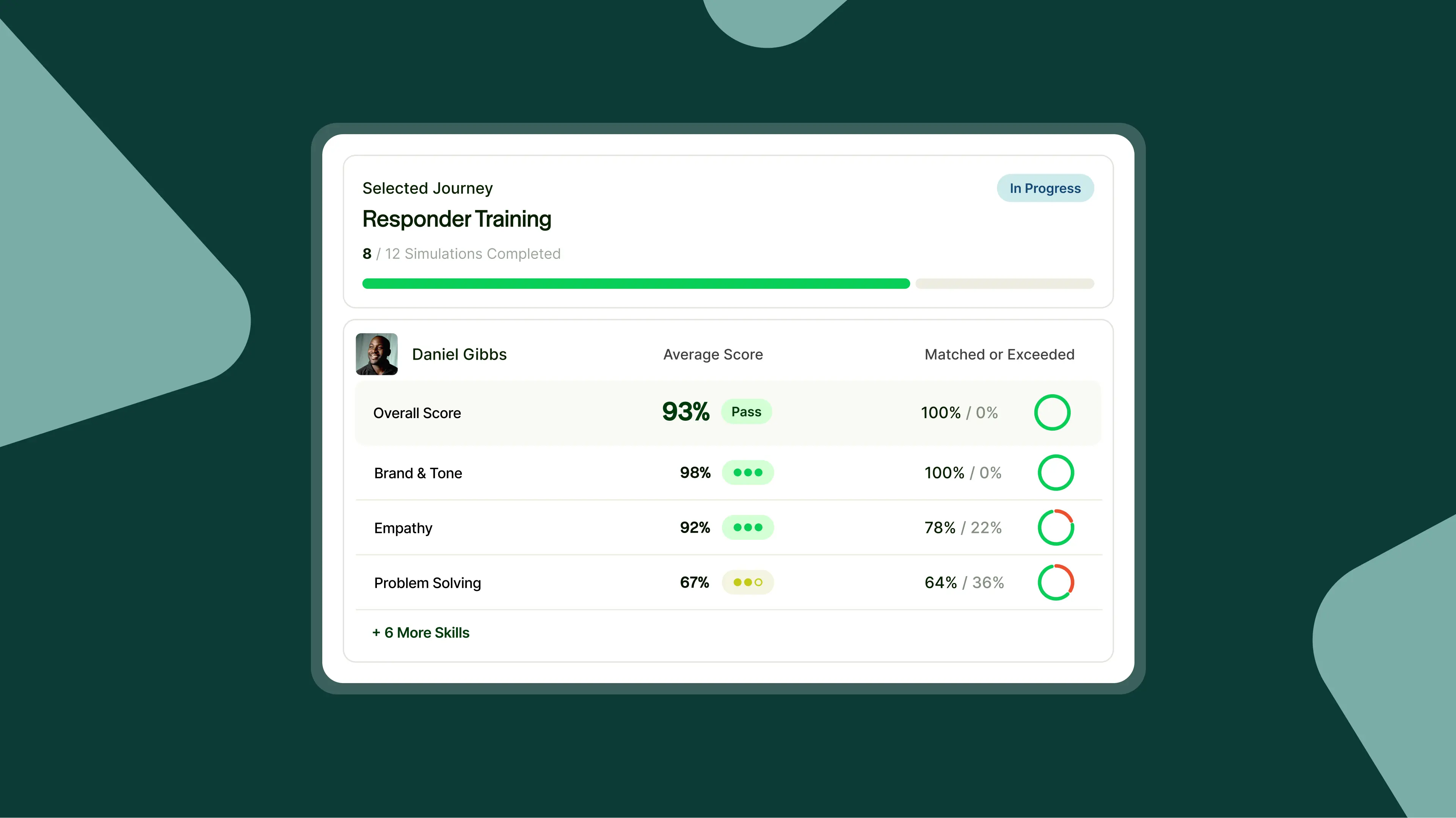
When a QA score surfaces a recurring gap (agents struggling with distressed callers or billing disputes, for example), that interaction type can be built into a simulation for practice. Simulations built from real flagged interactions are more relevant than generic training scenarios because they reflect the actual conversations agents face.
Let's say your AI QA system flags 15 calls this week where agents failed to de-escalate distressed callers. Instead of sending those agents a coaching email, you can convert those flagged interactions into simulations where agents practice the same scenario in a safe environment before the next live call. Agents move from "I know I need to improve" to "I have practiced this scenario five times and I know what to do differently."
This closes the loop between measurement and readiness: QA identifies the gap, simulation provides the practice, and subsequent QA scores track whether the gap has closed.
Track improvement by cohort, team, and topic
AI QA data applied to 100% of interactions enables performance tracking at the cohort, team, and topic level, not just the individual agent level.
Cohort tracking allows teams to compare performance across groups: new hires vs. tenured agents, different shifts, different channels. If new hires consistently score lower on compliance checks, that signals a training gap rather than an individual performance issue.
Topic-level tracking shows which conversation types consistently produce low scores across the team. If billing disputes generate low scores for 70% of agents, that is not a coaching problem, it is a process or training problem. Over time, this data builds a picture of organizational readiness that informs hiring, onboarding, and ongoing development decisions.
FAQ
Will AI QA scoring replace human QA reviewers?
AI QA scoring replaces the volume work of reviewing every interaction manually, though human reviewers remain essential for calibration, edge case adjudication, and coaching judgment. The role shifts from reviewer to quality strategist.
Does AI make fewer QA scoring errors than human reviewers?
AI makes different types of errors than humans (systematic rather than random), which makes them easier to identify and correct over time. At scale, the combination of sampling limitations and reviewer inconsistency in human QA produces more organizational risk than a well-configured AI scoring system.
What should a team do when an agent disputes an AI QA score?
Disputed scores should be reviewed by a human evaluator, and the outcome should be logged and used to calibrate the model. A clear dispute process builds agent trust and improves AI accuracy over time.
Can AI QA scoring be used for regulated or high-stakes conversations?
Yes. AI QA scoring is particularly well-suited to regulated environments because it applies scoring criteria consistently across every interaction, creating a defensible, auditable record of quality oversight. Teams in healthcare, financial services, and crisis response should ensure their AI QA platform meets relevant compliance standards such as HIPAA, SOC 2, and HITRUST.
See how ReflexAI improves QA coverage and readiness
ReflexAI's Assure automatically scores 100% of conversations across calls, chats, emails, and messages, applying customizable scoring models aligned to your organization's rubrics and protocols. Assure surfaces the specific moments that drive scores and pairs them with recommended alternatives, so coaching is concrete and development is continuous.
For teams ready to move from random sampling to full coverage, Assure integrates directly with Prepare, turning flagged interactions into realistic training simulations before the next live call.