


AI conversation simulation software lets people practice difficult conversations with an AI character before they face them for real. The AI character plays a caller and responds to what the learner says and how they say it. Each practice conversation is scored immediately, allowing the learner to see what worked and what to change. Below, we explain how conversation simulation software works and what to look for when choosing software that improves performance on live calls.
Summary
- AI personas give every agent consistent, unscripted practice. Each persona starts with a set goal and emotional state, but the conversation changes with what the agent says, so agents can build confidence before speaking with real callers.
- AI conversations should be paired with human coaching. A 2026 peer-reviewed review of AI in medical education found that AI characters playing patients behave consistently from one learner to the next. The review found that its benefits came from AI used alongside human teaching.
- Practice calls and live calls should be scored the same way. When practice and live calls are scored on one framework, you can see if skills improved on real calls. ReflexAI's Prepare and Assure share a scoring framework, so managers can compare an agent's practice scores with their live-call quality assurance (QA) scores.
- Most published results for AI simulation software come from vendors. A result from a small group of agents, or one that only counts practice activity, doesn't tell you much about what's working on live calls. Third-party reviews on sites like G2 show how customers rate these tools and why.
What is AI conversation simulation software?
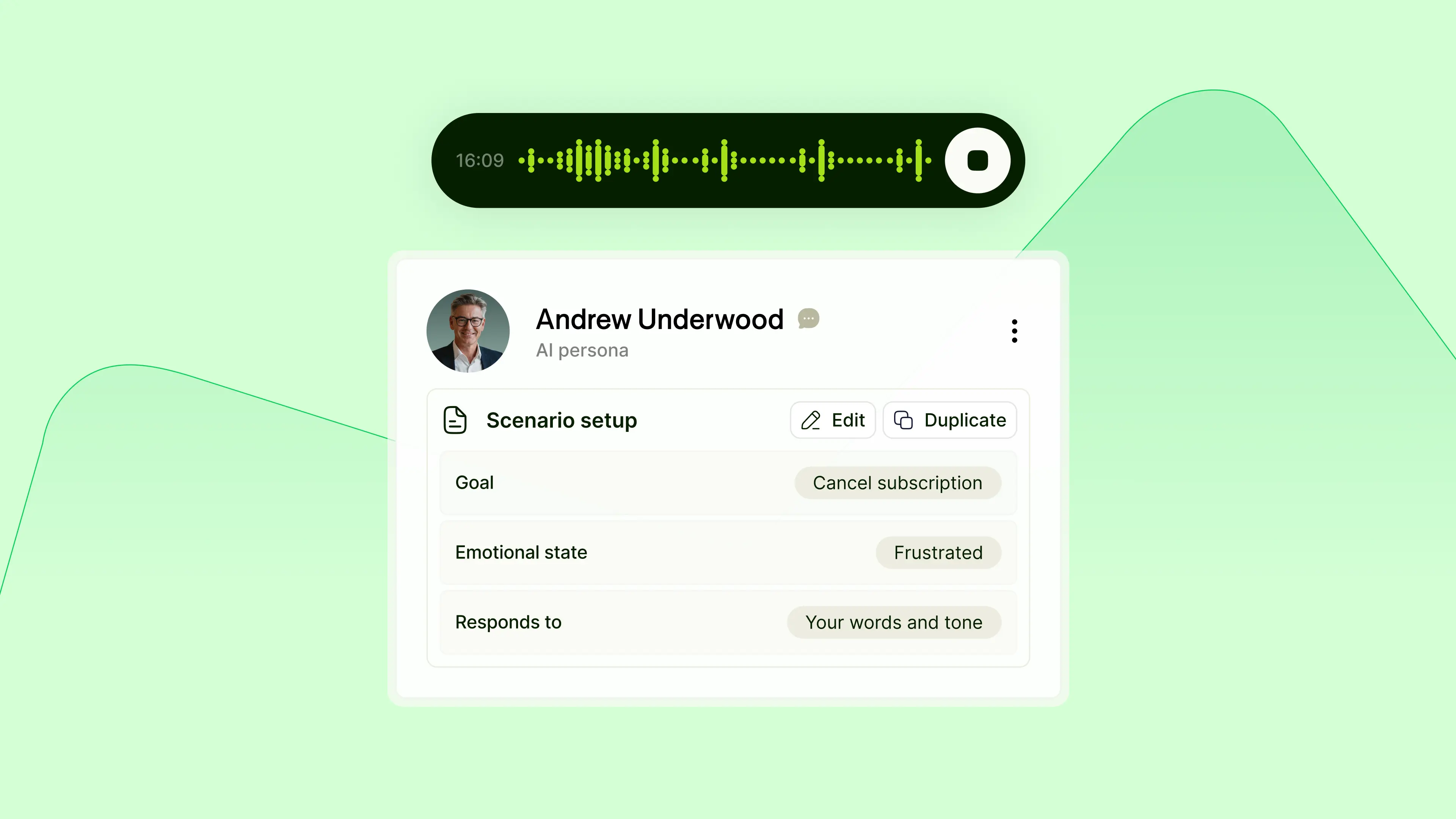
AI conversation simulation software is training software that lets frontline teams practice full, unscripted conversations with AI personas. Each persona plays someone the team talks to in its daily work, like:
- A frustrated customer calling to cancel a subscription
- An anxious patient verifying their identity before discussing test results
- A person in crisis calling a support line
- A skeptical prospect pushing back on price during a sales call
This guide covers simulation software that trains people. Developers also use the term "conversation simulation" for software that plays simulated users to test chatbots and AI agents before launch, which is a different kind of tool.
Classroom courses and e-learning modules teach agents what to say, but agents read or click through the material and don't practice saying it to a caller.
In traditional roleplay, a colleague or manager plays the customer or caller. Agents get uneven practice this way, because the trainer may play a role differently depending on their mood and how well they know the scenario. With AI conversation simulation, every agent practices with a persona that has the same goal and emotional state. The conversation still changes based on what the agent says, so no two practice calls go exactly alike.
How AI conversation simulation software works
With AI conversation simulation software, agents practice a scenario and get feedback, then repeat the scenario as often as they need. Here's how each step works.
1. Scenario creation and adaptive AI personas
The first step in conversation simulation is to develop your scenarios. Start with your existing material, like a call script or a situation that keeps going wrong on live calls. The scenario sets the persona's goal and emotional state going into the conversation. In ReflexAI, managers build scenarios and the personas adapt their tone and responses in real time to what the agent says and how they say it.
For example, if an agent talks over a frustrated caller's complaint, the simulation may push harder. If the agent acknowledges the complaint, the simulation may calm down.
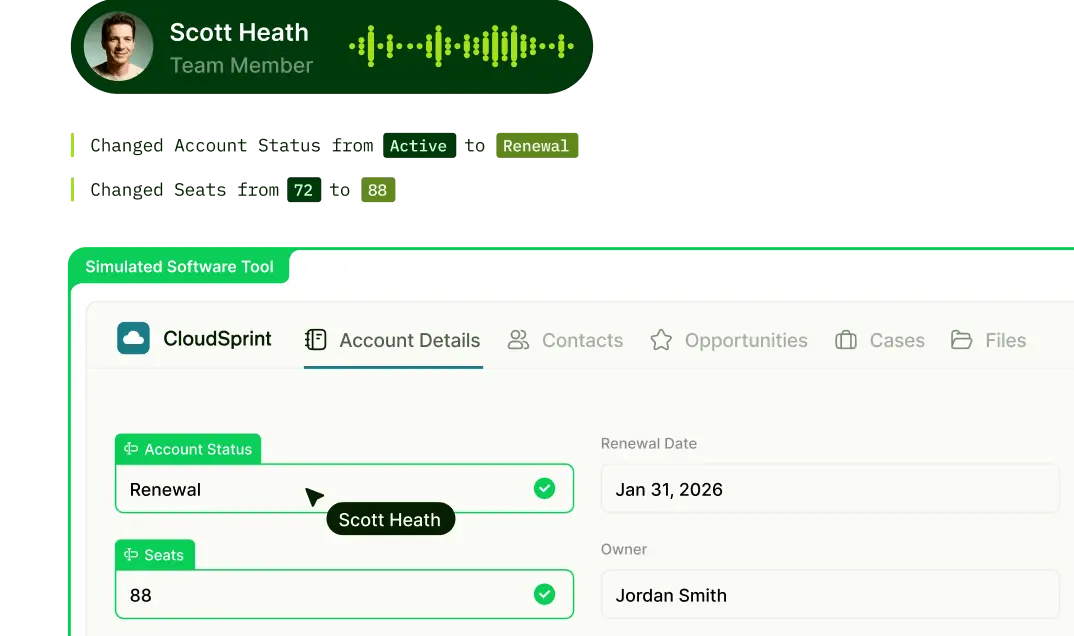
Agents can practice by voice, video, or text, depending on plan tier. ReflexAI's software overlays let them work in simulated versions of the CRM, EHR, or ticketing tool they use on live calls. New agents can rehearse the hardest calls, including the system steps, during their first weeks of training before taking them live.
2. Automated scoring and immediate feedback
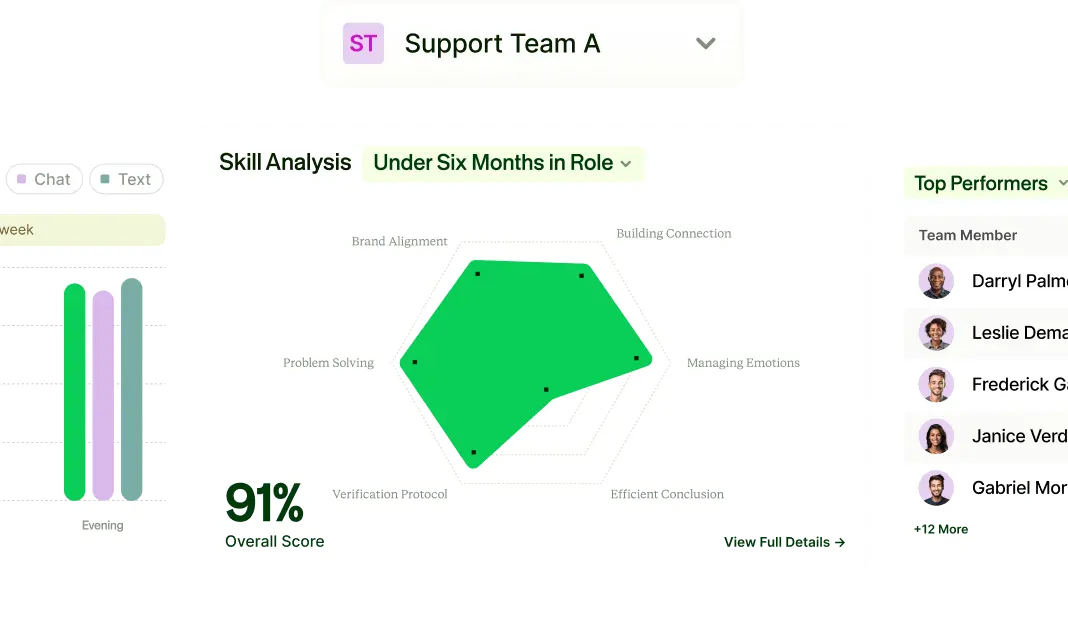
After each simulation, the software scores the conversation on a set of dimensions and shows the agent the results right away. Every agent's attempt is scored against one standard, so your entire team learns how to handle protocol steps consistently.
ReflexAI scores simulations on dimensions like empathy, accuracy, tone, and protocol adherence, and teams can import their own scoring rubrics. In traditional roleplay, agents often wait days for feedback because a supervisor has to review each session first.
3. Coaching and repeat practice
Research shows that AI simulation training is more impactful when it's paired with human coaching. A 2026 narrative review in Advances in Medical Education and Practice looked at AI in medical training and found that the benefits of AI in simulation training came from AI-augmented human teaching rather than from unsupervised AI systems. In a contact center, the coach is usually a manager.
The software keeps a score for every practice call, but a manager decides what the scores mean for each agent. For example, if an agent's empathy score drops on billing disputes, the manager can review the call with the agent and assign more practice on that type of call. The agent then repeats the scenario, and the manager compares the new score with the last one.
Why AI conversation simulation works
The narrative review looked at how medical education programs use AI characters, called virtual patients, to train students. The review describes four benefits:
- Consistent difficulty. AI virtual patients "perform in consistent and repeatable patterns," so every learner faces a scenario at the same level of difficulty. Human simulated participants vary from one session to the next.
- A good fit for emotional scenarios. AI-simulated practice is especially useful in scenarios that require high empathy and complex decision-making.
- Less strain on human role-players. Putting human role-players through distressing scenarios may raise concerns about their emotional and psychological safety, and AI can reduce those concerns.
- More confidence with real patients. Students who practiced with AI virtual patients had less anxiety and more confidence during actual patient interactions.
While these findings come from medical education, they can be adapted for contact center scenarios. For example, agents can practice a hard conversation for the first time with an AI persona, where a mistake harms no one. Crisis line counselors can rehearse the most distressing calls without putting a colleague through them.
Standalone simulation tools vs connected practice and QA
Conversation simulation software should help agents improve their call skills. When evaluating these tools, make sure that practice and live calls are scored the same way. The following table compares standalone and connected tools, with questions to ask vendors during an evaluation.
Question to ask | Standalone practice tool | Connected practice and QA |
What gets scored? | Practice sessions, on the tool's own rubric | Practice and live conversations, on a shared scoring framework |
Where do scenarios come from? | A generic library or one-off builds | The team's scripts and protocols, plus what QA shows agents missing on live calls |
Can a manager see whether practice improved live calls? | Only by pulling data from a second system | Practice and live scores use the same dimensions and can be compared directly |
How are coaching decisions made? | From practice scores alone | From practice scores read alongside live-call QA insights |
What can leaders report? | Completions and practice activity | Readiness and compliance trends seen in live conversations |
Most demos show only the practice session, so ask the vendor to demonstrate how their tool compares practice scores with live-call scores. In Deloitte Digital’s 2026 Global Contact Center Survey, 72% of leaders at contact centers falling behind on AI said integrating their technology and systems was a top challenge.
ReflexAI connects practice and live-call QA with two products. Agents practice in the Prepare simulation platform, and managers review QA insights from scored live calls in Assure.
The products have a common scoring framework, so managers can compare an agent's practice scores with live-call scores directly. For example, if Assure shows agents missing a verification step on live calls, a manager can build a relevant practice scenario and track protocol adherence on live calls over the following weeks.
AI conversation simulation software in healthcare, sales, and leasing
ReflexAI has published results in three settings: a study of call center agents focused on healthcare compliance, Verstela’s outbound sales team, and Cortland’s leasing team. All three sets of results are ReflexAI’s own findings.
Compliance and rapport in a healthcare contact center
Healthcare contact centers handle conversations governed by hospital policy, HIPAA, and state and federal regulation. In this environment, a missed protocol step can cause real harm.
ReflexAI's healthcare compliance simulation study of 174 call center agents compared agents by how many simulations they completed. The study found:
- 18% higher protocol compliance scores among agents with high simulation use
- 17% more conversations meeting the highest organizational standards among agents who completed a high number of simulations
- 16% more conversations with stronger rapport among agents using simulations
Following protocol and building rapport can feel like competing goals on a call, but agents who practiced more scored higher on both. The study doesn't prove that the extra practice caused the higher scores.
Outbound sales practice at Verstela
Verstela, a staffing services firm, uses ReflexAI to train outbound sales reps for short, high-pressure calls with decision-makers. Reps complete 15 to 20 simulations during training and do two roleplays at the start of each workday. At Verstela, simulations have replaced more than 1,000 hours of manager time spent building and evaluating trainee roleplays.
Cortland, one of the largest multifamily operators in the US, uses ReflexAI to train its Leasing Hub associates on prospect conversations. Cortland compared their live calls from the 30 days before and after deployment and found:
- A 64% overall improvement across key behaviors
- 4X more cross-sell attempts
- A 63% improvement in assessing customer needs
- A 38% improvement in effective call summarization
These figures come from live calls rather than practice sessions. Because the study compares calls before and after deployment, it doesn’t rule out other factors that changed during the same period.
How to check a simulation vendor's outcome claims
Ask vendors for the source of every outcome figure they share. You can test their claims with these questions:
- Does the figure come from a named study with a stated sample size, or from a number with no source?
- Does the study measure live-call results, or only practice activity like completions?
- Does the study show that simulation caused the result, or only that the two are linked?
- Can the vendor connect you with customers who will describe the results in their own words?
Buyers should also check third-party reviews on websites like G2 and Capterra, which the vendor does not control. Look at the number of reviews as well as the rating, since a high score from a handful of reviewers says little.
Choose simulation software that connects practice to live calls
AI conversation simulation software is a good investment when it changes how agents handle live calls. The software should score practice and live calls on the same framework, so managers can see if agents use what they practiced on real calls. When evaluating vendors, ask them these questions:
- Does the persona respond to what the learner says and how they say it, or does it follow fixed branches?
- Can the team build scenarios from its own scripts, protocols, and QA findings?
- What is each simulation scored on, and does that match the team's QA scorecard?
- Can practice scores and live-call scores be compared side by side?
- How does a manager use the results to decide what to coach next?
ReflexAI's Conversation Performance Platform helps teams prepare for and improve the conversations with the most at stake. In Prepare, agents and counselors get realistic, scored practice before a hard conversation goes live. On G2, ReflexAI has a 4.7 out of 5 rating from 37 reviews, as of October 2026. The platform scores live conversations on the same framework, so managers can compare the two.
Take a tour of ReflexAI to see Prepare simulations and Assure's QA insights side by side.
Frequently asked questions about AI conversation simulation software
What is the most realistic AI for conversation?
For training, the most realistic conversational AI responds to both the words and the emotional tone of the learner. It also stays in character for the whole conversation and can be built from a team's own scenarios. For phone teams, practicing out loud is more realistic than typing replies in a chat window. When testing realism in a demo, pick a scenario you know well and give the persona an answer it would not expect.
What is the best AI for simulations?
For training frontline teams, the best AI for simulations is purpose-built conversation simulation software rather than a general chatbot. Look for a tool that scores practice against your own standards and lets you compare those scores with live-call quality data. If managers can only see how often agents practiced, they can't tell if the agents' live calls improved.
Which is the best conversational AI?
Chatbots and virtual agents are the best conversational AI for answering customers. Conversation simulation software is the best choice for training agents. Teams judge a chatbot by how well it resolves customer requests. They judge a simulator by how realistic it feels and how closely its scores match live-call results.
Is there an AI that can simulate conversations?
Yes. AI conversation simulation software creates personas that hold full spoken or typed conversations and adapt to what the learner says. A persona might play a frustrated customer or a skeptical prospect. Teams use these simulations to rehearse hard conversations before they happen live.