


Contact center performance management is an ongoing process for helping agents improve how they handle customer conversations. Managers define what a good conversation looks like, review live calls and call transcripts, and coach agents on the skills they need to improve. The sections below explain why the calls reaching agents are getting harder and how managers can better prepare agents to handle them.
Summary
- The performance management cycle often stops at coaching. In a typical program, managers set standards, score calls, coach agents, and adjust goals. Many programs don't give agents a way to practice what they were coached on before their next live call.
- Leaders lack time. In research ReflexAI commissioned from GLG, 77% of contact center leaders said they don't have enough time for coaching, calibration, and development.
- Automated scoring can give managers time for training agents. When software scores calls, managers don't have to listen to each one before deciding what to coach. They can spend more of that time working with agents.
- Simulation training helps agents reach proficiency faster. McKinsey reports 20% to 30% reductions in agent time to proficiency in client engagements that used simulation-led onboarding and training.
- Practice calls and live calls should be scored the same way. ReflexAI's Prepare and Assure share a common scoring framework, so managers can compare how an agent performs in practice with how they perform on live calls.
What is contact center performance management?
Contact center performance management is the framework companies use to measure and improve agent performance on calls. Quality assurance (QA) reviewers score calls against a rubric or scorecard, and managers use those scores to coach agents and set new goals. Most programs follow five steps:
- Setting expectations. Leaders define what a good conversation sounds like and tie key performance indicators (KPIs) to business and customer goals.
- Monitoring conversations. QA reviewers score real calls against those standards. Managers also track operational data, such as handle time and schedule adherence, in their workforce management software.
- Analyzing outcomes. Managers review the QA scores and trace each result, good or bad, to the skill or process behind it.
- Coaching agents. Managers coach agents on the specific behaviors that need to change.
- Adjusting goals. Managers set new goals based on the results and start the process again.
Many programs get hung up at step 4 because managers don't have time to review calls and follow up with each agent. Software that uses AI to score calls gives managers more time to coach. Assure, ReflexAI's QA software, scores calls and helps identify which skills each agent needs to practice before the next call. Assure can score up to 100% of interactions and automates scoring well beyond the sub-10% manual sample typical of legacy QA. Teams catch compliance and performance issues before they escalate, without paying to score every call.
Why contact center performance management is harder now
Contact center performance management is getting harder because AI agents are handling an increasing number of routine customer service interactions. This leaves the most sensitive or complex issues to human team members, and it can be challenging to accurately score these types of calls.
Gartner predicts that by 2029, agentic AI will "autonomously resolve 80% of common customer service issues." That leaves the most complex issues for human agents, for example:
- A distraught patient whose identity has to be verified before sensitive results are shared
- A customer who is upset because a package marked as delivered never arrived
- A bank customer who just found fraudulent charges on their account
- A caller in crisis who needs help right away
In a Gartner survey of 321 service and support leaders, 63% said they're shrinking their frontline teams slowly by not replacing agents who leave, and shifting the agents who stay toward more valuable work. McKinsey also suggests that agent responsibilities are shifting, with the agent role becoming an advisory one that pairs human empathy and skill with AI tools.
Because the remaining calls are harder, a longer handle time doesn't always mean an agent is slow. Managers learn more by observing how an agent handled the call, such as calming an upset caller or following protocol under pressure, than from efficiency metrics alone.
Contact center performance management KPIs to track
Most contact centers track several KPIs, and it's tempting to focus on one or two, such as handle time, and draw conclusions from those alone. You'll get a more accurate picture of how an agent or team is performing when you assess all KPIs together.
KPI | What it measures |
Average handle time (AHT) | Average time an agent spends on each contact, from greeting through wrap-up notes |
First contact resolution (FCR) | Percentage of contacts where the issue is fixed without the customer reaching out again |
Customer satisfaction (CSAT) | Post-contact survey score showing how customers rated a specific call or chat |
Net Promoter Score (NPS) | Survey score showing how likely customers are to recommend the company, based on their overall experience with the brand |
Quality score | How a reviewed call rated against the team's QA scorecard, on items such as protocol adherence, empathy, and accuracy |
Schedule adherence | How closely agents' actual working time matches the schedule in workforce management software |
Occupancy | Percentage of logged-in time agents are busy with calls, chats, or after-call work |
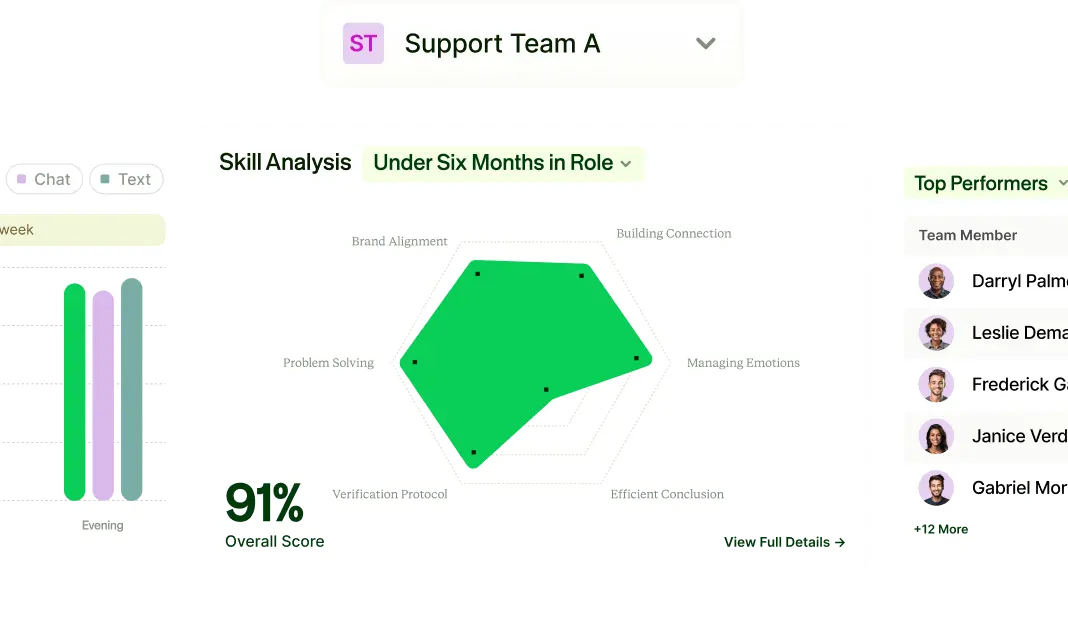
When a KPI changes, it signals that performance shifted in some way, but not why it shifted. An AHT spike might mean agents are struggling with complex queries, or that a slow legacy system keeps customers waiting for the screen to load. A drop in FCR might trace to a training issue, or to a broken self-service flow that pushes failed tasks into the voice queue. To find the cause, managers can review a sample of scored calls from the agents and dates where the KPI changed, but this is time consuming and often where the QA process gets bottlenecked. With a performance dashboard, managers can compare QA scores and KPIs across agents and teams over time, which helps them spot patterns without reviewing calls one at a time.
Agent engagement and recognition
In effective performance management programs, managers should recognize what agents do well. When an agent’s QA scores improve on a skill they’ve been coached on, managers can call out that progress in a one-on-one or a team meeting. Some teams share strong calls as examples, so other agents can hear what a good conversation sounds like. Recognition gives agents a reason to keep practicing and makes it clear the program isn’t only about catching mistakes.
Where the performance management cycle breaks down after coaching
Many performance management programs don't go beyond coaching, and flagged issues aren't resolved. Agents may end up back on live calls making the same mistakes since they haven't been able to adequately practice what they need to improve.
Why contact center coaching stalls even with AI involved
Coaching falters even in contact centers that already use AI tools, often because the tools don't connect to each other or don't fully meet the team's needs. In 2026, ReflexAI commissioned GLG to survey 109 contact center directors, VPs, and executives, none of them current ReflexAI customers. Among the leaders surveyed:
- 85% have at least one AI tool in place for training or QA, but only 29% say they use AI effectively in their operations.
- 77% don't have enough time for coaching, calibration, and development.
- 58% say their training tools aren't fully meeting their needs, and 61% say the same about their QA tools.
- Only 52% can measure if their actions had any effect.
In open-ended answers, leaders brought up the disconnect between training and QA without being asked. It came up repeatedly as the most critical problem they identified.
Separate skill problems from process problems
When a KPI changes or a QA review flags a problem, the first step is to find out if the agent or the operation is causing it. You can coach agents to handle conversations better, but you can't coach them past a slow CRM or a confusing policy. The reverse is also true. If only a few agents are struggling, changing a process for the whole team won't help them.
The following questions can help you tell a skill problem from a process problem.
- Who does it affect? If only a few agents struggle with a type of call that their peers handle well, the cause is likely a skill issue. If every agent starts struggling with it at the same time, the cause is more likely a process problem.
- When did it start? If average handle time went up the day a CRM update went live, the update is the likely cause.
- What do the conversations show? When you review a few scored calls, you can hear if an agent skipped a step or waited on a system that stalled.
If it's a skill issue, coach the agent and assign practice. If it's a process or tooling issue, send it to the person who owns that system or policy, such as an operations or IT lead. After they make the change, check the KPI again to see if it improved.
Connect QA findings to agent training
In call simulations, agents rehearse what they've been coached on, so they're better prepared for tough calls. In McKinsey's client work, teams that used simulation-led onboarding and training cut agent time to proficiency by 20% to 30%. Yet only 57% of leaders in the GLG panel said their training gives agents enough realistic practice to prepare for live calls.
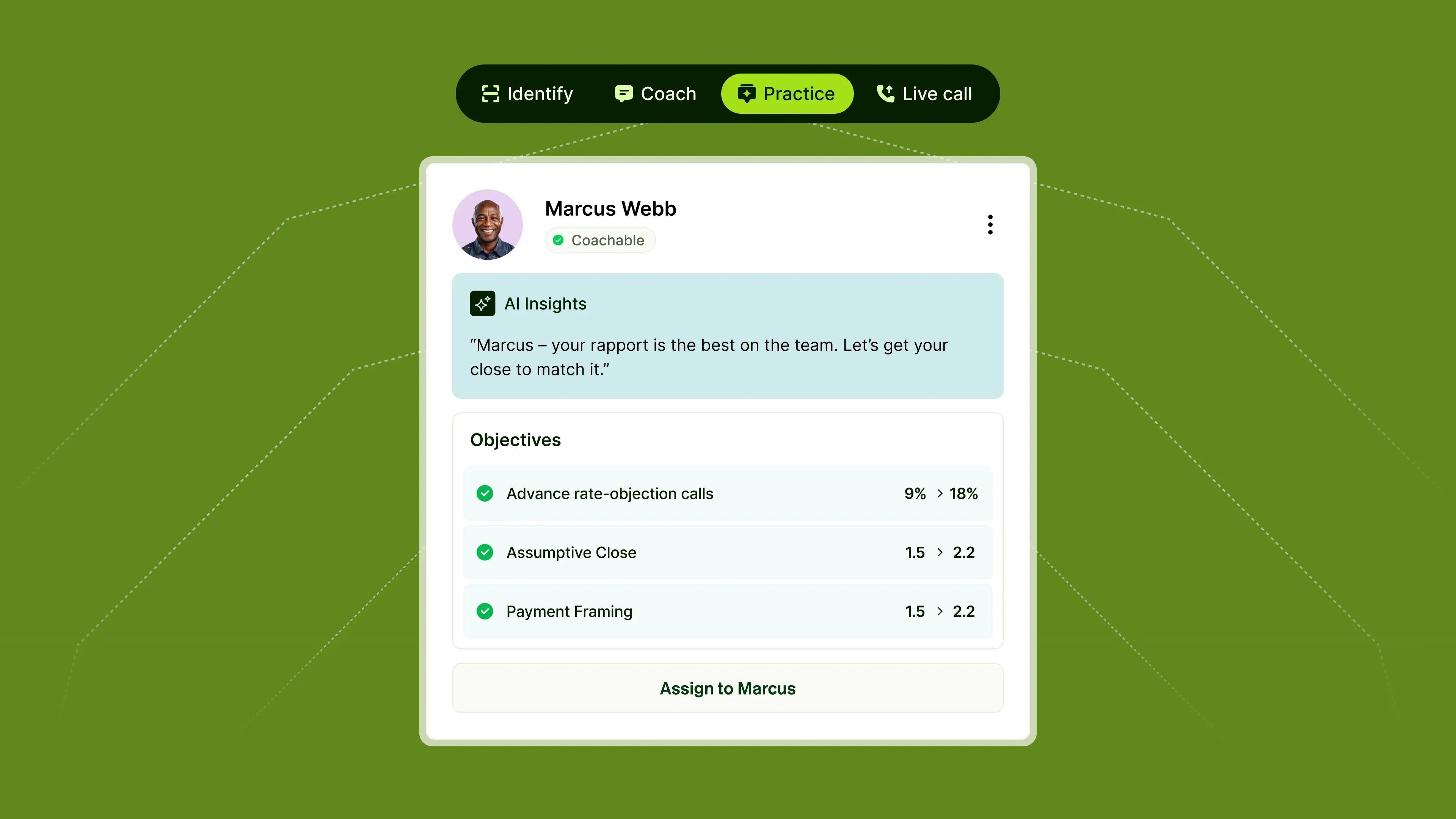
ReflexAI connects evaluation and practice through two products, Assure and Prepare. Assure helps managers identify which skills need coaching. Prepare, an AI simulation training platform, lets agents rehearse conversations with AI personas that adjust in real time to how the agent responds. Each simulation is scored immediately on empathy, protocol adherence, and responsiveness.
Prepare and Assure share a common scoring framework. Today, a manager can take a finding from Assure, assign the matching scenario in Prepare, and compare the agent's practice and live-call scores on the same dimensions. The manager can then see if the agent uses the rehearsed behavior on live calls.
Use these criteria to check if a performance management platform connects QA findings to practice:
- A shared standard. Practice and live calls should be scored against the same rubric so the two can be compared directly.
- A path from finding to practice. A manager should be able to move from a QA finding to a matching practice scenario without rebuilding it by hand.
- Realistic practice for hard conversations. Scenarios should cover the high-stakes, emotionally difficult calls your agents take, with immediate feedback.
- Evidence of change. A manager should be able to check if a coaching session changed how the agent handles live calls.
- QA insights that point to coaching. Scoring more calls helps only if managers can see from the scores what to coach next. Many large contact centers don't see reviewing every call as a benefit.
Teams comparing QA tools can start with ReflexAI's guide to choosing a contact center QA platform.
Protocol compliance gains in a 174-agent simulation study
Rehearsal before live calls is especially important in healthcare contact centers. Agents there work under hospital policy, HIPAA, and state and federal regulation, so a skipped identity check or a missed protocol step can affect a patient's safety and the organization's standing.
In a study of 174 call center agents that ReflexAI reports, the agents with high simulation use showed an 18% improvement in protocol compliance scores and met the highest organizational standards in 17% more conversations. Protocol compliance is a common item on QA scorecards, so managers can measure gains from practice without adding a new metric.
Build a performance management program that changes live calls
In an effective performance management program, contact center leaders trace each KPI change to a specific cause and figure out if it's an agent skill issue or a process problem. Agents then rehearse the calls their managers coached them on before they take the next live call.
ReflexAI, the Conversation Performance Platform, helps teams practice, measure, and improve their most important conversations. Assure shows managers what to coach. Prepare lets agents practice the exact conversations they need to improve. Because both tools score calls the same way, managers can see if an agent uses what they practiced on live calls.
Cortland, one of the largest apartment management companies in the US, used Prepare to train the Leasing Hub associates who handle first conversations with prospective residents. Associates rehearsed inquiry and pricing conversations before taking live calls. In live calls from the 30 days after deployment, compared with the 30 days before, associates improved at assessing customer needs by 63% and at summarizing calls by 38%.
Schedule a demo to walk through how your own contact center QA findings can map to practice scenarios in Prepare.
Frequently asked questions about contact center performance management
What is the difference between quality assurance and performance management?
Quality assurance (QA) is a component of performance management. With QA, reviewers score calls against a scorecard to see where agents met the standard and where they fell short. Performance management is the full cycle built around those scores. Managers use the scores to coach agents and assign practice, then set new goals based on the results.
What are the 5 key performance indicators of a call center?
The five KPIs most call centers track are first contact resolution, average handle time, customer satisfaction, Net Promoter Score, and quality score. Together they cover resolution, efficiency, customer opinion, loyalty, and how well agents meet the team's standards.
What are the main KPIs for a call center?
The main KPIs for a contact center are first contact resolution, average handle time, customer satisfaction, Net Promoter Score, and quality score, plus abandonment rate, escalation rate, and service level. Workforce teams also track schedule adherence and occupancy. When a KPI changes, managers review a sample of scored calls from that period before deciding how to respond.
How can you improve performance in a call center?
You can improve call center performance by reviewing a sample of scored calls for each KPI that changed and deciding if the problem is an agent's skill or a broader process. Send process problems to the team responsible for that system or policy, such as IT or operations. For skill problems, coach agents on the specific behavior and give them realistic practice before their next live calls.
What is the 80/20 rule in call centers?
The 80/20 rule in call centers is a service level target that calls for answering 80% of calls within 20 seconds. Many centers use it as a default benchmark for staffing and scheduling. It measures speed of answer only, so teams pair it with quality and resolution measures to see how the conversation itself went, and many adjust the target to fit their channel and customers.