











Top 7 AI role play simulation platform alternatives for 2026
When was the last time your simulation training scores went up and your live call performance didn't move?
According to industry research, 67% of contact center leaders report that training feedback doesn't align with their QA scorecards.
Studies show agents who practice only 1-2 times retain just 23% of new behaviors, compared to 78% retention for those completing 5+ repetitions.
And whatever happens in training stays in training - it never connects to what QA sees on the floor.
This list covers eight options: ReflexAI, Second Nature, Hyperbound, Quantified, Mursion, Zenarate, Virti, and ChatGPT.
All evaluated on the criteria that actually matter for frontline teams: realism, custom scoring, software practice, and QA integration.
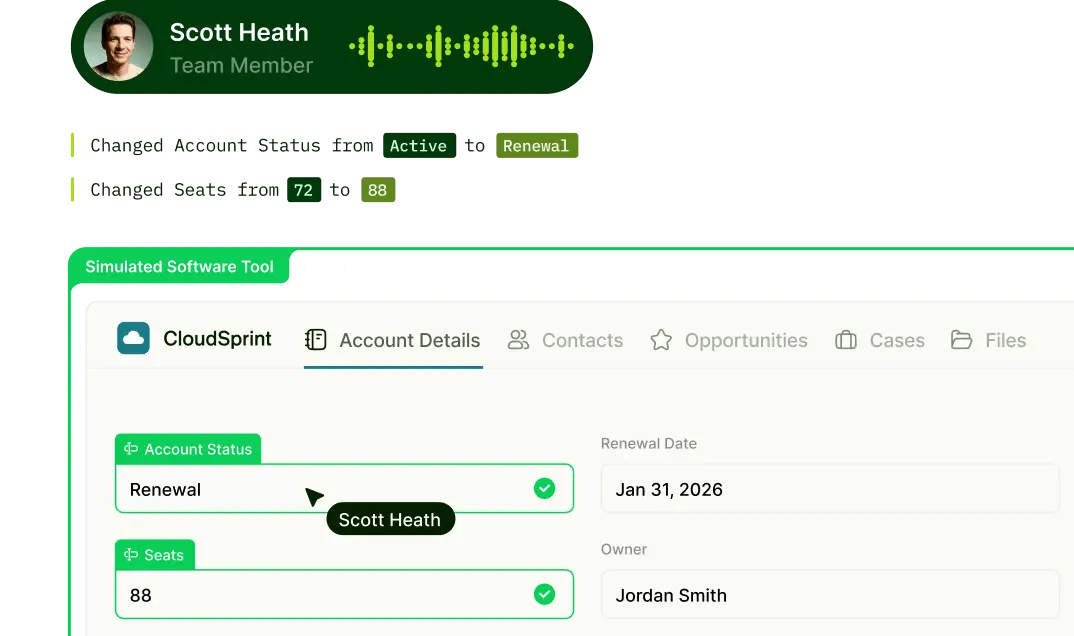
One concrete example of what that last one looks like: ReflexAI lets agents practice navigating Epic, Salesforce, or Zendesk at the same time as the conversation, not as a separate exercise.
The right platform depends on your conversation risk. Here's how each one stacks up.
What is an AI role play simulation platform?
An AI role play simulation platform uses conversational AI to place agents or frontline staff in realistic, practice-safe dialogue scenarios without requiring a live human to play the opposing role. Unlike general e-learning tools that deliver static content, these platforms generate dynamic, adaptive responses that mirror the unpredictability of live interactions.
Why do teams look for AI role play simulation platform alternatives?
Your current tool has a ceiling - research shows 72% of teams outgrow their first simulation platform within 18 months. The most common triggers are manual processes that can't keep pace with hiring, practice models that don't build reliable behaviors, and feedback systems that don't match your actual evaluation standards.
Manual roleplay does not scale
A manager playing the opposing role caps practice capacity - typically limiting teams to 3-5 roleplay sessions per agent per month, versus the 20+ repetitions research shows are needed for skill retention. Across shifts, time zones, and rapid hiring cycles, that model produces uneven readiness before agents ever take a live call.
Repetition builds readiness before live calls
Practicing once is not the same as practicing until a behavior is reliable. AI simulations remove the ceiling on repetitions, so agents can run the same scenario dozens of times without consuming manager time, which matters most when a poor first live call carries real consequences for a customer or patient.
Feedback must match your scorecards
Generic AI feedback scores on filler words or pacing. Teams with specific protocols, whether compliance scripts, empathy standards, or crisis de-escalation steps, need feedback that maps to their actual evaluation rubric. Mismatched feedback accounts for 43% of platform switches, making it the most common reason teams leave a first-generation tool.
Practice scores should connect to QA
Agents can pass simulations and still struggle on real calls when training and QA operate in separate systems. Some platforms close this loop by connecting simulation outcomes to automated QA on live interactions, so teams can see whether practice actually translated to the floor.
How we evaluated the alternatives
Each platform was assessed across the same six criteria so you can compare them directly.
- Conversation realism across voice and chat: Does the AI respond dynamically to what the agent actually says, across both channels?
- Scenario and persona customization: Can teams build scenarios from their own scripts, protocols, or prompts without engineering support?
- Custom AI scorecards: Can scoring dimensions mirror the organization's own evaluation rubric rather than a generic standard?
- Software workflow practice: Can agents practice navigating tools like CRMs or EMRs simultaneously with the conversation, not just the dialogue in isolation?
- Analytics and QA integration: Does the platform connect training performance data to live interaction outcomes?
- Security and compliance: Does the platform meet the standards required for sensitive industries, specifically SOC 2, HIPAA, HITRUST, GDPR, and ISO 27001?
What are the top AI role play simulation platform alternatives?
Each entry below covers what the platform is built for, its standout capabilities, and its primary trade-off. ReflexAI leads the list because it is the most relevant platform for high-stakes, compliance-sensitive frontline teams.
Platform | Voice + Chat | Custom Scenarios | Custom Scoring | Software Practice | QA Integration | Compliance |
ReflexAI | Yes | Yes | Yes | Yes (CRM/EMR overlays) | Yes (100% automated QA) | SOC 2, HIPAA, HITRUST, GDPR, ISO 27001 |
Second Nature | Yes | Partial | Partial | No | No | SOC 2, ISO 27001, HIPAA |
Hyperbound | Yes (voice-focused) | Yes | Partial | Partial (CRM integrations) | Partial (sales QA) | SOC 2, ISO 27001, GDPR, HIPAA |
Quantified | Yes | Yes | Yes | No | No | SOC 2 |
Mursion | Yes | Yes | No | No | No | SOC 2, GDPR |
Zenarate | Yes | Partial (structured) | Partial | Yes (screen simulations) | Partial (Call Analyzer) | SOC 2 alignment |
Virti | Yes | Yes | Partial | No | No | ISO 27001, ISO 9001 |
1. ReflexAI: best for high-stakes, compliance-sensitive frontline teams
ReflexAI is purpose-built for organizations where conversation outcomes carry real consequences, including crisis lines, behavioral health, healthcare contact centers, and customer support operations handling escalations.
Prepare (AI Training Simulations) delivers voice-first and chat simulations in 25+ languages, with configurable personas built from a single prompt or uploaded script. Agents practice navigating tools like Epic, Salesforce, or Zendesk simultaneously with the dialogue through software simulation overlays, which brings practice closer to actual working conditions rather than an isolated conversation exercise.
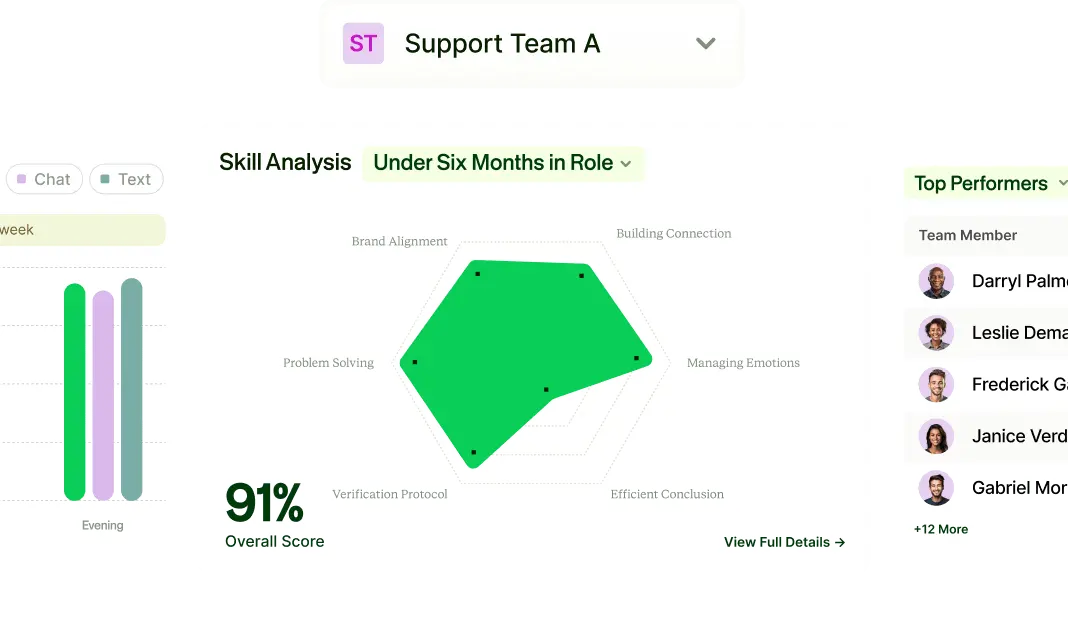
Assure (Automated Quality Assurance) evaluates 100% of calls, chats, emails, and messages using automated scoring models aligned to each organization's protocols. Flagged interactions convert directly into personalized simulations, closing the loop between training and live performance. Cohort tracking and collaborative workspaces let teams monitor performance patterns across groups and coordinate coaching without switching tools.
ReflexAI Studio powers both products as a self-serve system that lets teams build simulations and scoring models from any script, file, scenario, or prompt with no code. New scenarios can be created in seconds and scoring dimensions adjusted to match evolving protocols.
Compliance certifications: SOC 2, HIPAA, HITRUST, GDPR, and ISO 27001, which are table stakes for crisis lines, behavioral health, and healthcare contact centers handling sensitive conversations.
Primary limitation: ReflexAI is purpose-built for high-stakes conversation industries. Teams looking for a general sales enablement tool with pipeline analytics will find a more focused fit elsewhere.
2. Second Nature: best for sales teams practicing scripted pitches
Second Nature is a conversational AI sales coach that simulates two-way dialogue and scores reps against pitch coverage and delivery, with LMS-adjacent features that support onboarding. Scenarios are built around sales archetypes like discovery calls, cold calls, and objection handling.
Standout capabilities:
- SOC 2 Type II, ISO 27001, and HIPAA compliance certifications
- Sales-focused scenario library with pre-built pitch templates
- Integration with sales enablement platforms for content delivery
G2 reviewers (Second Nature holds a 4.5/5 rating from 150+ reviews) report "limited tolerance for off-script stuff" and inconsistent scoring when agents deviate from expected responses, which surfaces as a real risk in emotionally complex or compliance-heavy conversations where agents must respond to unpredictable escalations.
Choose Second Nature when your team runs structured sales motions and needs fast onboarding for scripted pitches. Avoid it when your agents handle emotionally volatile or protocol-driven conversations where the AI needs to adapt to what the agent actually says.
3. Hyperbound: best for cold call and outbound voice practice
Hyperbound converts an ideal customer profile into a lifelike AI buyer in minutes, with strong support for cold calls, gatekeeper scenarios, and discovery conversations. The platform markets 25+ integrations with sales tools like Salesforce and HubSpot, and its enterprise page claims automated scoring of live sales conversations.
Standout capabilities:
- SOC 2 Type II, ISO 27001, GDPR, and HIPAA compliance certifications
- Fast scenario creation from ICP inputs
- CRM compatibility and automated scoring of live sales conversations
G2 reviewers (Hyperbound holds a 4.7/5 rating from 200+ reviews) report lag and delays during calls, and approximately 15% of reviews note that bot realism could be enhanced. There is no public indication of EMR practice or clinical workflow support, so the platform's integrations and examples remain sales-stack oriented.
Choose Hyperbound when your team runs high-volume outbound and needs fast bot setup from an ICP. Avoid it when your agents handle inbound, customer support, or multi-turn complex conversations outside a sales context.
4. Quantified: best for enterprise sales in regulated industries
Quantified uses photorealistic AI avatars and has traction in pharma and financial services, where message control and compliance phrasing matter. The platform is configured to each customer's playbook, rubrics, and content library, and it includes ComplianceGuard AI to flag off-label responses during roleplay practice.
Standout capabilities:
- SOC 2 Type II compliance certification
- ComplianceGuard AI for regulated messaging
- Integration with approved content libraries
Configuration to a specific playbook and rubric is a strength in regulated environments, though it also implies non-trivial setup and governance work before the first simulation runs. G2 reviewers (Quantified holds a 4.6/5 rating from 50+ reviews) note a desire for more ability to practice objection handling, suggesting scenario variety may be more limited than newer platforms.
Choose Quantified when your team operates in pharma or financial services and needs tight message control during practice. Avoid it when you need rapid scenario creation or an integrated QA workflow alongside simulation.
5. Mursion: best for interpersonal and leadership skill development
Mursion uses a hybrid model where live human interactors, called Simulation Specialists, provide the voice and responsiveness for AI avatars. Sessions are scheduled in advance and matched with a trained specialist, producing highly realistic emotional responses for soft skills, DEI training, and leadership scenarios.
Standout capabilities:
- SOC 2 and GDPR compliance certifications
- High emotional realism through human-in-the-loop model
- Strong for interpersonal and leadership development
Scheduling constraints and per-session staffing economics make it less practical for high-volume frontline agent training where hundreds of reps need daily practice. Rescheduling close to session time can still incur a charge, and there is no public evidence of CRM or EMR hands-on practice or automated QA integration with live interactions.
Choose Mursion when your team needs deeply nuanced interpersonal or leadership practice and can absorb the scheduling and cost model. Avoid it when you need to scale practice across a large frontline team on a daily basis.
6. Zenarate: best for contact center script adherence
Zenarate focuses on contact center simulation with an on-screen conversation brief that mirrors what agents see in live tools. The platform supports screen and software simulations and includes a Call Analyzer module for reviewing live recordings.
Standout capabilities:
- Screen and software simulations for contact center workflows
- Call Analyzer for live call review
- Security program aligned to SOC 2 Framework
Scenarios are built using utterances and branching logic, which gives teams control over conversation paths, though G2 reviewers (Zenarate holds a 4.4/5 rating from 75+ reviews) explicitly describe simulations as "a bit linear" and note that "you only get what you program." Conversations can feel structured rather than dynamic, limiting the platform's ability to simulate emotionally volatile or unpredictable interactions.
Choose Zenarate when your team follows structured scripts and needs software simulation alongside conversation practice. Avoid it when your agents face emotionally unpredictable interactions that require a more generative, adaptive AI response.
7. Virti: best for immersive soft skills and healthcare simulation
Virti uses AI virtual humans and cross-platform delivery across VR headset, desktop, and mobile to create immersive practice experiences. No special hardware is required, though VR and AR headsets are supported for teams that want them.
Standout capabilities:
- ISO 27001 and ISO 9001 certifications (SOC 2 Type II in progress, expected Q3 2026)
- Multi-platform delivery including VR support
- Virtual human scenarios for soft skills and healthcare communication
G2 reviewers (Virti holds a 4.7/5 rating from 100+ reviews) flag a need for improved audio realism and more lifelike voices. Teams that need rapid scenario creation from existing scripts or protocols may find setup more involved, and there is no public evidence of CRM or EMR practice or automated QA scoring of live frontline interactions.
Choose Virti when your team benefits from immersive experience design and you have time to invest in scenario setup. Avoid it when you need fast scenario creation from existing scripts or a direct connection between simulation and live QA data.
How should you pick the right platform?
The wrong platform doesn't fail on day one. It fails three months in, when simulation scores look fine and live call performance hasn't moved. Let's say your team invests in a platform that looks great in demos but can't connect to your QA data - three months later, you'll have no way to prove training moved the needle. Three filters help teams avoid that outcome.
Match the platform to the conversation risk
Conversation risk is the severity of a poor outcome if an agent is underprepared. A team training agents to handle crisis calls or behavioral health interactions needs a platform that can simulate emotional volatility and score against protocol adherence, not one optimized for pitch coverage. Let's say your agents handle inbound calls from patients in distress: a platform built for cold call practice will not prepare them for that conversation, regardless of how polished the interface looks. What's the highest-stakes conversation your team handles today?
Run a focused pilot before rollout
Test with three to five scenarios that reflect the team's actual hardest conversations, not the vendor's demo scenarios. Measure time-to-first-pass (how many attempts before an agent meets the scoring threshold) as a proxy for platform effectiveness. A failed pilot looks like agents completing the module with passing scores while live call performance stays flat. Let's say your pilot group averages 85% on simulations but their QA scores don't budge - that's a signal the platform isn't building real readiness. What would a successful pilot look like for your team?
Measure readiness against live outcomes
The most important evaluation question is whether simulation scores predict live performance, and platforms that operate in isolation from QA data cannot answer it. Let's say your team completes 500 simulations in a month - without QA integration, you have no way to know if those practice hours actually improved live call outcomes. Connecting training outcomes to automated QA on live interactions is the only way to close the readiness loop. Ask any vendor directly: "How do you show me that simulation performance translated to the live floor?"
Can basic tools replace an AI role play simulation platform?
Teams often weigh purpose-built platforms against tools they already have. Basic tools cover some ground, though each hits a specific wall when conversation complexity or governance requirements increase.
LMS tools help structure learning but rarely simulate pressure
LMS platforms handle content delivery, certifications, and completion tracking well. Let's say an agent scores 100% on your LMS compliance module - they can still freeze on the first live call because the module never required them to respond to an unexpected objection or emotional escalation.
Video tools capture practice but do not adapt
Video recording tools let agents record a pitch or response for a manager to review, though there is no opposing AI to push back, probe, or escalate. Useful for asynchronous review, not for building the reflexes that high-pressure conversations require.
General LLMs can prompt practice but lack governance
ChatGPT can simulate a roleplay conversation if prompted correctly, with no custom scoring, no protocol enforcement, no audit trail, and no connection to live QA data. For teams in regulated industries, that gap creates compliance exposure that a vendor security packet cannot close. Is your current practice tool creating audit risk you haven't accounted for?
See what ReflexAI's simulations can do for your team
Platform choice depends on conversation risk, compliance requirements, and whether training connects to live outcomes. ReflexAI's combined Prepare and Assure offering gives teams realistic practice before the first live call and automated QA on 100% of interactions after, using the same evaluation standards for both.