








QA teams use call center quality assurance software to rate recorded conversations against a scorecard. A score is only useful if it shows an agent which skill to work on and gives them a way to practice it. QA and ops leaders are accountable for CSAT, compliance, and agent performance, so they can't afford scoring that wastes analyst time, erodes trust, and doesn't improve how calls are handled.
This guide explains what call center QA software does and how it connects to coaching and CSAT. It then covers five criteria for evaluating vendors and compares four tools.
Key Takeaways
- An agent's score should identify areas for improvement. A scored conversation should name the skill an agent needs to work on and what to practice next. How many calls the software scores is a secondary consideration.
- Judge vendors on five criteria. Software should score conversations accurately and consistently, turn findings into coaching and training plans, integrate with your systems, fit your vertical and compliance needs, and provide detailed analytics and reporting.
- High QA scores can hide unhappy customers. QA measures adherence to an internal standard, while CSAT measures how the customer experienced the call. The two can diverge even when scoring is consistent.
- Test AI scoring before you buy. Compare a vendor's scores with your calibrated human scores on your own scorecards. Any accuracy figure depends on the calls and scorecards used to measure it.
- ReflexAI's Assure and Prepare share a scoring framework. A team can compare an agent's results in practice simulations with that agent's live-call results on the same criteria.
What is call center quality assurance software?
Call center quality assurance software evaluates customer conversations against a scorecard, so a call center can measure service quality and compliance consistently and understand what each agent needs to improve. It does this by:
- Pulling call recordings and chat transcripts from the contact center platform
- Scoring conversations on criteria the team defines
- Flagging compliance misses
- Tracking trends by agent and team
- Storing each evaluation for review
- Reporting the results to QA analysts, supervisors, and trainers
A typical scorecard checks whether the agent verified the caller's identity, read the required disclosures, gave accurate information, resolved the issue, and handled a frustrated customer with care.
In a manual QA program, an analyst picks a handful of calls per agent each month and scores them by hand against the scorecard. The sample is small, and two analysts can score the same call differently. QA software automates the scoring, with many platforms evaluating every recorded interaction. This helps you spot patterns that smaller samples might miss.
How QA differs from quality control and management
Three common terms are often used interchangeably in contact center QA. They are quality control, quality assurance, and quality management. The table below shows how each term differs, using a financial services call that skipped identity verification as the example.
Term | Scope | Example on a financial services call |
Quality control (QC) | A check on a single interaction | A reviewer catches that one call skipped identity verification |
Quality assurance (QA) | Scored evaluation of conversations against a scorecard, tracked over time | The scorecard shows the agent missed verification on several recent calls |
Quality management (QM) | The full program of standards, calibration, coaching, training, and process changes | Leaders decide whether to coach the agent, update training, or revise the verification script |
Some QA products call themselves quality management suites because they include coaching tools, so make sure you clarify exactly what each product handles.
Why call center QA software matters for coaching and CSAT
An effective QA program changes agent behavior and helps agents build the skills needed to handle calls. Improvement should show up in CSAT as well as in QA scores. If an agent's QA score rises and CSAT stays flat, the program isn't improving service.
As ICMI explains, a call can meet every item on an internal QA checklist and still leave the customer dissatisfied. QA measures adherence to internal standards, while CSAT measures the customer's perception.
ICMI's September 2025 analysis found that 85% of organizations track abandonment rate, but only 38% measure agent satisfaction. Just over half (54%) of agents stay beyond two years. QA gives each agent specific feedback on their own conversations.
In a 2026 survey of 109 contact center leaders commissioned by ReflexAI through GLG, 85% of respondents said they have deployed at least one AI tool for training or QA, but only 29% said they use AI effectively in their operations. Because so few teams use AI effectively, buyers should ask whether a vendor's AI scoring is accurate and leads to coaching.
How to choose call center quality assurance software
Most call center QA vendors offer automated scoring, dashboards, and scorecard builders. Vendors differ in how well their platforms turn findings into coaching and training. The five criteria below can help you review each vendor.
1. QA findings that inform coaching and training
A scored conversation should identify the skill an agent needs to work on and provide a way for them to practice before the next similar call. To determine if the software has this capability, ask each vendor these questions.
- How does a manager go from a trend in the dashboard to a coaching assignment for a specific agent?
- Where does the agent practice the flagged skill, and how is that practice scored?
- Are practice sessions and live calls scored on the same criteria?
- How does the platform show whether coaching changed live-call performance?
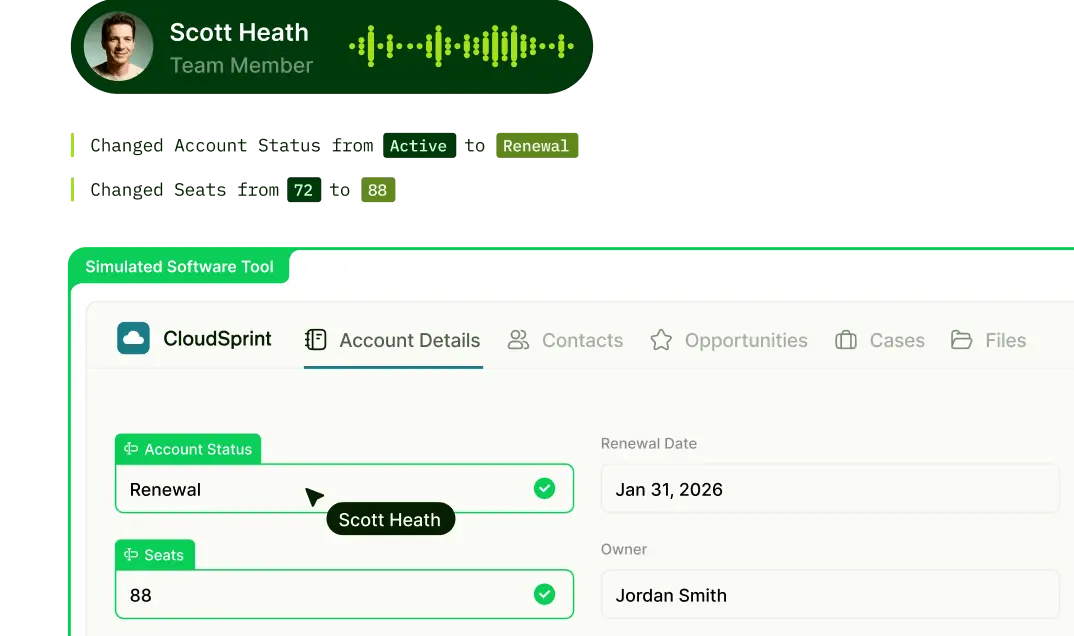
ReflexAI is the Conversation Performance Platform that offers Assure for QA and Prepare for practice. Assure's QA insights show a team what to coach and practice next in Prepare, and both products share a scoring framework.
2. Consistency and accuracy of AI scoring
Agents accept coaching only when they believe the score is fair and accurate, so test every accuracy figure a vendor quotes. Ask the vendor to score a sample of recent calls that your analysts have already scored and agreed on, using your own scorecard.
Compare the scores item by item and review each disagreement, giving extra weight to compliance items, where one miss can create regulatory or customer risk. Later, rescore some of the calls to confirm the model returns the same results.
Ask each vendor these questions:
- What calls and scorecards was the accuracy figure measured on?
- Can the vendor show which part of the transcript produced each score?
3. Integration with CCaaS, CRM, and workforce tools
At a minimum, QA software needs to connect to your contact center as a service (CCaaS) platform, the cloud system that routes and records calls and chats. That connection imports recordings and transcripts for scoring without manual exports.
A CRM integration attaches each evaluation to the customer record and ticket, so a team can compare a QA score with the post-call CSAT survey for the same interaction. A workforce management integration lets supervisors schedule coaching and practice during planned off-phone time.
Ask each vendor these questions:
- Which integrations are native, and which need custom API work?
- How soon is a completed call ready for scoring?
- Are video, voice, and text scored on the same scorecard?
- Can coaching assignments reach a learning management system?
4. Customizable scorecards for specific verticals and compliance needs
Compliance-heavy calls need different scorecards from sales calls. In industries like collections, healthcare, and insurance, a missed disclosure or skipped identity check should fail the evaluation automatically. A point deduction would let a serious miss disappear inside an otherwise good score.
On sales calls, the scorecard should give the most points to the moments that decide the sale. A scorecard built around tone and courtesy can give high scores to calls that lost the sale. Teams sometimes copy one industry's scorecard onto another call type. Ask each vendor these questions, using two of your own call types.
- Can the vendor build a separate scorecard for each call type?
- Can each scorecard include auto-fail items, such as a missed disclosure?
ReflexAI's simulation technology started in crisis intervention work, where conversational precision can affect someone's safety. Assure builds on that focus on high-stakes accuracy and adapts to whichever vertical a contact center serves.
5. Analytics and reporting that show whether QA leads to action
QA reporting should connect scores to what happened next, such as whether verification misses declined after coaching. Look for reports that cover the following.
- Trends by skill, team, and site over time
- Compliance adherence rates on items with regulatory or customer risk
- Coaching assignments completed
- QA scores next to CSAT for the same interactions
- Calibration results for reviewers and the AI model
Ask each vendor these questions:
- Do scores on a coached skill improve after coaching?
- How closely do reviewers and the AI model agree?
- Can the vendor build these reports on a sample of your own data?
4 best call center quality assurance software compared
Most contact centers run QA software alongside a CCaaS platform, a CRM, and workforce management tools. Your QA tool needs to fit that stack as well as your scoring needs. The table below compares four QA tools, with G2 ratings as of September 2026.
Tool | Best for | How QA connects to coaching | Strengths | Limitations |
ReflexAI Assure | Teams that want QA insights to inform coaching | QA findings feed practice simulations in Prepare; a shared scoring framework compares practice and live-call results | Compliance monitoring, voice and text analysis, scorecards that adapt to the team's vertical | Fit for pure sales teams less obvious at first glance |
MaestroQA (Rippit) | Support teams that need calibrated QA reviews | Calibration sessions and QA reports; coaching is one of several use cases on a broader conversation data platform | Conversation evaluations, reviewer calibration, automated scoring | Learning curve for custom reports; QA is now one of several use cases |
ScorebuddyCX | Teams that want QA scoring, analytics, and BI reporting together | Coaching plans and courses assigned from performance data through a built-in learning management system | AI auto-scoring, conversation analytics, BI reporting | G2 reviewers ask for more flexible reporting and dashboards |
Playvox by NiCE | Teams that want coaching packaged with QA | Coaching sessions tied to quality scores in the same suite | Customizable scorecards, evaluator calibration, automated quality assessments | Limited reporting and customization; slow load times on evaluations and coaching logs |
ReflexAI Assure: Best for teams that want QA insights to inform coaching
Assure connects QA findings to coaching. ReflexAI's Prepare lets agents practice the skills that QA flags in simulated conversations. The two products work together through a shared scoring framework, so a team can compare practice and live-call results.
ReflexAI is rated 4.8 out of 5 on G2 from 29 reviews, with 89% five-star reviews. Its review count is smaller than those of the longer-established tools in this comparison.
Its core features include:
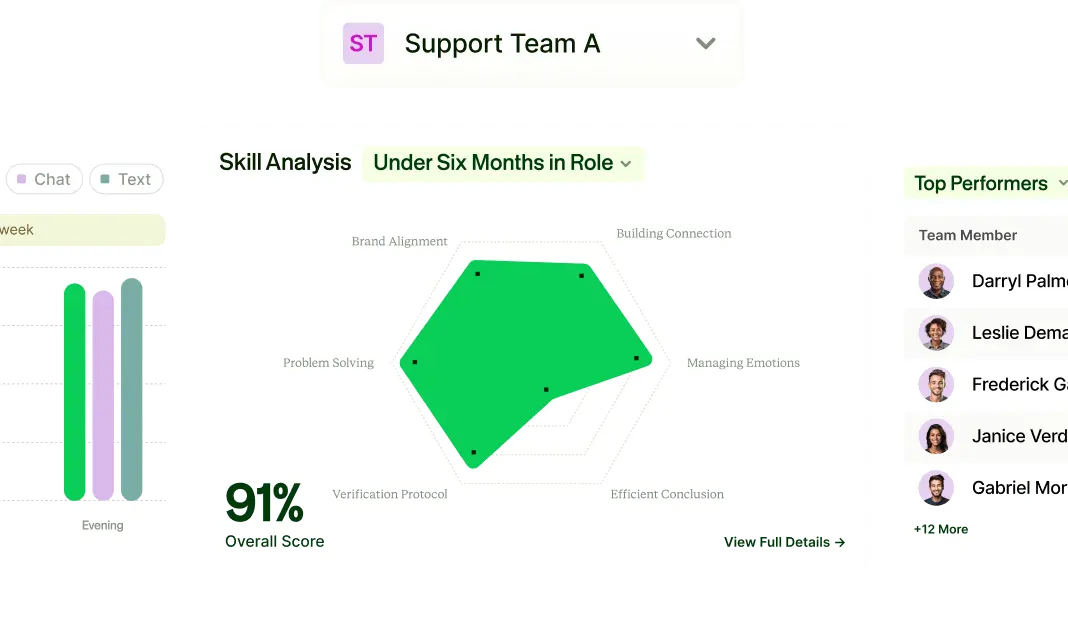
- Automated, consistent scoring, with scorecards and dashboards that show trends across agents and teams
- Compliance monitoring that flags adherence issues against protocol, policy, or regulatory requirements
- Analysis of voice and text interactions
- A scoring framework shared with Prepare, so performance in practice simulations and live calls can be compared directly
When Assure shows a pattern, a team can assign practice in Prepare and compare later live-call scores on that skill. In a ReflexAI study of 174 call center agents, those with high simulation use improved protocol compliance scores by 18% and showed stronger rapport in 16% more conversations.
Assure adapts its scorecard to your industry, so a healthcare contact center and a financial services contact center are scored on different criteria. ReflexAI's origins in behavioral health and crisis intervention make its fit for pure sales teams less obvious at first glance. Ask ReflexAI for pricing based on your conversation volume and channels.
MaestroQA (Rippit): Best for teams that need calibrated QA reviews
MaestroQA, now called Rippit, began as a quality assurance platform built around conversation evaluation and reviewer calibration. It has since expanded into conversation analytics, with QA as one of several use cases. It is rated 4.8 out of 5 on G2 from 325 reviews.
Its core features include:
- Conversation evaluations
- Calibration sessions that align reviewer scoring
- QA reports
- Automated conversation scoring
MaestroQA's calibration tools help teams keep reviewers scoring conversations the same way, and its rating is among the highest in this group. Rippit's site now describes an AI conversation data platform, with use cases that include churn risk detection and employee coaching. G2 reviewers most often mention a learning curve, especially for custom reports, and extra setup steps for some integrations. Request pricing from Rippit.
ScorebuddyCX: Best for teams that want QA scoring, analytics, and BI reporting together
ScorebuddyCX describes itself as a customer experience platform that combines QA with analytics and agent development. On G2, it's rated 4.5 out of 5 from 835 reviews.
Its core features include:
- AI auto-scoring against custom scorecards
- Conversation analytics
- Business intelligence reporting
- Agent development tools
The platform assigns coaching plans and courses based on agents' performance data. G2 reviewers most often ask for more flexible reporting and dashboards, and some cite navigation and integration gaps. Request pricing from ScorebuddyCX.
Playvox by NiCE: Best for teams that want coaching packaged with QA
Playvox Quality Management, now called Playvox by NiCE, is a quality management platform. It has the largest review base in this comparison, with a 4.8/5 rating on G2 from 1,163 reviews.
Its core features include:
- Customizable scorecards and agent evaluations
- Calibration sessions for QA evaluators
- Coaching sessions tied to quality scores
- Automated quality assessments
Playvox puts QA and coaching in the same suite. G2 reviewers mention limited reporting and customization, and slow load times when opening evaluations or coaching logs. Some also miss features such as KPI visibility and dispute raising. NiCE no longer has a dedicated Playvox product page, and the old address redirects to its back-office performance management page. Confirm with NiCE which Playvox features it still sells before requesting pricing.
See how Assure turns QA insights into coaching and practice
A QA platform pays off when it measurably improves agent behavior. Accurate scoring, integrations, vertical fit, and reporting all support that by connecting each scored call to coaching and practice, so agents are better prepared for similar calls in the future.
ReflexAI's Conversation Performance Platform offers Assure for QA and Prepare for practice simulations. Assure's QA insights show which skills to coach next and practice in Prepare, and both products share a scoring framework so a coach can compare practice sessions and live calls directly.
Take a tour of ReflexAI to see how a scored call becomes a practice assignment in Prepare, so you can judge the fit for your operation before you book time with the team.