











7 best 360Learning alternatives for contact centers in 2026
What does 100% course completion actually tell you about an agent?
According to 360Learning's own support documentation, not much. A learner can hit 100% even if they scored below the minimum threshold. Some unfinished SCORM courses get marked complete depending on how the status is sent. That's a fine trade-off for general employee training, where studies show completion rates correlate with knowledge retention at roughly 60-70% accuracy. For a contact center, it means you may not know an agent is underprepared until they're already on a live call.
This guide covers seven alternatives - ReflexAI, Observe.AI, Playvox, MaestroQA, Scorebuddy, CallMiner, and Cresta - and what each one actually addresses for contact center teams.
Why look for a 360Learning alternative for contact centers
360Learning is built for general corporate learning: collaborative course creation, peer-led content, and LMS fundamentals. Contact centers have a different set of demands. Agents handle unpredictable, high-pressure conversations that require practice, measurement, and real-time visibility, not course completion tracking.
The mismatch shows up in three places.
Course completion does not prove agent readiness
360Learning's own support documentation reveals a structural problem: a learner can show 100% course completion even if they score below a minimum threshold, and depending on how SCORM completion status is sent, some unfinished courses can be marked as completed.
That works fine for compliance tracking. It does not answer the question contact center leaders actually need answered: can this person handle an angry customer, find the right policy, and stay compliant under time pressure?
Industry guidance consistently points to role-play simulations and situational judgment exercises as the core methods for building real conversational skill:
- NICE: recommends simulation-based training for agent readiness
- ICMI: identifies role-play as a top-3 training method for contact centers
- Call Centre Helper: reports 78% of high-performing centers use situational exercises
Finishing a module is not the same as being ready for a live call.
Random QA misses escalation risk
Most contact center teams using a standard LMS have no visibility into what actually happens on calls. QA is done manually on a small sample, so risks, escalations, and coaching gaps go undetected across the vast majority of conversations:
- Typical QA sample size: 1-3% of interactions
- Unreviewed interactions: 97-99% of conversations
Generic roleplay does not mirror live tools
Agents in contact centers simultaneously navigate CRMs, ticketing systems, or EMRs while speaking or typing. Standard LMS roleplay simulates dialogue but not the software environment agents actually work in, which means practice conditions diverge sharply from live work.
What should contact centers look for in an alternative
Your QA rubric already exists. Your escalation patterns are already documented. The platform you choose should work around those realities, not ask you to rebuild them from scratch.
AI simulations for real conversations
AI simulation means a dynamic, AI-driven roleplay that adapts to what the agent says in real time, not a scripted branching exercise. The best tools support voice, not just text, and reflect the personas and emotional dynamics agents actually encounter.
Look for:
- Voice-first practice: agents rehearse spoken responses, not just written ones
- Adaptive personas: the AI responds differently based on tone, hesitation, and word choice
- Scenario customization: teams can build or upload scenarios from their own scripts and protocols in minutes
Custom QA scorecards and calibration
The platform should mirror your existing QA rubric, not impose a generic one. Custom scoring dimensions let teams evaluate agents on the exact criteria that matter to their operation, whether that is empathy, protocol adherence, or compliance language.
Calibration matters because inconsistent scoring across reviewers turns coaching into noise. If three supervisors score the same interaction three different ways, agents cannot act on the feedback.
Analytics across every interaction
Interaction analytics means automatically analyzing what happens across calls, chats, and messages, not just the ones a supervisor happens to review. The difference between random sampling and full-coverage analysis is the difference between guessing and knowing:
- Random sampling: a small fraction of interactions are reviewed; patterns and risks stay invisible
- Full-coverage analytics: every interaction is scored automatically, surfacing trends across agents, teams, and topics
Integrations with CRM and contact center tools
Without integration into Zendesk, Salesforce, HubSpot, or your telephony platform, data lives in silos and coaching cannot be tied to real performance.
Security for sensitive conversations
Any platform handling conversation data in healthcare, financial services, or crisis response should meet HIPAA, SOC 2, GDPR, and HITRUST standards. This is a qualifier, not a differentiator, but it eliminates vendors who cannot operate in regulated environments.
The best 360Learning alternatives for contact centers
These seven platforms were selected because they address the specific training, QA, and performance gaps that matter most to contact center teams. Each is evaluated through the lens of agent readiness and conversation quality, not general LMS functionality.
ReflexAI
ReflexAI is purpose-built for contact centers that need simulation-based training and automated QA in one platform. Two products work together: Prepare (AI training simulations) and Assure (automated QA), so training outcomes are directly tied to live performance data.
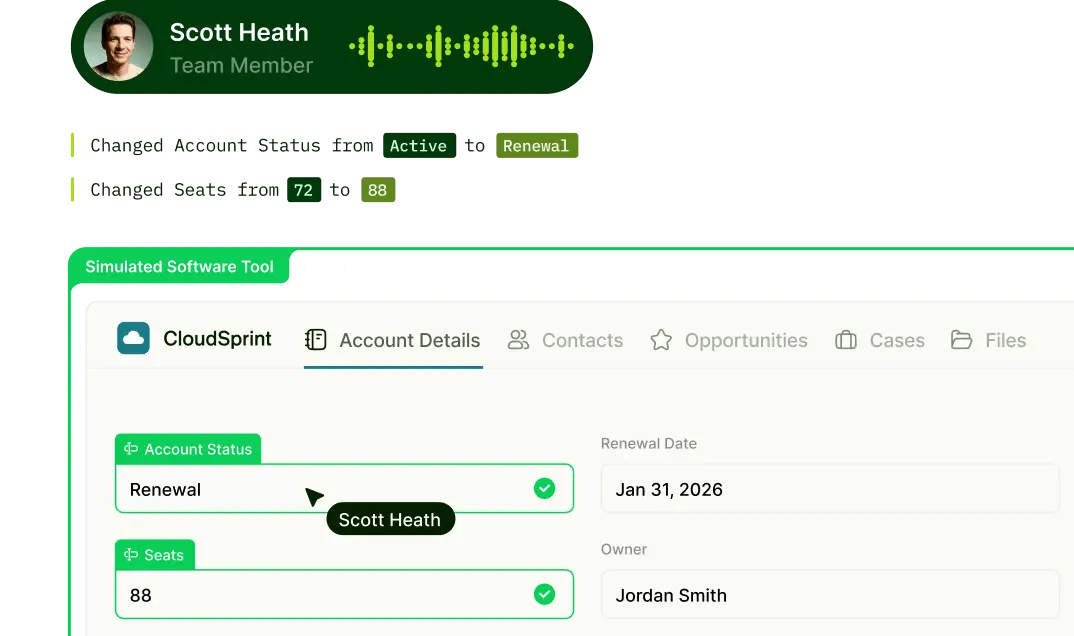
Prepare gives agents realistic voice and chat simulations before their first live call. Configurable personas, custom scoring dimensions, and software overlays replicate CRM or EMR environments so agents practice conversations while navigating the actual tools they will use in production.
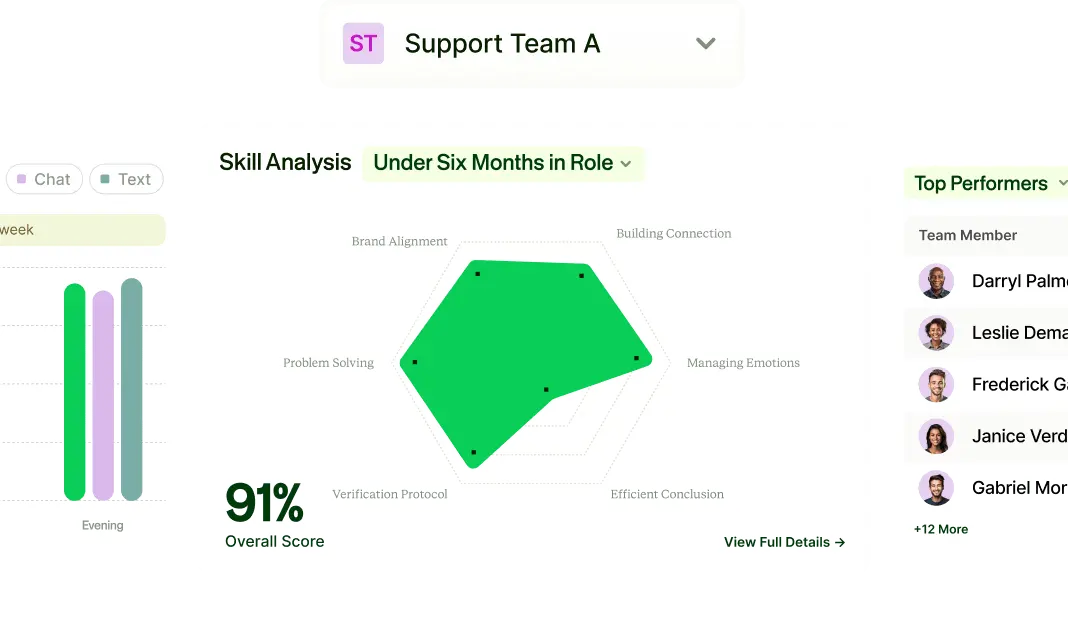
Assure automatically scores 100% of interactions across calls, chats, and emails using the organization's own QA rubric. Flagged interactions convert directly into personalized simulations, closing the loop between what went wrong on a live call and what an agent practices next.
- Best for: contact centers that want to connect agent training directly to live QA outcomes
- Key features: voice-first AI simulations, software environment overlays, custom scoring dimensions, 100% automated QA, cohort tracking, personalized coaching simulations
- Compliance: SOC 2, HIPAA, HITRUST, GDPR, ISO 27001
- Limitations: purpose-built for high-stakes conversation industries; not a general-purpose LMS for content-heavy course libraries
- Pricing: available on request
Observe.AI
Observe.AI is a conversation intelligence platform focused on real-time agent guidance and post-call QA scoring. The platform analyzes 100% of interactions and provides automated QA alongside real-time coaching prompts during live calls.
- Best for: large contact centers prioritizing real-time agent assist and automated scoring
- Key features: real-time coaching prompts, automated QA, sentiment analysis, agent performance dashboards
- Limitations: training simulation capabilities are limited; primarily a QA and intelligence tool rather than a pre-hire readiness platform
- Pricing: available on request
Playvox
Playvox is a workforce engagement and QA platform combining quality management, coaching, and scheduling. AutoQA coverage is explicitly positioned for text-based interactions, so teams with high voice volume should verify omnichannel coverage before committing.
- Best for: contact centers that need QA, coaching, and workforce management in one place
- Key features: customizable QA scorecards, coaching workflows, performance dashboards, Zendesk and Salesforce integrations, AutoQA for text interactions
- Limitations: no training simulation capability; AutoQA is text-focused
- Pricing: available on request
MaestroQA
MaestroQA is a QA and coaching platform built for support and service teams, with a strong focus on rubric-based scoring and calibration. The feature set is strongly oriented toward post-interaction QA program operations.
- Best for: teams that want structured, calibrated QA workflows with detailed coaching
- Key features: scorecard builder, calibration sessions, root cause analysis, Auto QA, transcription, CRM integrations
- Limitations: no AI simulation or pre-hire training capability
- Pricing: available on request
Scorebuddy
Scorebuddy is a contact center QA platform that automates scoring and reporting across voice, chat, and email. The platform provides audit trails for regulated environments, with key performance claims including:
- Auto-scoring accuracy: 90%+
- Best for: contact centers moving away from spreadsheet-based QA toward automated, multi-channel scoring
- Key features: automated scoring across voice, chat, and email; analytics dashboards; agent feedback workflows; audit trail
- Limitations: no simulation or training module; primarily a QA measurement tool
- Pricing: available on request
CallMiner
CallMiner is a conversation analytics platform that captures and analyzes 100% of omnichannel interactions, surfacing insights about agent behavior, compliance risk, and customer sentiment. A RealTime product category handles in-call conversation intelligence.
- Best for: contact centers that need deep speech analytics and compliance monitoring at scale
- Key features: automated transcription and scoring, topic detection, sentiment analysis, compliance flagging, real-time conversation intelligence
- Limitations: analytics-heavy; not designed for agent training or simulation; implementation can be complex
- Pricing: available on request
Cresta
Cresta is an AI-powered real-time coaching platform that delivers in-call guidance based on conversation patterns. The platform auto-scores 100% of conversations for compliance and performance using generative AI.
- Best for: contact centers that want AI-driven real-time coaching during live calls
- Key features: real-time agent prompts, automated performance scoring, knowledge surfacing during calls, coaching dashboards
- Limitations: focused on live call assistance rather than pre-hire simulation; less suited for readiness-before-first-call use cases
- Pricing: available on request
How do the top 360Learning alternatives compare
No single tool covers every need. The right choice depends on whether the priority is readiness before the first call, QA coverage after it, or both.
Platform | AI simulations | Automated QA | Custom scoring | Full-interaction coverage | Contact center integrations | Compliance certifications |
ReflexAI | Yes | Yes | Yes | Yes | Yes | SOC 2, HIPAA, HITRUST, GDPR, ISO 27001 |
Observe.AI | Limited | Yes | Yes | Yes | Yes | Verify with vendor |
Playvox | No | Yes (text-focused) | Yes | No | Yes | Verify with vendor |
MaestroQA | No | Yes | Yes | No | Yes | Verify with vendor |
Scorebuddy | No | Yes | Yes | No | Yes | Verify with vendor |
CallMiner | No | Yes | Limited | Yes | Yes | Verify with vendor |
Cresta | Limited | Limited | No | No | Yes | Verify with vendor |
Compliance details should be verified directly with each vendor for your specific use case and region.
How should contact centers choose the right platform
A comparison table tells you what each platform does. Choosing the right one comes down to three operational questions.
Match the platform to your highest risk conversations
Start with the use case: what types of conversations are you trying to improve? The answer shapes the tool category. If the priority is pre-hire readiness, the need is simulation. If the priority is ongoing performance monitoring, the need is QA coverage. If it is both, look for a platform that connects training to live outcomes.
Let's say your agents handle crisis escalations or sensitive healthcare conversations. A platform that only scores completed courses misses the point entirely. The risk is not whether agents finished a module; the risk is whether they can de-escalate a caller in distress while following protocol.
Test real scenarios with your QA rubric
Bring your own QA rubric and your own scenario into a proof of concept. Ask vendors to score a real interaction against your rubric, not a demo script. Platforms that require significant configuration to match your existing criteria add friction and delay time-to-value.
Measure onboarding time and QA coverage
Two metrics matter most: how quickly agents reach readiness (onboarding time to first unassisted call) and what percentage of interactions are being reviewed for quality. If a vendor cannot help you measure these before and after implementation, they cannot help you improve them.
What is the best 360Learning alternative for contact centers
For most contact centers, the gap 360Learning leaves is not about course libraries or collaborative authoring. The gap is agent readiness and conversation quality visibility. The decision logic breaks down into three scenarios:
- If QA automation is the priority: Playvox, MaestroQA, Scorebuddy, or CallMiner address post-interaction scoring and coaching workflows
- If real-time in-call guidance is the priority: Observe.AI and Cresta are built for live agent assist
- If readiness before the first call and QA after it need to be connected: ReflexAI is the purpose-built option. Prepare builds agent readiness through simulation, and Assure closes the loop with automated QA on every interaction
Let's say your team handles 10,000 calls monthly and only reviews 200. Are you trying to reduce escalations, cut onboarding time, or finally see what is happening across every interaction?
How ReflexAI helps contact centers prepare agents
ReflexAI is the only platform on this list that brings simulation-based training and automated QA together in one purpose-built system for high-stakes conversations. Prepare gives agents realistic practice before their first live call. Assure monitors every interaction after it. The platform serves contact centers, healthcare, crisis lines, and financial services teams that cannot afford to find out an agent was not ready after the call has already happened.