










Contact center AI applies natural language processing, generative AI, and machine learning to customer conversations. It can route a call to the right agent and help that agent during the conversation. After the call, it can summarize what happened and score how it went. In this guide, we cover 18 contact center AI use cases, along with the industries adopting them. The right use cases for your team depend on your industry and risk profile.
Key Takeaways
- Contact center AI covers the full interaction lifecycle. It includes forecasting and routing before a call, agent assistance during the call, and summarization and QA scoring afterward.
- AI assistance makes agents more productive. In an NBER study of more than 5,000 customer support agents, agents with a generative AI assistant resolved 14% more issues per hour on average. Novice and low-skilled agents resolved 34% more.
- Each industry starts with different AI use cases. Healthcare contact centers typically start with compliance monitoring and protocol practice, while travel contact centers start with around-the-clock self-service.
- AI maturity and profitability are connected. In Deloitte Digital's 2026 survey, the contact centers furthest along with AI were 85% more profitable than those furthest behind.
- Training and QA work best together. A scored live call shows which behavior an agent should practice next.
What is contact center AI?
Contact center AI is a set of software capabilities that interpret and support the conversations between a contact center's agents and its customers. It evaluates those conversations to show where agents need to improve. Teams use it to monitor live calls and chats, and a growing number also use it to train agents on simulated conversations.
Contact centers are already funding AI. In a 2025 Gartner survey of 265 customer service and support leaders, 77% said they feel executive pressure to deploy AI and 75% reported larger AI budgets than the year before.
These capabilities rely on three technologies.
Natural language processing
Speech recognition turns a call into text, and natural language processing reads that text to work out what the caller wants. Natural language processing also checks each transcript for required language, such as a disclosure the agent must read.
Generative AI
Generative AI can draft a call summary for the agent to review once the call ends. In training, it can play a convincing caller who reacts to what a new agent says.
Machine learning
Machine learning finds patterns across thousands of interactions, like which call types take longest or which behaviors show up on calls that end in a complaint.
Industries adopting contact center AI
Any organization that handles customer conversations at volume can benefit from contact center AI. The table below shows where adoption tends to begin in each industry. You won't need every use case in the table. The right platform adapts to your industry and to the standards your team already uses.
Industry | What prompts adoption | Use cases that usually come first |
CSAT, handle time, and agent retention | Agent assist, call summarization, QA insights, coaching | |
Disclosure requirements and fraud risk | Compliance monitoring, fraud detection, agent assist | |
Claims handling, fraud, and regulated communications | Claims-call support, fraud detection, compliance monitoring | |
Round-the-clock demand across time zones | Virtual agents, self-service, personalization | |
Protocol accuracy, identity verification, and HIPAA | Compliance monitoring, protocol practice, identity verification training | |
Routine student inquiries at scale | Virtual assistants, self-service, routing |
Agent-facing contact center AI use cases
Gartner lists agent enablement as a top area of value for AI in service and support. These use cases help agents handle live calls and prepare for them.
- Agent assist and next-best-action. AI listens to the live conversation and suggests an answer or next step for the agent. In an NBER study of 5,179 customer support agents, those with a generative AI assistant resolved 14% more issues per hour on average. Novice and low-skilled agents resolved 34% more.
- Real-time transcription. Speech-to-text turns the call into text as it happens. Live assist and compliance alerts both depend on that text. Agents can also check what the caller said without asking them to repeat it.
- Call summarization and after-call work. When the call ends, generative AI drafts the case notes and follow-up tasks. The agent reviews the draft before moving to the next contact. Gartner counts after-call automation among the use cases that reduce cost and risk.
- AI training simulation. AI personas simulate live callers and react to what a new agent says and how they say it. A new hire can rehearse a de-escalation or a patient identity check before facing a live call. ReflexAI's Prepare scores each voice or text roleplay on skills such as empathy and protocol adherence.
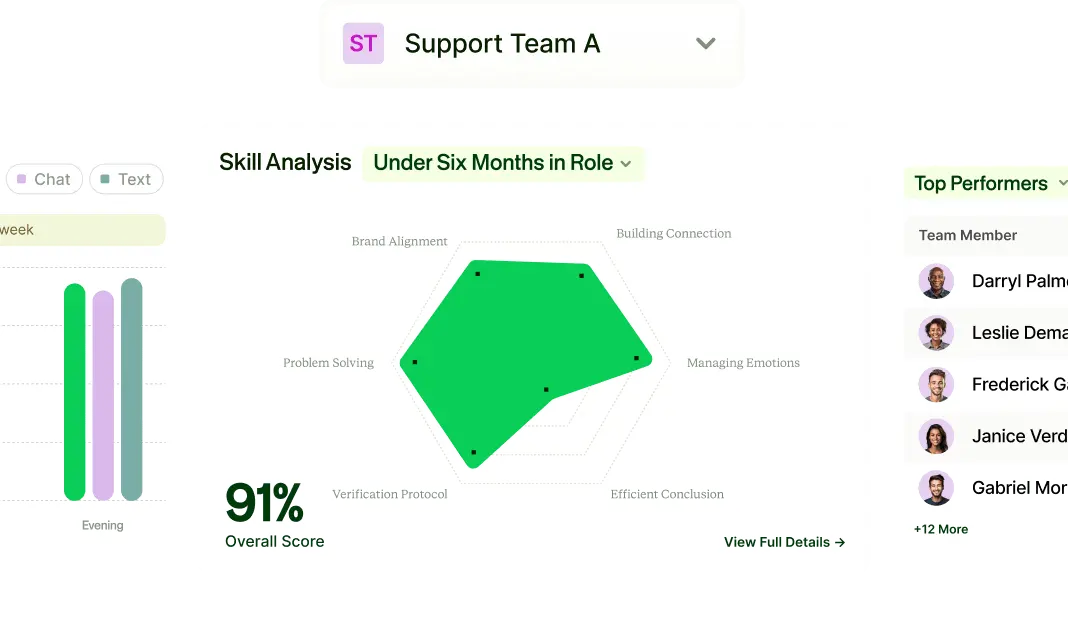
- Skill- and scenario-specific coaching. AI pinpoints the behaviors an agent needs to work on, such as skipping a verification step or talking over an upset caller. A supervisor can then focus one-on-one coaching on those behaviors.
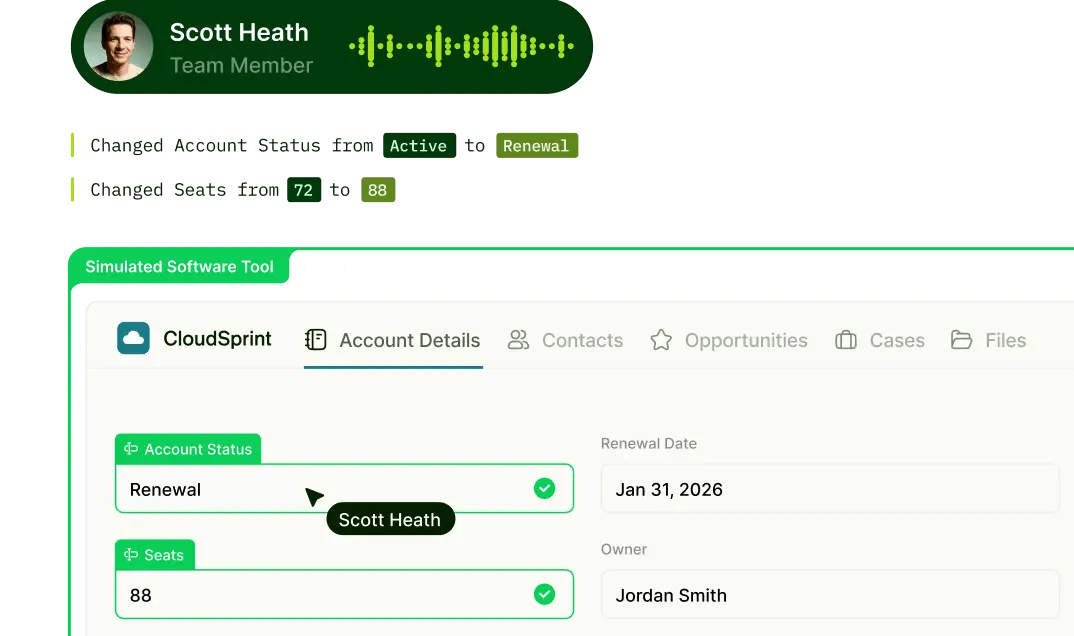
- Software and CRM simulation practice. Some training programs simulate the agent's desktop along with the caller. New hires practice finding an account and documenting a case in the CRM while they talk to the simulated caller.
Customer-facing contact center AI use cases
Customer-facing AI talks with customers directly, usually before a human agent joins the conversation. Gartner projects that by 2028, at least 70% of customers will start their customer service journey with a conversational AI interface. These use cases cover what AI handles on its own and how it hands customers off to agents.
- Virtual agents and conversational IVR. Customers explain the problem in their own words to a virtual agent, an AI system that responds by voice or chat. On phone lines, conversational interactive voice response (IVR) lets callers say what they need instead of pressing numbers in a menu. It answers routine questions and collects details before handing off to a person.
- Intent routing. Natural language processing works out why the customer is calling from the first few sentences. AI then routes the contact to the queue or agent with the right skills.
- Self-service resolution. AI search and generative answers let customers handle password resets, order status checks, and policy questions on their own at any hour. Teams whose customers span time zones benefit most.
- Sentiment-aware escalation. AI reads tone and word choice in real time. When a customer is getting frustrated, it transfers the conversation to a human or alerts a supervisor before the conversation breaks down.
- Personalization from customer history. AI pulls the customer's prior contacts and open cases from the CRM, so the virtual agent or human agent can pick up where the last interaction ended.
- Real-time translation. AI translates the conversation as it happens, so an agent can help a customer in a language the agent does not speak.
QA, compliance, and workforce AI use cases
QA, compliance, and workforce tools analyze patterns across many conversations. They show leaders where the risk is and which agents need coaching on which skills. Manual QA teams usually score only a small sample of calls, so most compliance and performance problems come to light only after they escalate. Here's how AI helps with the QA process.
- Automated QA scoring and QA insights. AI scores conversations against the team's own scorecard and turns the scores into findings a manager can act on. Assure, ReflexAI's quality assurance product, evaluates every recorded interaction and produces QA insights that tell managers which behaviors to coach and which scenarios agents should rehearse in Prepare. For teams comparing tools, ReflexAI has a guide to choosing the right contact center QA platform.
- Compliance and protocol monitoring. AI checks each conversation for required disclosures, identity verification steps, and protocol language. It flags missing information against internal policy or regulatory requirements. Agents can then rehearse the protocol steps that were flagged as missed. In a ReflexAI healthcare customer example covering 174 agents, those with high simulation usage in Prepare showed an 18% improvement in protocol compliance scores. They also met the organization's highest standards in 17% more conversations.
- Fraud and PII detection. AI flags signs of account takeover or social engineering. It also detects when a caller reads out a card number or health information, so that data can be redacted from recordings and transcripts.
- Sentiment and trend analytics. When sentiment and topic data are aggregated across teams, they show which call types frustrate customers, which products generate the most contacts, and which teams are improving or slipping over a quarter.
- Forecasting and workforce management. Machine learning predicts contact volume for each interval from history, seasonality, and planned events. It then builds schedules that meet service level targets without overstaffing.
- Root-cause and coaching-priority analysis. AI links outcomes such as repeat calls or complaints to the behaviors and processes behind them. It then ranks which issues to coach first, so supervisors start each week with a specific coaching list.
Benefits of contact center AI for cost, CSAT, and retention
The strongest evidence that contact center AI pays off comes from comparing mature adopters with everyone else. A 2026 survey from Deloitte found that the contact centers furthest along with AI were 85% more profitable than those furthest behind and 69% more likely to rate customer experience good or excellent. Mature adopters were also 60% more likely to rate employee experience good or excellent. Here's how AI helps across customer experience and the agent workforce:
- Efficiency and cost. Drafted summaries and live assist reduce after-call work and the time agents spend searching for answers. Self-service resolves routine requests on its own, so fewer calls wait in the queue.
- CSAT. Deloitte Digital's survey found that the contact centers furthest along with AI were 23% more likely to deliver personalized experiences. In the NBER study, customer sentiment improved when agents had AI assistance.
- Faster ramp time. Newer agents gained the most in the NBER study. Simulation lets new hires practice difficult calls before they talk to a live customer.
- Consistency. Standardized scoring means every agent is evaluated against the same criteria.
- Agent retention. The NBER researchers found that agent retention improved alongside productivity.
Having AI tools doesn't mean a team is using them well. In a 2026 GLG research panel of 109 contact center leaders commissioned by ReflexAI, 85% reported deploying at least one AI tool for training or QA, and only 29% said they're effectively using AI in their operations. In Deloitte Digital's survey, leaders of contact centers that are falling behind on AI named their top challenges as integrating technology, systems, and tools (72%), legacy systems (58%), and data security and compliance (53%).
The right mix of humans and AI gives routine, predictable work to AI and keeps people on conversations that call for judgment, empathy, or accountability.
Connect contact center practice and QA with ReflexAI
In many contact centers, training and QA are separate programs. A reviewer can flag the same mistake month after month, because the finding never reaches the trainers who decide what agents practice. When the two programs are connected, the QA score on a live call tells trainers which behavior an agent needs to practice.
ReflexAI's Conversation Performance Platform helps contact center teams practice, measure, and improve the conversations that matter most. It adapts to any industry by using the team's own scenarios and scorecards. Prepare and Assure work together to make this happen.
Prepare lets agents practice high-pressure conversations
With ReflexAI Prepare, trainers and managers configure AI personas that react to what agents say and set custom scoring dimensions that reflect their own standards. They can also manage scenarios across onboarding and ongoing training. At Verstela, a staffing services firm, managers build their own scenarios in ReflexAI Studio. Simulations have replaced over 1,000 hours of manager time the company once spent developing, overseeing, and evaluating trainee roleplays.
Assure turns live calls into QA insights
ReflexAI Assure scores live conversations and turns the results into QA insights that show a team what to coach and practice next. Its scorecards and dashboards show compliance and performance trends across agents and teams.
Today, Prepare and Assure share a common scoring framework, so managers can compare an agent's simulation scores with their live-call scores. The comparison shows whether the agent uses practiced skills on real calls or needs more training. ReflexAI is working toward a closer connection between the two products, where results from live calls directly inform which scenarios agents practice next. Read more about how QA and simulation training work together.
ReflexAI has a 4.8 out of 5 rating on G2 from 29 reviews as of September 2026, and 89% of those reviews are five-star. To see how QA insights from your own calls can shape your agents' training, schedule a demo.
Frequently asked questions about contact center AI use cases
What is contact center AI?
Contact center AI uses natural language processing, generative AI, and machine learning in contact center operations. During calls, it routes contacts and assists agents in real time. After calls, it summarizes conversations and scores them for quality and compliance. It also forecasts staffing needs and gives agents simulated callers to practice with.
What are some examples of AI use cases in call centers?
Contact center AI use cases fall into three groups:
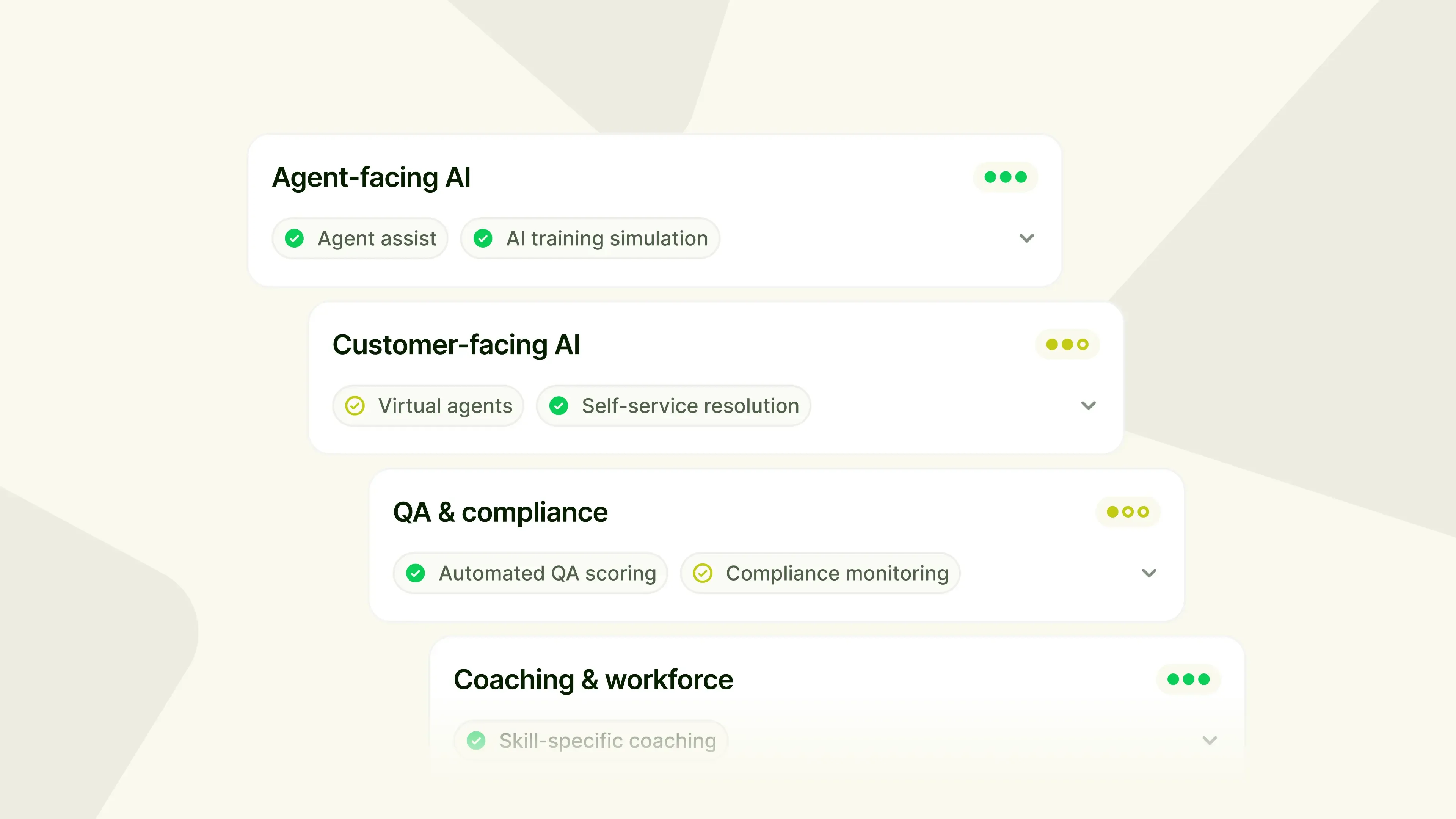
- Agent-facing tools help the person on the call through agent assist, real-time transcription, call summarization, and training simulation.
- Customer-facing tools handle self-service and routing, including virtual agents, intent routing, and sentiment-aware escalation.
- QA, compliance, and workforce tools analyze conversations across the operation, including automated QA scoring, compliance monitoring, fraud detection, and workforce forecasting.
How do you start using AI in a contact center?
Start with one measurable problem, such as slow new-hire ramp or compliance misses, and choose the use case that addresses it. Record a baseline for the metric, pilot with one team, and compare results before expanding. Plan integration early, since leaders of contact centers that are falling behind on AI name integration as their top challenge. Connect QA to training from the start, so trainers can build practice around the problems reviewers find.
What is the right mix of humans and AI in a contact center?
Each contact center determines the right mix based on its goals and industry, so set clear goals for what AI should handle and review the results regularly. AI works best on high-volume, predictable requests such as order status checks and password resets. Conversations involving safety, health, money, or an upset customer belong with people.
How does AI improve agent training or onboarding?
AI lets new agents practice realistic calls with simulated customers before they talk to real ones, and it gives them scored feedback right after each attempt. New agents build skills on difficult calls, such as de-escalations and identity checks, before they face an agitated customer. On live calls, agent assist gives new hires extra support. QA insights then show trainers which skills each agent should work on.