


Most people in a mental health crisis don't need an emergency department. They need the right response at the right moment. Often that response begins with a phone call, a text, or a knock on the door from a mobile crisis team.
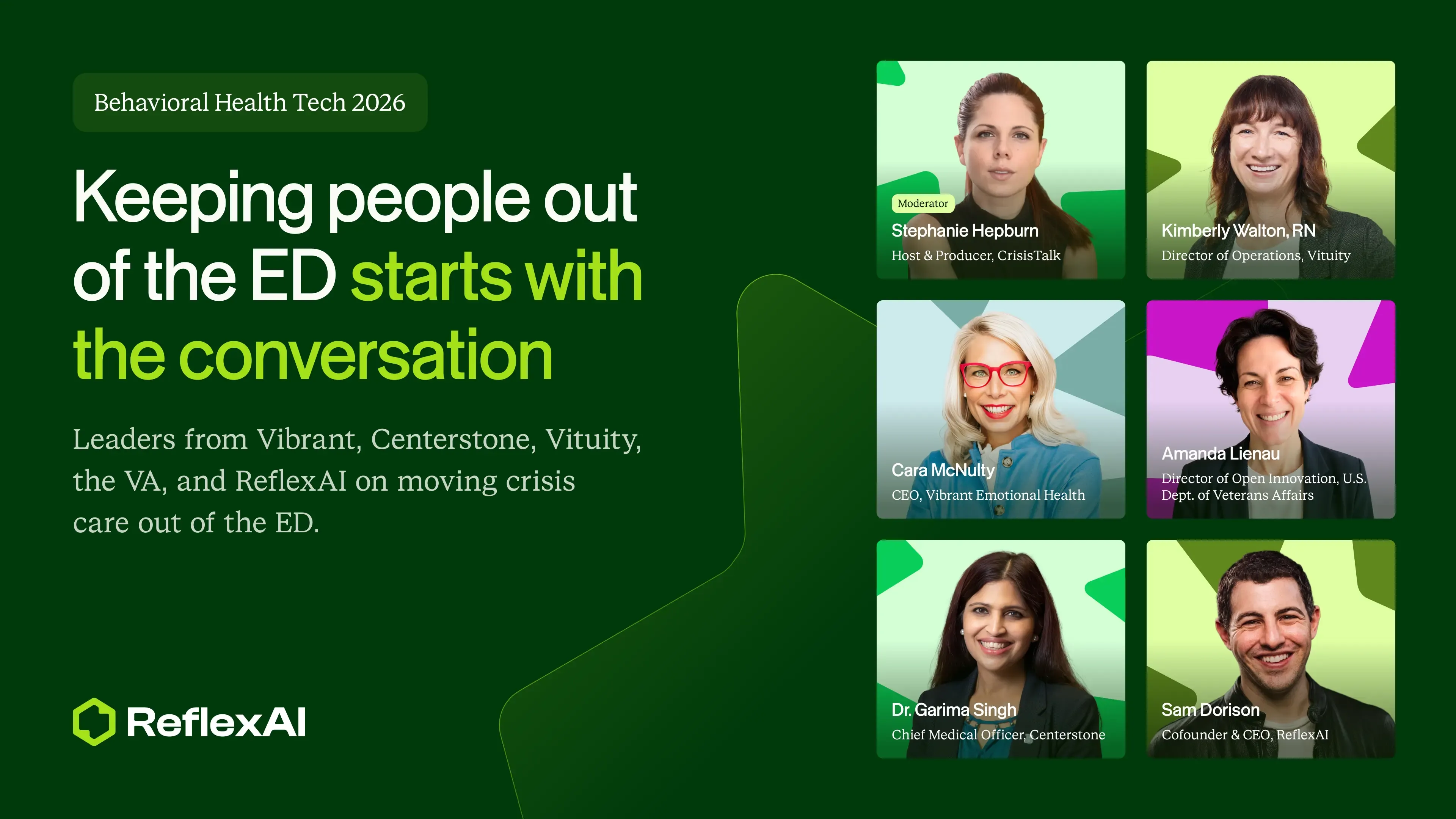
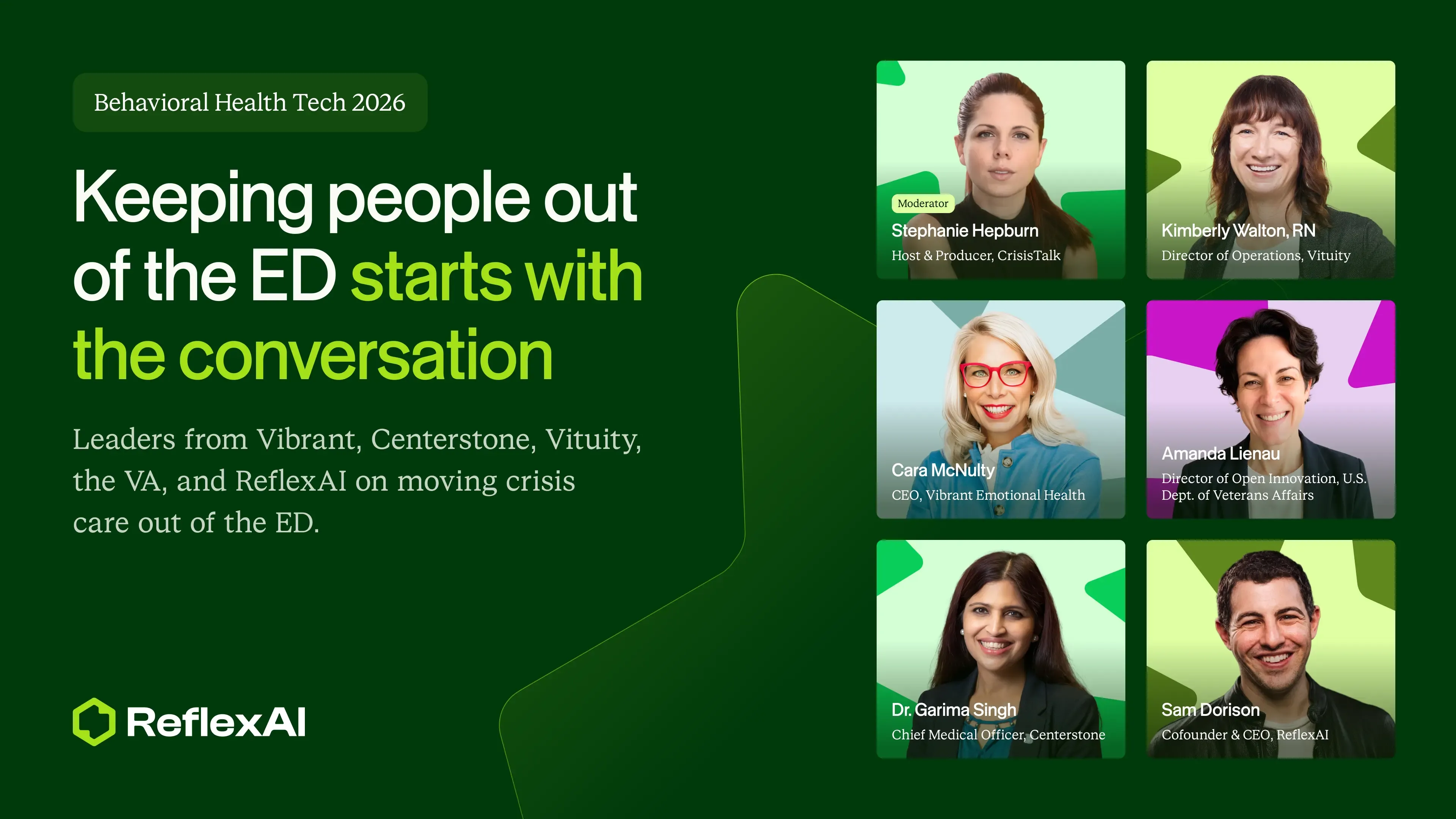
At Behavioral Health Tech 2026 in Nashville, five leaders from across the crisis continuum discussed how communities are moving that care out of the ED and into settings built for it. Stephanie Hepburn, Host and Producer of CrisisTalk, moderated. Panelists:
- Kimberly Walton, RN, Senior Nurse Consultant at EmPATH Consulting and Director of Operations, Vituity
- Cara McNulty, CEO, Vibrant Emotional Health
- Amanda Lienau, Director of Open Innovation, U.S. Department of Veterans Affairs
- Dr. Garima Singh, Chief Medical Officer, Centerstone
- Sam Dorison, Cofounder and CEO, ReflexAI
The full 50-minute session is below. If you're short on time, here are the moments we keep coming back to.
1. Most crisis care doesn't belong in the ED
Kimberly Walton, RN, opened with a candid look at how behavioral health patients are usually handled in the ED.
"I was an emergency department nurse for over 10 years, so really had the opportunity to see what happens with behavioral health patients when they come into the ED. And to start with, I did not have a lot of education, nor do my colleagues, when you work in an emergency department, on how to manage the patients. It's very cookie cutter, historically. They check in, we give them the same ESI level, we take them to the back of the room, we take their belongings, have security come and sit with them."
The result is long holds, escalation, and patients who wait days to see a psychiatrist. The alternatives the panel described are already producing results:
- Crisis centers: Centerstone's three Missouri crisis centers served close to 18,000 people in 2025. 92% of them never needed the ED. "I tell my non-psychiatrist friends, we are psychiatry urgent care," said Dr. Garima Singh.
- Mobile crisis: "When we deploy those mobile crisis units, 62% of the time, that situation is resolved without the individual going to the emergency room," said Cara McNulty.
- EmPATH units: For patients who do arrive at the hospital, Vituity's EmPATH units cut the time to see a psychiatrist to about 60 minutes, compared with "sometimes days in the emergency department." About 75% to 80% go home with community resources.
- Law enforcement time: An officer who brings someone to an ED typically stays about 110 minutes. At Centerstone's crisis centers, the handoff takes 16.9 minutes.
2. ED diversion starts with a 988 call, text, or chat
Keeping someone out of the ED rarely comes down to a single policy or facility. It happens one call, text, or chat at a time.
Cara McNulty noted that about 80% of people who reach out to 988 and Vibrant's other lifelines aren't in imminent danger. They need support in the moment, a referral, or someone to help them navigate a system that, in her words, "puts the onus on the help seeker."
Kimberly Walton, who also volunteers as a 988 crisis counselor, sees the same thing in her texts:
"These are people who would've historically walked into the emergency department."
She explained that the same message sent to a parent or friend might have become a 911 call, then an ED visit, then a hospital admission nobody needed. A skilled conversation sends it somewhere else.
Sam Dorison pointed to a growing share of 988 contacts: people calling about someone else.
"You might not call 911 when you're like, 'My brother's been acting weird and hasn't texted me back for two days.' That's probably not a 911 call, but it is a 988 call."
Sam also described a kind of diversion that never shows up in a report. "There is the truly invisible diversion," he said. "It's the person who calls 988, and as a result of that, gets connected to their own support network better, and it is true prevention."
3. Crisis counselor training is in the details
If diversion happens in the conversation, the people having those conversations need to be ready. When Stephanie Hepburn asked about workforce readiness, Sam Dorison had one message for the room.
"It is unbelievably important to sweat the details of this work."
He gave a concrete example from 988 counselor training. When responders are headed to someone's home, the counselor needs to ask whether there are pets that could run out the door, and whether there are firearms in the house so 911 knows what it's walking into. "That is a technically detailed conversation," he said. A chaplain talking with a veteran or a counselor taking a third-party 988 call faces entirely different details.
The skill shows up in subtler places too. Sam described how some people, often teenagers and neurodivergent people, share little unless asked directly. Counselors who support them have to be excellent at drawing information out, and training has to prepare them for it.
Then there's empathy, which Sam argued is easy to imitate and hard to do well.
"There's really generic empathy, but there's really tailored empathy. … 'That sounds really hard.' It's technically empathy, but no one's ever built strong trust on that."
Compare that with "It makes total sense that you feel lonely when your friends don't text you back." That response is specific to the person and their situation, and it's the kind of response that builds trust.
Kimberly Walton pointed out that this training rarely reaches hospital staff. "It's just not something that emergency department or a lot of the folks that go into the hospital ever get," she said. Dr. Singh made the same case for the next generation of crisis staff: "We need to have quality staff who is equipped, who is trained, who is educated."
4. Measure counselor skill beyond course completions
The last audience question asked how organizations can tell, at scale, whether staff are actually improving or just finishing courses. Sam's answer was direct.
"The way that you know someone can do a job well is you make sure they can do the job well."
In practice, that means realistic practice simulations plus quality review of every real interaction. "With all respect for continuing education hours," he said, they're "not going to quantify it correctly."
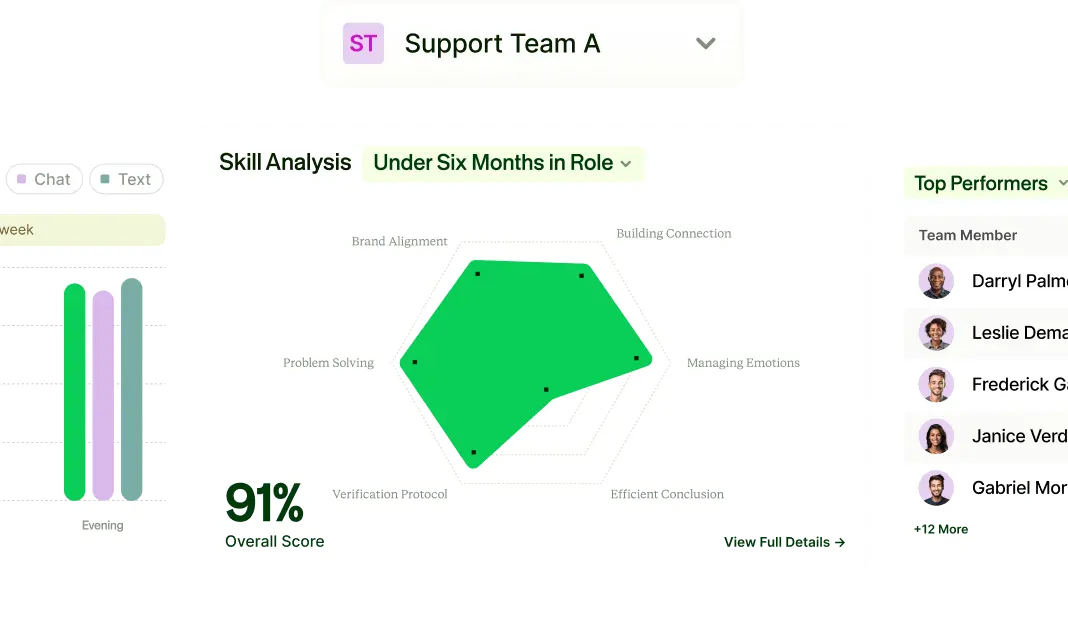
He shared results from a study ReflexAI ran with Volunteers of America Western Washington, a 988 center. Counselors who completed eight or more practice simulations handled more conversations at the highest standard than counselors with little simulation experience:
Skill | Increase in top-scored conversations |
Risk screening | + 18% |
Empathetic communication | + 16% |
Overall performance | + 17% |
Resources are limited, as several panelists pointed out, so teams need to know how much practice pays off. Sam closed the point this way:
"You need to know what payoffs for skill improvement get you the biggest bang for your buck in terms of team time, and that's a research question. It's not an ideological question."
Amanda Lienau described the same mindset at the VA. Mission Daybreak narrowed 1,300 ideas to 10 finalists, and a related program narrowed 360 concept papers to nine pilots. Each pilot has to show its adoption, impact, and path to scale. "There's lots of good ideas out there," she said, "but only some of them really have the stickiness that can be tested meaningfully."
5. Crisis response is everyone's business
No single program carries this work alone. Cara McNulty described sessions in New York City where 911 and 988 teams walked through each other's processes side by side.
"Everyone thought this is how one plus one equaled two, and it was one plus one equaled 837."
Her advice for any community building those partnerships: "It's about getting to know the people before you need to know them."
Amanda Lienau widened the circle further. Families, friends, and fellow service members all have a role to play.
"How do we help everybody to realize that suicide prevention is everyone's business? … How then can we engage everybody at the right level of care so that we're not relying on the most skillful for every situation?"
Dr. Singh made the same case for families. Centerstone's youth crisis center in Springfield, Missouri, teaches parents what to do the next time, including when to call a psychiatrist, when to come to a crisis center, and when the ED is the right call.
Cara closed with a reminder to keep people at the center of the system. "Say their names, make them human, not over-systematize," she said. She also asked everyone to spread the word that 988 is free by call, text, or chat, and that "you don't have to be in crisis" to reach out.
Watch the full conversation
This recap covers only a few highlights. The full session goes deeper into Centerstone's youth crisis model, how EmPATH units work day to day, the VA's approach to testing new ideas, and audience questions on long-term outcomes.
Thank you to Stephanie Hepburn for moderating, and to Cara McNulty, Dr. Garima Singh, Kimberly Walton, and Amanda Lienau for a candid, practical conversation.
ReflexAI helps 988 centers, crisis lines, and behavioral health organizations prepare their teams for the conversations that matter most, with realistic practice and quality review across every interaction. Talk to our team about how we can support yours.