










For over 30 years, RAINN has operated the National Sexual Assault Hotline, a 24/7 confidential service for survivors of sexual violence and their loved ones. Every year, hundreds of team members join RAINN's training program, arriving with high motivation and wildly different professional backgrounds. Some come from victim services or crisis intervention. Others come from corporate offices with no crisis experience at all.
However they arrive, they all have to meet the same readiness standard before they can take a real call.
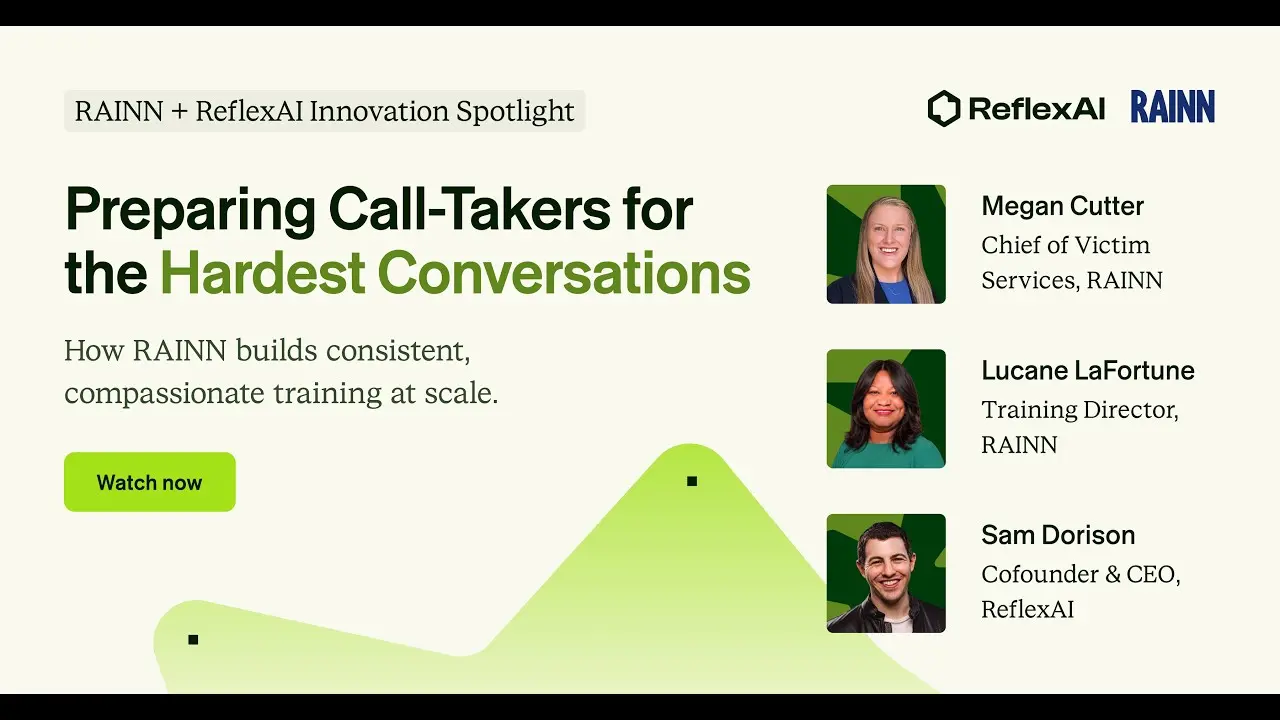
That standard, and how RAINN redefined it, was the subject of a recent Innovation Spotlight conversation between ReflexAI Cofounder and CEO Sam Dorison and two RAINN leaders: Megan Cutter, RAINN's Chief of Victim Services, and Lucane LaFortune, RAINN's Training Director. Together they talked through what changed when RAINN partnered with ReflexAI to move from a completion-based training model to a simulation-based one, built on ReflexAI's platform, and what that change produced. Getting there meant rethinking what "readiness" actually means. As Lucane explained:
How do we actually know someone is ready? Because completing training and being ready to support a survivor are not necessarily the same thing.
Hundreds of trainees, one readiness standard
Before talking about what changed, Megan described what RAINN was actually up against: a training model built on person-centered, trauma-informed principles, applied to a large and constantly rotating group of people with very different starting points.
RAINN tried nearly everything to solve for consistency: in-person training, virtual training, small groups, large groups, one-on-one sessions, more role play, less role play. Each iteration helped, but ran into the same wall, as Megan described:
There becomes a point where you just need more opportunities for people to practice. You need more staff to help them practice. You need people to grade and provide feedback on those practice sessions.
A second problem ran alongside the skills challenge, less visible but just as real: confidence. Someone could be doing everything right on paper and still not feel ready to sit with a survivor in crisis. Sam, who previously ran a 2,000-person crisis call center himself, described hitting the identical wall: trainers interpreting scenarios inconsistently, and skilled counselors leaving the role early simply because they didn't feel confident enough to stay.
RAINN stopped measuring attendance and started measuring skill
The shift RAINN made redefined what "ready" actually means for call-takers in training. As Lucane put it:
The biggest change we've made is moving from asking, did you complete the training? To asking, can you demonstrate the skill set?
In practice, that meant building a defined readiness benchmark directly into the training model: 80% or higher on the final simulation now represents demonstrated readiness. Falling short of that benchmark gives RAINN information: a clearer signal of exactly where a trainee needs support, delivered while it's still useful.
That distinction mattered because of what RAINN's old process actually looked like day-to-day. RAINN scored role plays by hand after the fact. Debriefs sometimes happened without the full picture of where a trainee had struggled, occasionally as much as 48 hours later, by which point the moment had already faded, as Sam put it:
Even when you do have that opportunity... that could be 48 hours later, in some situations. And I think we all kind of know we're not doing anyone any favors if we say, finish this thing, remember exactly what happened, so two days later you can receive feedback on it
The results: faster debriefs, fewer retakes, more confident counselors
Lucane described the outcome in three words: readiness, confidence, and momentum.
Readiness, because RAINN now has direct evidence of applied skill rather than attendance alone. Confidence, because trainees get a space to make mistakes safely before ever facing a real conversation, what Lucane's team calls "being in the lab." And momentum, because coaching time is no longer spread evenly across everyone regardless of need.
That shift showed up in two concrete ways:
- Debrief time dropped from roughly 45 minutes to roughly 30 minutes per trainee, as facilitators spent less time reconstructing what happened and more time coaching on what actually mattered.
- Most trainees now reach readiness on their first graded role play, without needing a second attempt.
Megan was careful to frame the goal accurately: this was never about pushing more people through faster for its own sake.
The goal was never really to only move people through the hotline training faster. That doesn't necessarily change retention. The goal was to know sooner when someone was ready.
Why an off-the-shelf simulation wouldn't have worked for RAINN
One point both Megan and Lucane returned to: none of this would have worked as an off-the-shelf tool.
RAINN's team stayed closely involved in calibrating the simulations in ReflexAI to RAINN's specific response model, language, and standards, and in stress-testing the system by deliberately trying to break it. As Lucane described it, the relationship was "symbiotic," with RAINN shaping the tool rather than simply adopting it.
Sam's advice to other organizations considering a similar shift echoed the same idea, using a flight simulator as the comparison:
Most pilots that you talk to are very glad that flight simulators exist because they don't want to figure something out for the first time when they're in a plane.
The same principle applied here. It only works if trainees actually want to use it, and RAINN's team heard exactly that: trainees consistently ranked the simulations among the most valuable parts of training, citing the realism, the immediate feedback, and the chance to get an early glimpse of what a real hotline conversation feels like.
What's still being learned
RAINN and ReflexAI were candid about what isn't fully answered yet: whether this shift changes retention, both during training and after someone begins taking live shifts. As Megan explained:
There's still so much that we're working to understand. For one, we're really still gathering data. We need more of that longitudinal information. One of the things we're the most interested in is retention.
For a sense of the kind of longitudinal impact possible at scale, ReflexAI's research brief on 988 crisis counselors found that counselors who completed a high number of simulations, eight or more, met performance standards more consistently than those with limited practice: 17% higher on overall performance, 18% higher on risk assessment, and 16% higher on empathetic communication, across nearly 42,000 real interactions.
Advice for other crisis organizations considering simulation training
Asked what she'd say to a crisis organization hesitant to make a similar shift, Megan didn't downplay the discomfort of change:
Explore it, and at the same time, be patient with yourselves and with your teams, especially if you've already got a training process you've spent years improving and iterating. It can feel risky to do something different, and I think that's okay.
Her advice, in short: watch how new trainees and facilitators actually respond, rather than betting on the technology alone.
What convinced us ultimately was not the technology and the possibility that we could do this, but watching the new trainees really provide positive feedback.
Lucane's addition was more direct: the partner matters as much as the tool.
It's not just about the simulation. It is a package.
Learn more about the work RAINN does every day at rainn.org.
To learn more about ReflexAI’s simulation-based training platform, schedule a conversation with our team.
FAQ
How does RAINN measure whether a call-taker is ready for the hotline?
RAINN uses a defined readiness benchmark built into its final training simulation. A score of 80% or higher represents demonstrated readiness, rather than relying on training completion alone.
What changed when RAINN moved to simulation-based training?
RAINN shifted from measuring whether trainees completed training activities to measuring whether they could apply the skills in realistic, scored simulations. This reduced average debrief time from about 45 minutes to about 30 minutes and reduced how often trainees needed a second graded role play.
Are RAINN's training simulations voice, text, or both?
Both. RAINN's simulations with ReflexAI include text and voice-based conversation practice.
Does simulation-based training improve counselor retention?
RAINN is still gathering longitudinal data on retention specifically. Early results are promising, but RAINN has been clear that more data is needed before drawing firm conclusions.