










From Content to Context: How ReflexAI’s Intelligence Layer Works
A homeowner calls an insurance carrier's sales line, asks for a quote on the house they are buying, and wants to know one thing before they commit: will this policy cover water damage?
The question might sound routine, but answering it requires the sales agent to navigate a complex web of coverage definitions, underwriting guidelines, and what an agent is permitted to say before a policy is bound.
Contact center leaders own both sides of this: the training that prepares agents for conversations like this one, and the QA that confirms the interaction was handled well and handled correctly.
Over years of accumulated experience, organizations have built up enormous knowledge bases of policies and best practices to cover situations like this: coverage guides, underwriting guidelines, disclosure requirements, compliance memos, training materials, and objection-handling playbooks, spread across wikis, shared drives, and document platforms.
The content is there, but the challenge is finding the right piece of that knowledge, in the right place, at the right moment.
ReflexAI's intelligence layer builds that context, then puts it behind every simulation your team creates and every conversation your QA program scores.
Knowledge is everywhere, but is that enough?
Consider Maya, a QA manager for a home insurance carrier's sales line. Her agents make hundreds of judgment calls a day, and almost none of those judgments are freestanding. What an agent can say about coverage before the property is underwritten, when an issue has to be routed to a licensed agent for review, what to say when a customer pushes back on the premium: each decision traces back to policy and best practices the organization has already written down.
Knowledge bases are large, complex, and often messy. Three problems show up in most organizations:
- Finding the single right document for a specific situation is hard. The answer to "Can an agent tell this customer their water damage is covered?" is rarely titled that way, and the person searching doesn't always use the words the document uses.
- Multiple documents often cover the same topic. A coverage guide, an underwriting guideline, and a compliance memo may all have bearing on the same call. Identifying all of them, and reconciling what they say, takes time and expertise.
- Knowledge goes stale. An underwriting rule tightened six months ago may live in a different folder than the coverage guide it superseded. Both documents are still in the knowledge base, but only one of them is true.
This is a problem for everyone whose work depends on that knowledge. The agent has to make the right call in the right moment. The trainer has to build learning content that reflects current policy. And QA has to answer a deceptively simple question: did this agent handle this interaction the way our organization says it should be handled?
Think back to the call about water damage from the opening. Imagine being Maya: the person who has to score how the agent did. To do this, Maya has to navigate the knowledge base to find the relevant documents, reconcile what they say, and know which version was in effect at the time. This is the process for one call. Now, expand this to the dozens of agents she has on her team, every week.
Why generic search tools and bolted on LLMs both miss the same thing
Most organizations have already reached for the obvious tools to help solve this problem.
The first is search. The idea is to make the knowledge base more searchable, so that agents and managers can retrieve the information they need. Modern search handles a lot: a query for "water damage" can surface documents about water damage, water backup, and sudden and accidental discharge. What it can’t do is surface the documents that are related to the question but share none of its words, such as the flood exclusion that lives in a separate policy form, or the disclosure requirement that governs what an agent may promise about coverage before the policy is bound.
The second is using commonly available AI productivity tools: give a Large Language Model (LLM) access to the knowledge base and ask it to grade how an agent did. This approach quickly proves to be impractical. A model with access to the entire knowledge base faces several issues: it has to perform an expensive search with every conversation, and it makes inconsistent evaluations from conversation to conversation.
Both approaches share the same flaw: they retrieve textual content without understanding the full context about what the organization actually knows.
Connect once, contextualize continuously
ReflexAI’s intelligence layer starts from a different premise. Rather than retrieving documents on demand, it builds a durable understanding of an organization's knowledge, and both training and QA content are built on top of that.
Here's how it works:
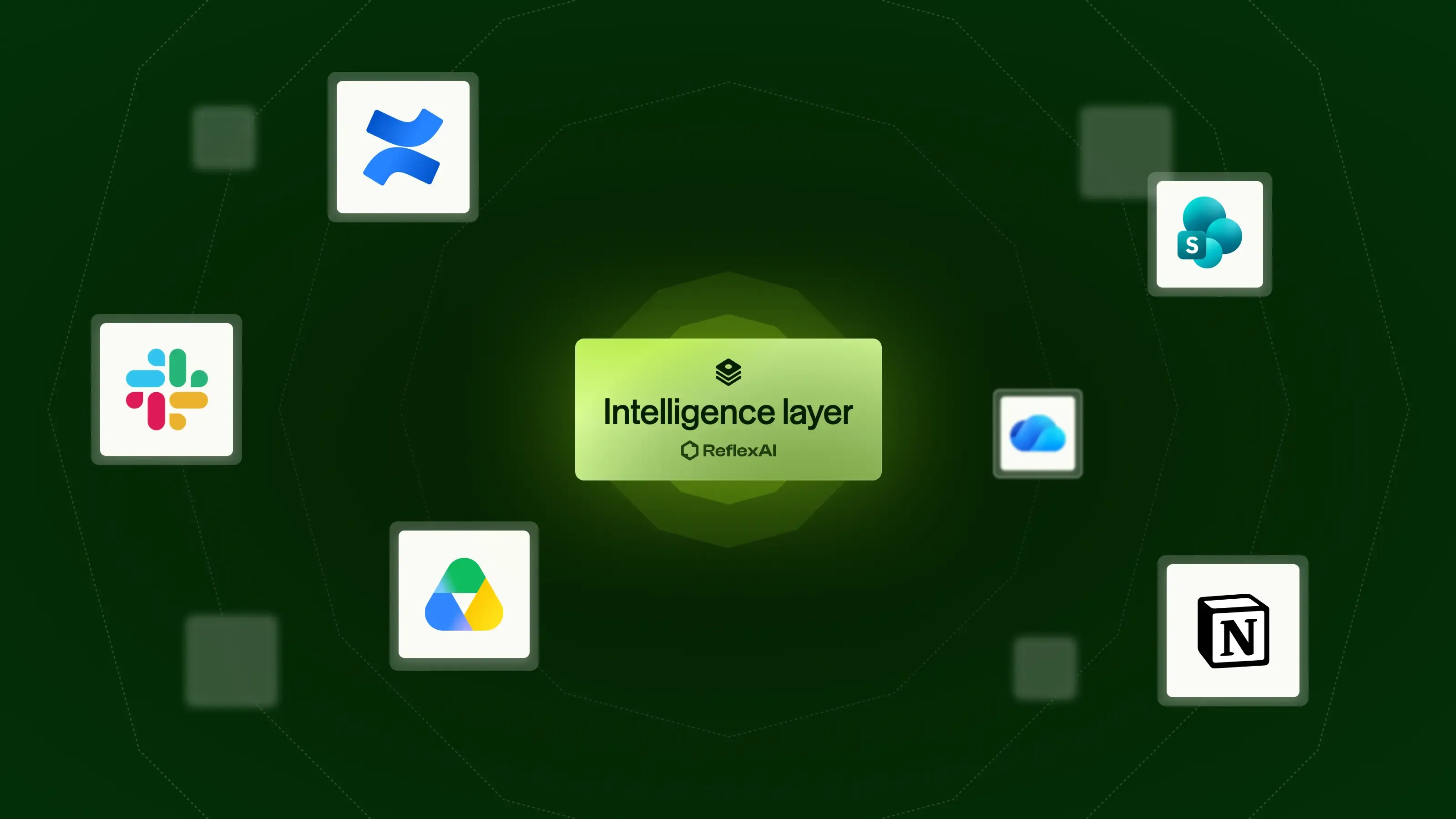
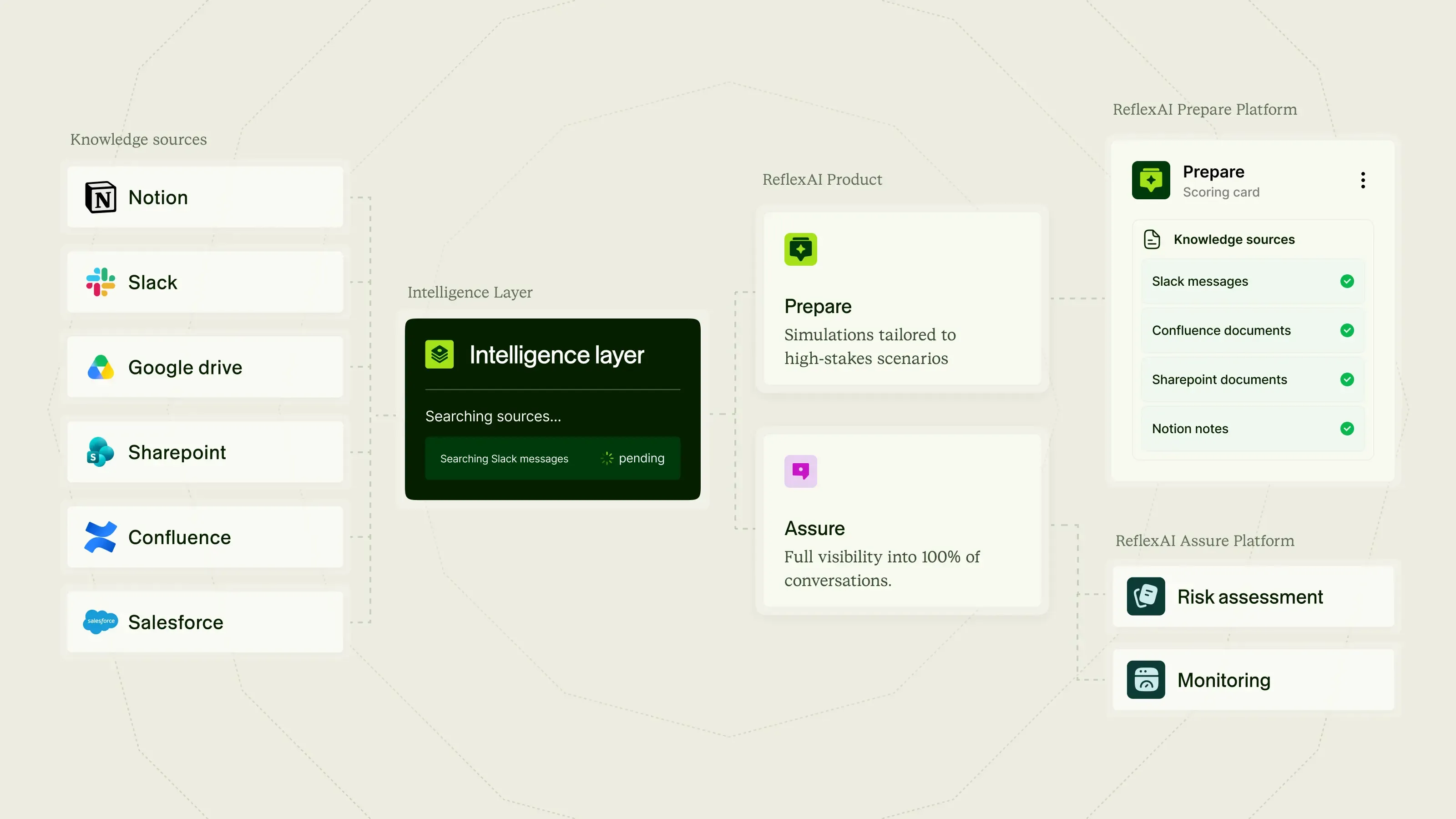
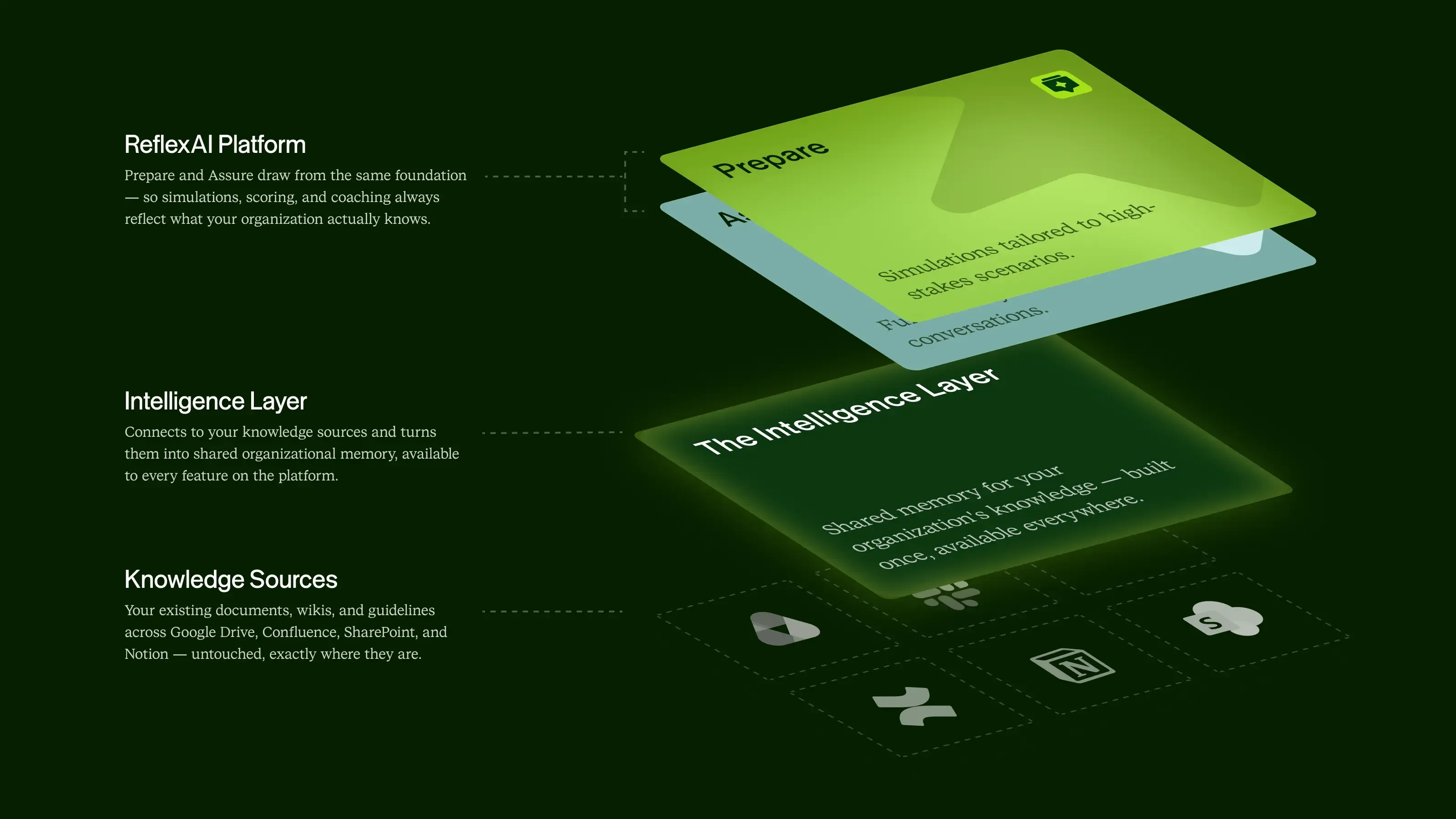
- Connect: The intelligence layer connects to the places where an organization's knowledge already lives, such as Google Drive, Confluence, SharePoint, and Notion.
- Contextualize: It reads that content and builds a structured understanding of what they contain, mapping how your policies, terminology, and procedures apply to a given conversation. That context becomes shared memory for the ReflexAI platform.
- Apply: Every experience on the ReflexAI platform draws on the intelligence layer. Scoring criteria reconcile what documents say, so a rubric reflects the coverage guide, the underwriting guideline, and the compliance memo together. Insights surface against what the organization actually cares about.
The result is a single, current understanding of your organization that every part of the ReflexAI platform can draw on.
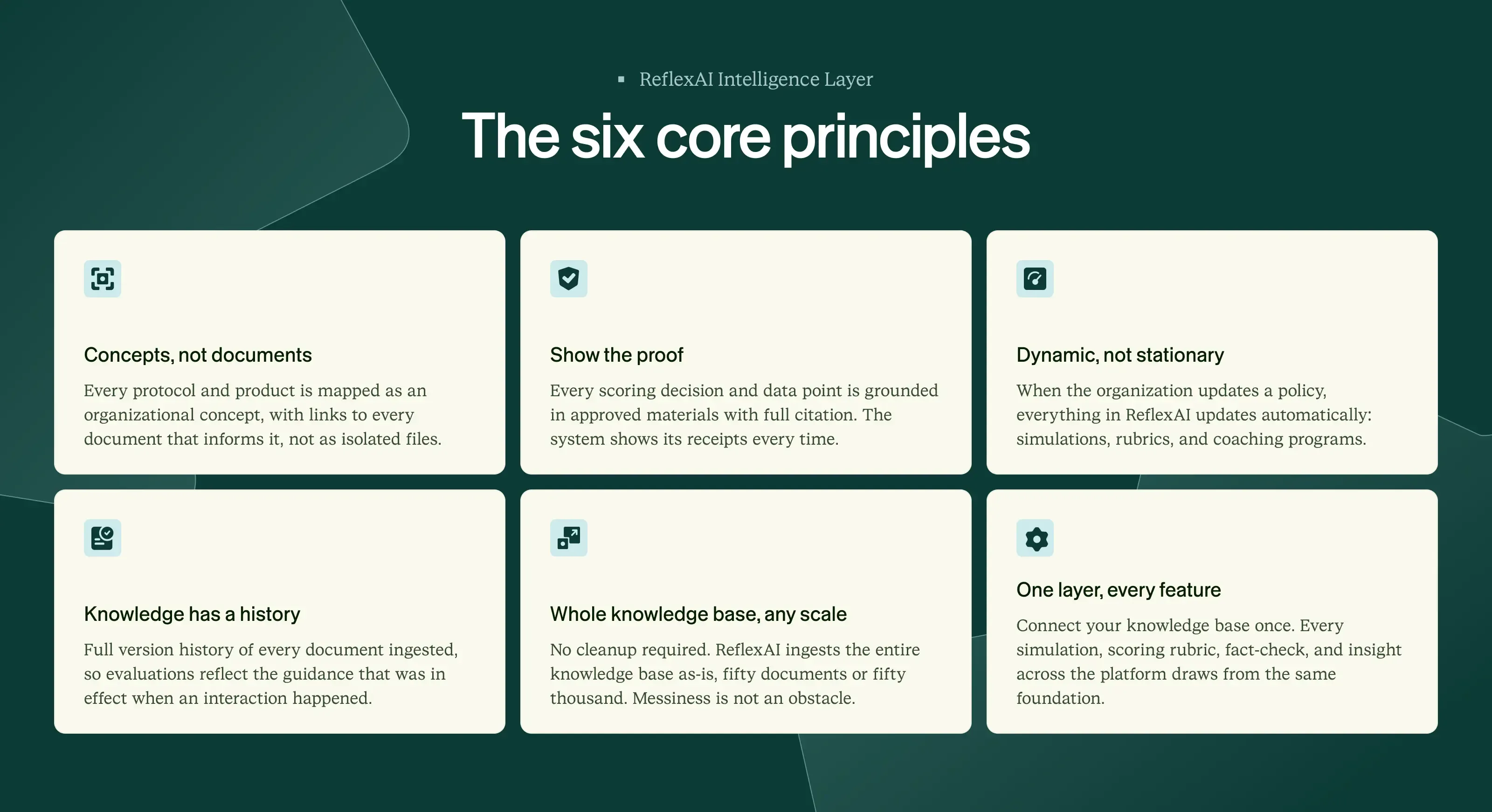
Getting there took more than connecting an LLM to a knowledge base. We designed the ReflexAI intelligence layer around six principles, and each one exists because of a specific way knowledge fails in real operations.
Concepts, not documents
The data stored by the ReflexAI intelligence layer is centered around organizational concepts, rather than files. Every protocol and product is mapped out, and the link between concepts and the documents they come from is preserved.
For Maya's query, "water damage" isn't just about coverage. In ReflexAI, it's connected to everything the organization knows about it: the sudden and accidental discharge that a standard policy covers, the gradual seepage it excludes, the water backup endorsement a customer has to buy separately, the flood exclusion that sends them to a different policy entirely, and the compliance memo that most recently changed what an agent may say about any of it. The answer to the customer's question considers information from a coverage guide, an underwriting guideline, and a memo. It becomes a single answer backed by all of the individual content related to it.
This is the principle everything else builds on. It is the difference between a system that stores an organization's documents and one that understands an organization's knowledge, with full context.
Show the proof
An answer that cannot be traced is an answer that cannot be trusted, and our customers work in environments where trust is paramount.
Every data point in ReflexAI is grounded in the organization's approved materials and keeps track of its supporting documents. When a scoring decision says an agent should have escalated an issue, ReflexAI points out which policy says so and where. Employees, coaches, and QA teams don't have to take the system's word for it. The system shows its receipts every time.
Dynamic, not stationary
Knowledge changes constantly. Policies, best practices, and guidance change frequently. Any system that works with knowledge bases must stay up to date with these changes or risk going stale. A simulation built six months ago can still be teaching a rule that no longer exists, and nobody notices until an agent follows it on a real call.
When the organization updates a policy, the information within ReflexAI automatically updates with it. Nobody needs to re-upload files, and nobody rebuilds simulations, scoring rubrics, or coaching programs by hand after a small revision in their guidance. This is the maintenance burden that has historically made accuracy scoring impractical to sustain.The organization maintains its documents in their own knowledge base, and the ReflexAI platform keeps up.
Knowledge has a history
Staying current solves part of the time problem, but ReflexAI also logs a history of the knowledge changes over time for accountability.
If a policy is modified today, an organization may still need to know whether an agent handled a conversation correctly six months ago, under the policy that applied at the time. ReflexAI is designed to keep the version history of the documents it ingests, so evaluations can reflect the guidance that was in effect when the interaction happened. This gives organizations a defensible record for audits, reviews, and disputes.
Most systems only keep the current version of a document. In the environments our customers work in, where policies change often and evaluations must hold up to review long after the fact, ReflexAI provides a full view of conversation performance.
The whole knowledge base, at any scale
Organizations don’t need to clean up their documents before they start using our platform. Even finding a small collection of high priority documents can consume valuable time that our customers can instead spend training their staff.
Knowledge bases are sprawling, uneven, and full of history. ReflexAI is built to ingest the entire knowledge base as is, whether that means fifty documents or fifty thousand. The messiness is not an obstacle to work around. It's the very problem being solved.
One layer, every feature
Everything described so far, the concept-level organization, the grounded answers, the knowledge that stays current and keeps its history, shouldn’t just power one feature. ReflexAI’s intelligence layer is the foundation that powers every feature throughout our platform.
When Maya's organization connects its knowledge base, that one connection feeds everything. The simulations her trainers build, the scoring criteria her QA team applies, the fact-checks that run on an agent's statements, and the analytics she uses to spot team-wide patterns, all draw on the same understanding of the organization. A policy updated once is updated everywhere, and no feature is working from an older or partial copy of the truth.
One knowledge base connection, one layer, every feature.
The same context behind evaluation, insight, and practice
Return to Maya's improvement loop, this time powered by ReflexAI’s intelligence layer.
Evaluating conversation performance comes first. How are agents on Maya's team performing based on the most up-to-date best practices? Scoring criteria in Assure, ReflexAI’s live-performance QA module, are now grounded in the organization's actual policies: the current documents rather than the deprecated ones. So, Maya's agents are evaluated against an up-to-date and comprehensive understanding of all of the organization's policies, best practices, and guidance. And when someone reviews an old interaction, the evaluation reflects the guidance that applied at the time, not the version that replaced it.
Then, insights. What is the performance of Maya's team over time? Are they slipping on key behaviors and outcomes that are vital to the organization's goals? ReflexAI digs through the metrics that matter and provides them to Maya when they're needed.
Finally, action. Once Maya identifies key issues that need to be addressed, she creates a coaching plan on ReflexAI's platform. The intelligence layer enables the platform to create the exact simulations and scoring dimensions in Prepare, ReflexAI’s simulation module, needed to fix the issue.
Without ReflexAI, Maya has to manually look through documents, metrics, and best practices while relying on her decade of expertise to measure performance, interpret it, and take action.
With ReflexAI’s intelligence layer she can leverage her organization's knowledge base to streamline the performance loop.
The promise is simple: connect your content once and every evaluation, simulation, and insight grows better over time from your own organizational context.
We’d love to show you how it works. Schedule a demo today.