


Call center quality management is the process of evaluating agents' conversations with customers and helping agents improve when they fall short. It starts with a scorecard that lists the standards for a good call. Reviewers rate calls against that scorecard, and managers use the results to coach agents and plan what they practice. Quality assurance (QA), the scoring step, is one part of quality management. Below, we explain how to measure call quality and how to turn QA findings into coaching and practice.
Summary
- Human agents now take the hardest calls. In a Gartner survey published in February 2026, service leaders said AI will automate routine tasks while people handle complex or emotionally sensitive interactions. Gartner also found that 84% plan to add new skills to the agent role.
- Harder calls raise the stakes for QA, but AI tools aren't delivering yet. In a 2026 survey of 109 contact center leaders commissioned by ReflexAI, 85% had at least one AI tool for training or QA, but only 29% said they use AI effectively.
- Managers find problems on calls but lack time to fix them. In ReflexAI's survey, 77% of contact center leaders said they don't have enough time for coaching and calibration.
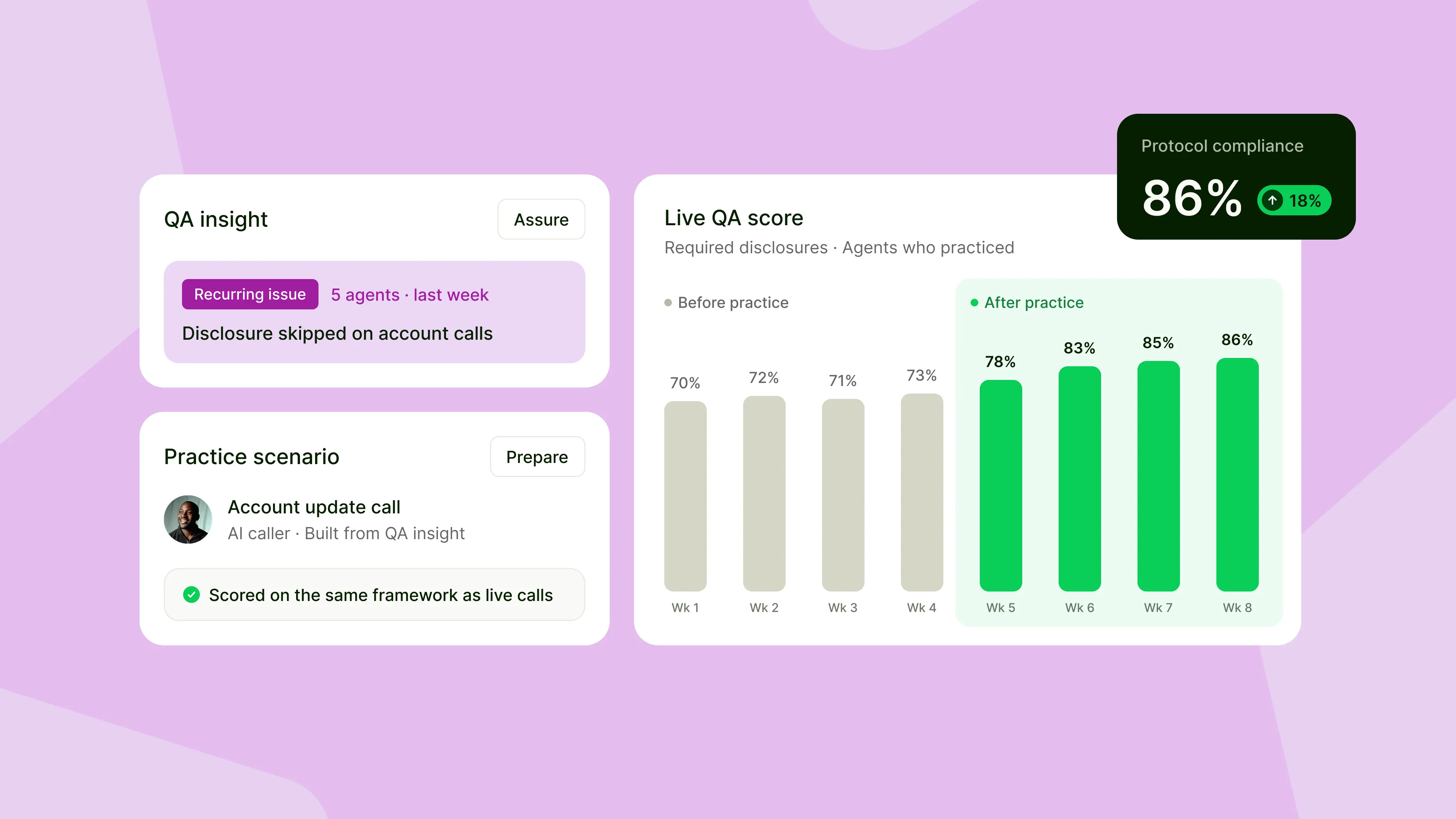
- AI tools help agents practice independently. With AI simulations, agents can rehearse a difficult call on their own and get scored right away. ReflexAI's Prepare scores practice calls on the same framework Assure uses for live calls, so managers can see if practice improved an agent's live calls.
- Agents who practiced more followed protocol more often. In a ReflexAI study of 174 call center agents, those with high simulation use improved their protocol compliance scores by 18% and met the highest organizational standards in 17% more conversations.
What is call center quality management?
Call center quality management (QM) is the practice of reviewing agents' calls with the goal of helping them improve. It includes quality assurance (QA) and quality control (QC).
- Quality assurance involves scoring conversations against a scorecard over time. For example, a QA reviewer might score an agent's calls on accuracy, protocol adherence, and empathy, then report trends by agent and team.
- Quality control involves checking individual calls for specific requirements. A reviewer might confirm that an agent read a required disclosure on a flagged call, or verified a caller's identity before discussing an account. If reviewers keep finding skipped disclosures, many teams add disclosures to the QA scorecard.
Call center managers use QA and QC results together to decide which problems to fix first, which agents to coach, what agents should practice, and if a standard needs to change.
Quality control (QC) | Quality assurance (QA) | Quality management (QM) | |
Question it answers | Did this interaction meet the requirement? | Are our conversations meeting the standard over time? | Is the team getting better at its most important conversations? |
Scope | Individual interactions and specific checks | Conversations scored against a scorecard | Standards, evaluation, coaching, practice, and program changes |
Example | Confirming a required disclosure was read on a flagged call | Scoring empathy, protocol adherence, and resolution across a week of calls | Turning a recurring missed disclosure into practice and checking whether live scores improve |
Output | A pass or fail on a check | Scores and trends | A change in how agents handle live calls |
Most contact centers already run some form of QA and QC. Programs differ most in how fully they implement the coaching, practice, and follow-up that quality management adds.
What are the benefits of call center quality management?
Call center quality management delivers four main benefits.
- Callers get the same answer from every agent. When every agent is scored on one scorecard, callers get accurate answers and the same care no matter who picks up.
- Fewer customers call back. When agents solve a problem correctly the first time, customers don't need to reach out again.
- New agents get up to speed more quickly. Contact centers hire new agents often, so managers spend much of their time training. They can walk a new agent through a scored call and point to the exact step the agent missed.
- Managers catch compliance risks early. In healthcare, financial services, and crisis lines, a skipped verification step or a missed disclosure can affect someone's health, finances, or safety. Regular reviews show managers when agents keep skipping a step, before it leads to a complaint or a regulatory finding.
These benefits are growing more important as automation absorbs routine customer service requests and agents spend more time dealing with escalations, account-specific problems, and emotionally charged calls. An effective quality management program raises the standard on these types of complex calls.
In a Gartner survey of 321 customer service leaders, more than 80% of organizations planned to expand human agent responsibilities as AI automates tasks and handles routine calls. But despite the fact that AI can answer their questions, customers still want to speak with human agents. In a separate Gartner survey, 87% of customers said companies using GenAI for service must offer a way to reach a person.
How to measure call center quality and build a QA scorecard
Contact centers can measure call quality with operational and customer metrics (e.g., how long calls take and how satisfied callers are). QA reviewers then use the team's scorecard to grade how well the agent did on the call. Most programs do a good job collecting these numbers, but struggle to act on the findings.
Core call center quality metrics
These are the four metrics that call center QM programs routinely measure:
- First contact resolution (FCR) is the share of issues resolved on the customer's first contact, with no callback or transfer needed.
- Customer satisfaction (CSAT) is the rating customers give an interaction, usually collected in a short survey.
- Average handle time (AHT) is the average length of an interaction, including talk time, hold time, and after-call work.
- QA score is the result of evaluating a conversation against the team's scorecard, usually expressed as a percentage of available points.
Reviewing a single metric out of context can be misleading. An AHT that drops by 30 seconds could be a sign that agents are resolving calls faster, but it could also mean they're skipping verification steps or ending calls too soon.
Managers can tell what's really happening by checking FCR and QA scores alongside AHT. If more customers call back, or QA reviewers flag skipped steps, agents are likely rushing through their calls.
Building a QA scorecard
A QA scorecard is the checklist reviewers use to grade calls. Most scorecards include these criteria.
- Identity verification
- Accurate information
- Protocol adherence
- Required disclosures
- Empathy
- De-escalation
- Resolution
When you build a scorecard, write a short definition for each criterion and include an example of what a passing call sounds like. For identity verification, that might be "Agent confirms the caller's name and date of birth before discussing the account."
Not all QA criteria are the same
Not every criterion should count equally toward the score. Give more points to steps that can cause serious harm if an agent skips them. Some mistakes, like discussing a patient's care before verifying their identity, should fail the call outright. Give softer skills like tone and rapport points based on how much they help resolve the call.
Teams that handle calls and chats usually keep one scorecard and change a few criteria for each channel. For example, phone agents are scored on how they put callers on hold, and chat agents on how clearly they write.
Acting on QA insights
Manual QA teams usually review fewer than 10% of calls, so a problem that shows up on a handful of calls can go unnoticed. Automated QA tools can score far more calls and group the results by agent, team, or topic, which shows managers where to focus coaching. ReflexAI's Assure, for example, can score up to 100% of interactions.
In ReflexAI's research, 61% of 109 contact center leaders said their QA tools aren't fully meeting their needs, and 58% said their training tools fall short. For example, a QA tool might flag that five agents skipped a required disclosure last week. A manager then needs to coach the agents and have them practice reading the disclosure.
Turning QA findings into changed behavior on live calls
Using a QA score to improve calls requires some follow-up. You need to identify the recurring pattern, then create a plan to help agents address the issue. The agents involved need time to rehearse a better response and get comfortable with it. Finally, you need a way to confirm that the agent or team's live-call scores improved.
Why QA findings stall before reaching practice
Most contact centers can find problems on their calls. Fixing them is harder, because managers are short on time and training schedules are set far in advance.
In a ReflexAI-commissioned survey reported by Training Industry, 85% of contact centers had deployed at least one AI tool for training or QA, but only 29% said they were using AI effectively. Most leaders in the survey (77%) said they don't have enough time for coaching and calibration. In open-ended answers, leaders repeatedly named the split between QA and training as their biggest problem.
Teams usually plan training sessions weeks or months ahead. If QA reviewers see on Tuesday that agents are skipping a required disclosure, the next training session might not cover it for weeks. Agents keep taking live calls in the meantime.
Turning a recurring weakness into a practice scenario
When QA reviewers find the same problem across many calls, like a skipped disclosure or a de-escalation that loses the caller, managers can use QA and simulation training together to turn that problem into a practice scenario.
With Prepare, ReflexAI's AI simulation training product, agents rehearse these scenarios with AI personas that adapt in real time to what they say and how they say it. Agents can practice on their own, without a manager present, and get scores on empathy, accuracy, tone, and protocol adherence after each simulation.
Because Prepare and Assure use the same scoring framework, managers can compare an agent's practice scores with their live-call scores.
Checking whether live performance changed
Only 52% of leaders in ReflexAI's research say they can measure whether the actions they take on QA trends have any effect. Shared scoring lets managers check if practice improves agents' live calls. They can track the agents who practiced a scenario as a group and compare their live QA scores before and after the practice.
In a ReflexAI study of 174 call center agents, agents with high simulation use showed three improvements.
- Protocol compliance scores rose 18%
- They met the highest organizational standards in 17% more conversations
- They showed stronger rapport in 16% more conversations
Protocol compliance is a top concern in healthcare, where contact centers must follow hospital policy, HIPAA, and state and federal regulations. ReflexAI is building the Conversation Performance Platform so that live-call results will shape what each agent practices next.
Call center quality management best practices
These practices help strengthen a call center quality management program.
- Write standards around your highest-stakes conversations. Build your scorecard around the moments where a mistake can hurt someone, such as identity verification, required disclosures, or a caller in distress. Give those items the most points.
- Calibrate every reviewer on a fixed schedule. Calibration ensures that reviewers are scoring all calls the same way. Have each reviewer and any automated scoring tool score the same calls separately, then compare results. Rewrite any criterion where reviewers disagree. Calibrate again whenever the scorecard or a policy changes.
- Pick one recurring problem each cycle. Review QA trends weekly and choose the problem that occurs most often or poses the most risk for the next round of practice.
- Turn that problem into practice before the next coaching session. Build a scenario that recreates the part of the call where agents went wrong. Have the agents who made the mistake rehearse it.
- Score practice and live calls on the same criteria. With one set of criteria, managers can compare an agent's practice scores with their live-call scores and see if their live calls got better after practice.
- Build practice into onboarding. Have new hires practice with AI simulations of the calls they'll face in their first weeks, before they take them live.
When choosing software, look for a tool that reviews your high-risk conversations, scores calls consistently across human reviewers and automation, and uses the same scoring for practice and live calls. ReflexAI's guide to choosing a contact center QA platform covers other factors to compare, like scalability and data security.
Where does your call center quality management program break down?
Most quality programs produce more QA findings than managers have time to address. Generating a QA score isn't enough to fix an issue. If QA findings only show up on a dashboard and managers don't make time for training, live-call scores won't improve.
ReflexAI is the Conversation Performance Platform, built to help teams practice, measure, and improve their most important conversations. Teams use Assure's QA insights to find recurring problems and Prepare to practice fixing them before the next live call.
ReflexAI's 2026 research report lays out what 109 contact center directors, VPs, and executives said about their training and QA programs. Download the report to compare your own program with theirs.
Frequently asked questions about call center quality management
What does QA do in a call center?
QA evaluates conversations against a scorecard to see whether agents meet the team's standards for accuracy, protocol, compliance, and customer experience. It shows managers where performance falls short and which issues keep coming up across a team.
How does AI help with quality management?
AI helps contact centers review more calls and act faster on what they find. With automated QA, teams can score far more calls than manual reviewers can, and managers can see which problems show up repeatedly across agents. With AI simulations, agents can practice fixing those problems on their own and get scored right away. When practice and live calls are scored the same way, as they are with ReflexAI's Prepare and Assure, managers can check if practice improved agents' live calls.
What is the 80/20 rule in a call center?
The 80/20 rule is a common service-level target, meaning 80% of calls are answered within 20 seconds. It measures how quickly customers reach an agent and says nothing about the conversation that follows. Teams that track it alongside FCR, CSAT, and QA score can see both speed and quality.
How do you improve QA in a call center?
To improve QA in a call center, start by calibrating reviewers so everyone scores calls the same way. Then pick one problem that keeps showing up in QA reviews, like a skipped disclosure, and build a practice scenario around it. Have the agents who made the mistake rehearse that scenario before their next live calls, then compare their QA scores afterward to see if they improved.
How do you measure quality in a call center?
You can measure call center quality by using a QA score alongside first contact resolution (FCR), customer satisfaction (CSAT), and average handle time (AHT). The QA score shows if agents followed the team's standards. The other three show if customers got their issue resolved quickly and left satisfied. Track these numbers over time and by agent group to see if coaching and practice improved live-call results.
How do you choose quality management software?
Choose quality management software that connects QA scores to training. Look for a tool that reviews your high-risk conversations, keeps scores consistent across reviewers, and uses the same scoring criteria for practice and live calls. If a tool only reports scores, managers have to turn every problem into coaching on their own, and 77% of leaders in ReflexAI's research say they don't have time for that.