


Call Center Attrition: Rates, Causes, and Fixes for 2027
Call center attrition is a workforce metric that measures the percentage of agents who leave a contact center over a set period, usually a year. Most call centers lose a large share of their frontline staff each year, with the first few months the most critical time for keeping new agents. This guide covers 2027 benchmarks and the attrition formula, then explains why new agents leave and how managers can help them stay through better onboarding and coaching.
Summary
- Call centers lose close to half their agents every year. Average turnover is 40-45% a year, according to 2026 estimates from Insignia Resources, a staffing firm. Financial services centers reach 52-61%.
- Each agent who leaves costs up to $46,000. Insignia estimates $10,000 to $20,000 in direct costs to recruit and train a replacement and a total of up to $46,000 once you count the months before a new hire reaches full performance.
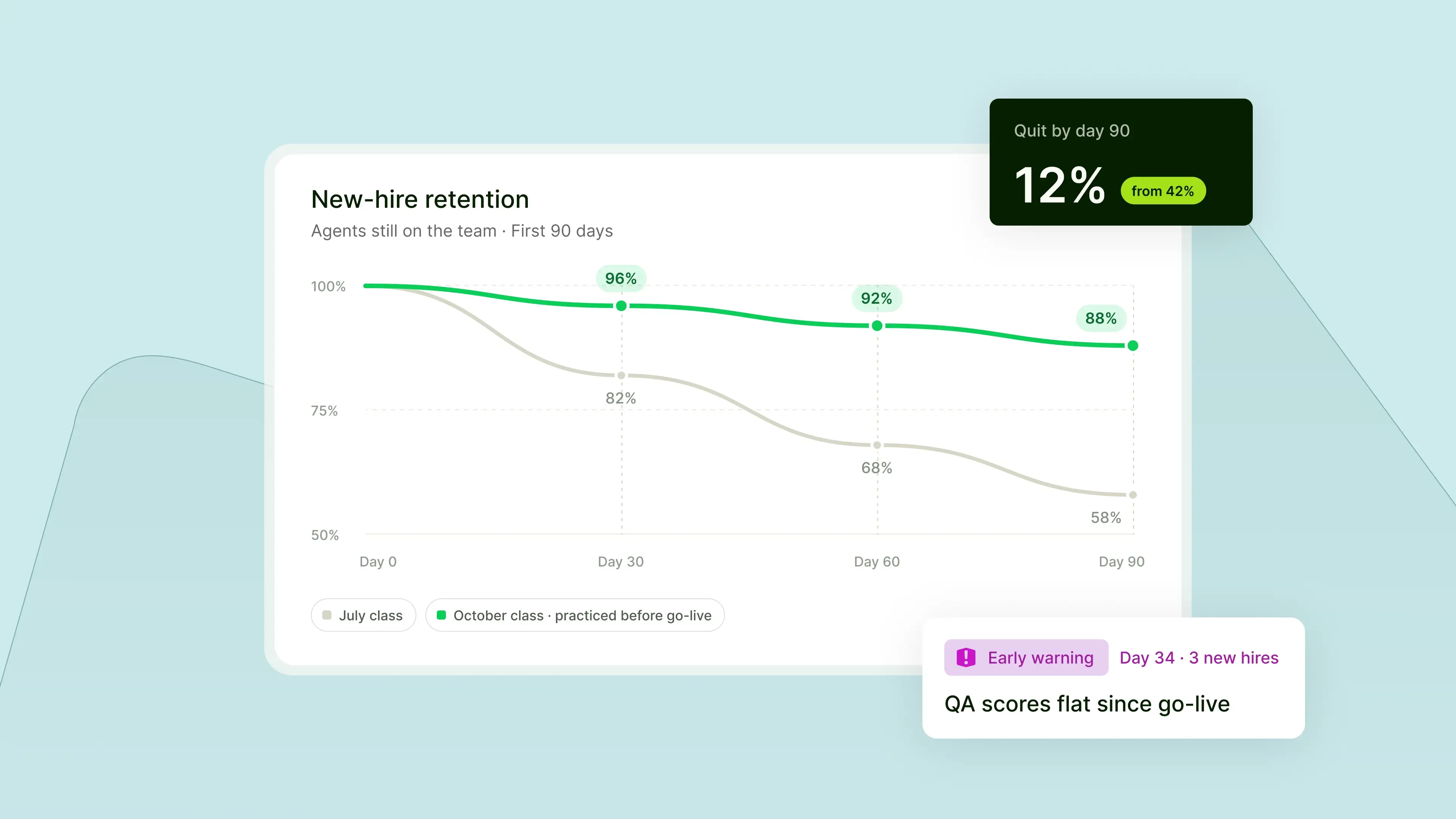
- First-year agents leave at the highest rates. Insignia estimates first-year call center attrition at 69-73%. Managers learn more from tracking quit rates at day 30, 60, and 90 than from the annual figure.
- When feedback feels like punishment, agents leave. According to experts interviewed by CX Dive, agents feel punished when feedback arrives two weeks after a bad call, and they quit when they’re graded constantly with no path to improve.
- Agents who stay are taking on more complex work. Gartner found 63% of service leaders are shrinking frontline headcount through attrition while 85% add responsibilities to frontline roles.
Agent turnover rate industry benchmarks
Average call center turnover is 40-45% a year in 2026, according to estimates from Insignia Resources, a staffing firm. High-stress sectors reach 55-60%. These are industry estimates, not government data. Insignia’s 2026 turnover estimates by segment are in the table below.
Segment | Estimated annual turnover (2026) | Context from Insignia |
All call centers | 40-45% | Industry-wide average |
High-stress sectors | 55-60% | Upper range across sectors |
Financial services | 52-61% | Complex products, frustrated customers |
Healthcare | 47-56% | Life-or-death calls, insurance complexity |
Virtual or remote centers | 15-20 percentage points lower | Compared with traditional on-site operations |
How to define and calculate call center attrition rate
To calculate call center attrition rate, you need the number of agents who left during a period without being replaced and the average number of agents on the team over the period. Divide the agents who left by the average headcount, then multiply by 100. Use a year as the period to compare your rate with the annual benchmarks above.
The attrition rate formula with a worked example
Turnover and attrition rates both divide by average headcount. They differ in which departures you count.
- Average headcount = (agents at start of period + agents at end of period) ÷ 2
- Turnover rate = (all agents who left ÷ average headcount) × 100
- Attrition rate = (agents who left and were not replaced ÷ average headcount) × 100
Say a call center starts the year with 200 agents and ends it with 180, so its average headcount is 190. During the year, 57 agents left. The company hired replacements for 37 of them and left 20 roles open.
- Turnover rate = 57 ÷ 190 × 100 = 30%
- Attrition rate = 20 ÷ 190 × 100 = about 10.5%
Use the turnover rate to estimate recruiting and training costs, and the attrition rate to see how much answering capacity the team lost.
How attrition differs from turnover
People often use attrition and turnover interchangeably, but they measure different things. Turnover counts every agent who leaves, voluntarily or not, whether or not the seat is refilled. Attrition, in its stricter sense, counts only departures the organization doesn’t refill. When attrition is high, the team is getting smaller. A call center that hires a replacement for every agent who quits has high turnover and little attrition.
In 2026, many service leaders are reducing headcount through attrition by leaving roles open, so their two rates can be far apart. Most published benchmarks, including Insignia’s 40-45%, count every departure, which makes them turnover benchmarks. Compare them with your turnover rate. Your attrition rate will look lower because it leaves out the agents you replaced.
What call center turnover costs per agent
Replacing a single call center agent costs $10,000 to $20,000 in recruiting and training expenses, according to Insignia Resources. Counting the six to eight months a new hire needs to reach full performance, the total cost can reach $46,000 per agent.
High turnover can also cost a call center its customers’ trust. According to CX Dive, experienced agents take their knowledge with them when they leave, and customers notice while new agents catch up. In Shep Hyken’s 2026 State of Customer Service & CX report, 80% of customers said inconsistent information would likely make them switch or leave a brand.
Why call center attrition happens
The most commonly cited reasons agents leave call centers are low pay, limited room to grow, demanding metrics, and schedules that change without warning. A factor that’s easier to overlook is how a center prepares and coaches new agents. New agents who feel unready for hard calls, or who get feedback too late to use, are more likely to quit in their first 90 days.
One-and-done onboarding leaves agents unprepared
Many onboarding programs cover product and policy content up front, then put agents on live queues. Agents finish onboarding knowing the policies without having practiced a single hard conversation. With this approach, an agent can pass a knowledge check on refund policy and still freeze when a distraught caller pushes back, or stumble over a compliance disclosure in the middle of a tense exchange.
Agents who can answer customers’ questions with confidence are more satisfied in the job and less likely to burn out. When they can’t, customers get inconsistent answers, a problem that usually starts in training. An agent who experiences hard calls for the first time on a live line has to learn under pressure, with a real customer waiting.
Late feedback and constant grading feel like punishment
Jeannie Walters of Experience Investigators told CX Dive that when feedback arrives weeks after a bad call, agents experience it as punishment. By then the agent has taken many more calls and can’t recall the details or where the call went wrong, so a late review points out the mistake without helping the agent fix it.
Delayed reviews can also teach new agents that feedback means they’re in trouble, which is demoralizing while they’re still deciding if they want to stay. Agents who are graded constantly, with no chance to practice before the next scored call, start to see each score as a mark against them.
Ongoing coaching can help retain agents longer
Onboarding prepares agents for the situations a trainer can predict, while managers who keep coaching can help each agent handle the harder, more complex calls. Coaching also helps agents improve on calls where their scores slip in month two or three, when early exits are most common. As agents get better at the calls that used to trip them up, they gain confidence that they can do the job, which gives them a reason to stay.
First-day ghosting and the first 90 days
First-day ghosting occurs when a new hire accepts an offer and doesn’t show up, or attends a day or two of training and stops responding. It’s the earliest form of a larger problem, new agents quitting in their first months on the job. Insignia estimates first-year attrition in call centers at 69-73% in 2026, and Kay Jackson, writing in Contact Center Pipeline, observes that at many centers “a quarter or more” of new hires leave within three months.
Managers can spot early attrition months before the annual rate changes by tracking:
- Quit rates at day 30, 60, and 90, compared across hiring classes
- New-hire handle times that stop improving week over week
- Early-tenure QA scores that flatten or drop after the first weeks on the phones
- Practice performance on hard call types, such as de-escalation, before agents go live
How to reduce call center attrition
To reduce call center attrition, cover the basics of pay and schedules, then focus on how you prepare and coach new agents.
- Pay. Benchmark wages against local employers hiring the same people.
- Schedules. Make schedules predictable and offer remote or flexible options where operations allow. Insignia estimates that remote centers have turnover 15-20 percentage points lower than on-site ones.
- Career path. By day 30, show new agents the skill tiers and career paths open to them, as Contact Center Pipeline’s early-tenure playbook recommends, so they see the job as a first step with somewhere to go.
- Recognition. Recognize good calls specifically and promptly.
Fixing pay and schedules helps every agent. The practices below focus on new agents in their first 90 days, when early exits are most common.
Build onboarding around realistic practice before the first live call
Before new agents take live calls, have them practice each type of hard call they’ll face several times, such as:
- An upset caller who wants a refund the policy doesn’t allow
- A compliance disclosure delivered word for word under time pressure
- A customer describing a health scare or a financial loss
With a call center simulation for agent training, new hires rehearse hard calls in private with a realistic caller and no customer at risk. Contact Center Pipeline’s playbook recommends pairing regular practice with a buddy and weekly check-ins through the early weeks, while new agents are still building confidence. After each practice session, the reviewer should point to the moment that worked or slipped and give the agent another attempt.
Shorten feedback timing and set a steady coaching cadence
Give feedback as close to the call as possible. In a same-day or next-day review, the agent still remembers the conversation and can apply the feedback on their next call. Set up a short weekly coaching session built around one or two skills from recent calls, so agents can see the center is investing in them. End each session by assigning practice on one QA finding before the next session.
To check that coaching is working, compare early-tenure QA scores and quit rates across hiring classes. Managers can see if coaching cadence affects who stays by measuring call center training effectiveness this way.
Prepare remaining agents for harder work as AI takes routine contacts
The Deloitte Digital 2026 Global Contact Center Survey found that 35% of contact centers already use agentic AI, which completes tasks on its own. Gartner’s 2026 survey of 321 service leaders found that 63% are reducing frontline headcount gradually through attrition, and 85% are adding new tasks and responsibilities to frontline agent roles. As AI takes over routine contacts, the calls left for human agents are becoming more complex and emotional.
When an experienced agent leaves, the center loses someone who already knows how to handle the difficult calls AI leaves behind. New agents who replace them get fewer simple calls to learn on, so they face harder calls sooner, with less time to ramp up.
Check how ready your agents are for hard calls
To check if your agents are ready for harder calls, look at these three numbers:
- Quit rates at day 30, 60, and 90 for your last few hiring classes, to see how early new agents leave
- New agents’ scores on your hardest call types. Low scores point to onboarding that didn’t prepare them.
- How long a QA finding takes to reach the agent as coaching. If it takes weeks, agents are getting feedback too late to use.
If new agents score well and get timely feedback but still leave, look at pay and schedules.
ReflexAI, the Conversation Performance Platform, helps people practice, measure, and improve the conversations where the most is at stake. With Prepare, agents can rehearse de-escalation, compliance disclosures, and emotionally heavy calls in realistic voice and chat simulations, with feedback as soon as each session ends. With Assure, managers get QA insight across far more conversations than a manual sample reaches, since Assure can score up to 100% of interactions. Both products score against the organization’s own standards, so a manager who spots a pattern in live calls can assign practice on the skill agents are missing.
Schedule a ReflexAI demo to see how practice on your own hard calls and coaching from your own QA data could fit your onboarding, or see how contact center teams use Prepare as an AI training tool for contact center agents.
Frequently asked questions about call center attrition
What is the typical attrition rate in call centers?
The typical call center turnover rate is 40-45% a year in 2026, according to estimates from Insignia Resources, a staffing firm. Rates are higher in financial services (52-61%) and healthcare (47-56%). Among new hires, first-year attrition is an estimated 69-73%.
What is the 80/20 rule in a call center?
The 80/20 rule is a service-level target for answering 80% of calls within 20 seconds. It measures speed of answer and isn't an attrition metric. When a center loses agents faster than it can hire and train them, meeting the 80/20 target puts more calls on the agents who remain, including new hires who are still building confidence.
Is 20% attrition high?
No, a 20% annual rate is low for a call center, roughly half the 40-45% industry estimate. Losing 20% of a hiring class in its first three months is a different story, because it points to a problem with onboarding.
Is a call center a dead-end job?
No, and the role is expanding. In a 2026 survey, Gartner found most service leaders are adding responsibilities to frontline roles as AI handles routine contacts, which makes experienced agents more valuable. The job feels like a dead end when a call center offers no visible path forward and no coaching beyond the first weeks. Call centers can keep agents from feeling stuck with steady coaching and a clear career path.