











Your agents passed the compliance module. Quiz scores look good. The audit trail is clean.
Then a live caller pushes back on identity verification, and the queue starts building. The agent skips a step to keep things moving.
AI roleplay gives training teams a way to rehearse these high-pressure conversations before they happen. This playbook covers how to use simulation-based training to build conversation readiness in financial services.
Why traditional compliance training falls short in financial services
This is a workforce math problem. Every agent on your team can clear the compliance module and score well on the quiz, then freeze or fumble the moment a real customer pushes back. Knowing a policy in a quiet room and applying it while someone is upset or stalling are different skills, and most training programs only build the first one. It shows up with vulnerable customers and affordability assessments, on any call where the script runs out and the agent has to read the actual person on the phone. The FCA's case against TSB puts a number on what happens when that second skill never gets built. The regulator issued a £10.91 million fine and required £99.9 million in redress to 232,849 customers for failures in how staff handled customers in arrears. The regulator put it plainly, noting "training did not fully support staff in understanding customers' circumstances."
Which conversations create the most compliance risk?
Poorly prepared employees create regulatory and liability exposure in specific, predictable conversation types. The exact scenarios vary by product, role, and jurisdiction, but these are common high-risk conversation types for financial services teams:
- Suitability and product recommendations: Advisors who can’t explain why a product fits a client's needs create documentation and conduct risk that surfaces in regulatory reviews. Let's say a client asks why you recommended Fund A over Fund B. An advisor who can't articulate the rationale creates immediate compliance exposure.
- Fee and cost disclosures: Agents who rush or skip required disclosures expose the firm to regulatory action, particularly when customers later dispute charges. For example, an agent skips the annual fee disclosure to save time, and that omission becomes evidence in a regulatory review six months later.
- Complaints handling: A poorly managed complaint conversation can escalate to an ombudsman referral, regulatory complaint, litigation risk, or reputational damage. In a situation where a customer's complaint doesn't fit neatly into a category, an agent who defaults to the script rather than exercising judgment may escalate harm.
- Vulnerable customer identification: Missing the signals that a customer is in financial difficulty or distress creates both conduct risk and reputational risk. If a customer mentions they've recently been widowed, an agent who misses that signal and pushes a product recommendation creates regulatory exposure.
- AML and fraud conversations: Agents who don't know how to handle a flagged customer risk both under-reporting and over-escalation, creating regulatory exposure on both sides. When a transaction triggers an alert, an agent who tips off the customer or dismisses the flag entirely has created a compliance failure.
Why e-learning and live roleplay do not scale
Human-dependent training breaks down for structural reasons, not because any one method is badly designed.
Traditional method | Where it breaks down |
Annual e-learning module | Often covers policy knowledge without testing judgment. Employees may pass the quiz but still freeze on the call. |
Live roleplay with a trainer | Difficult to run consistently at scale across a distributed team. Quality depends heavily on who's running the session. |
Shadowing and observation | Passive. The employee watches the conversation but may get limited opportunity to practice it themselves. |
Take the roleplay ceiling alone. One trainer runs one scenario with one trainee at a time. Say a cohort of 50 new hires needs ten practice scenarios each before they're ready for a live call, at roughly 20 minutes a scenario. Over 160 hours of senior-agent time in a single quarter, pulled straight off the floor. Many teams don't have that capacity, particularly when senior agents are needed on the floor to hit their own numbers. Practice gets compressed, scenarios get generic, agents go live undertrained.
AI roleplay solves the structural constraint by giving employees a private, repeatable practice environment that mirrors the actual conversations they'll face.
What is AI roleplay for financial services compliance training?
An AI roleplay simulation is a practice conversation where an AI takes on the role of a customer, client, or counterparty and responds dynamically to what the employee says in real time. Unlike a branching e-learning scenario with scripted paths, the AI adapts to what the employee actually says, creating a practice environment that reflects the unpredictability of a real customer call.
A compliance scenario is a structured practice situation built around a specific regulatory requirement or conduct standard, such as a fee disclosure or a suitability conversation. Scoring dimensions are the specific criteria used to judge performance within that scenario, covering things like disclosure accuracy and empathy under pressure.
The employee speaks or types their side of the conversation. The AI responds as a realistic customer would, adjusting tone and pushback based on what the employee says. Once the conversation ends, the employee gets feedback scored against the dimensions set for that scenario ahead of time.
Let's say a new contact center agent at a retail bank needs to practice explaining an overdraft fee to a frustrated customer who disputes the charge. In an AI roleplay simulation, the agent handles the exchange as it happens. The AI pushes back and asks follow-up questions, responding to the agent's tone in real time, before the agent ever takes a live call.
AI roleplay is often confused with two other things. A branching e-learning scenario offers choices, but the paths are scripted and the options run out fast. Live roleplay with a trainer captures real unpredictability, but it depends on who's running it that day, and it doesn't scale past however many trainers you have available to sit in a room.
Where does AI roleplay create the most value in financial services?
The answer breaks down by team and conversation type, because the compliance risk for an advisor conducting a suitability review looks nothing like the risk for a contact center agent handling inbound complaints.
Advisor and client conversations
Financial advisors, wealth managers, and insurance agents carry conversations where regulatory accuracy and emotional intelligence have to work together. Getting the disclosure right while keeping the client's trust doesn't happen by reciting a slide deck.
New client onboarding: Advisors need to explain suitability assessments and product recommendations without sounding scripted, especially when a client asks "why this fund and not that one?" and expects a confident, specific answer.
Fee and performance objections: Handling "why am I paying this much?" accurately and without becoming defensive requires practice under pressure. Knowing the policy isn't enough. Delivering it calmly to a skeptical client is the harder skill.
Product changes and renewals: Communicating changes to terms or pricing in a way that meets disclosure requirements while retaining the client is a judgment call advisors need to rehearse.
Picture a newly qualified advisor who has to explain why a recommended portfolio has underperformed. AI roleplay lets them practice that conversation, including the client pushing back, before it happens in a real review meeting.
Contact center and servicing conversations
For contact center agents, the compliance risk is less about judgment and more about consistency. They need every agent saying the right thing, in the right order, every time.
Complaints handling: Agents need to deliver required language and escalation steps the same way under pressure, whether the customer on the line is calm or furious. The Financial Ombudsman Service received 305,726 complaints in 2024/25, a 54% increase from the prior year, with 34% upheld. Practicing the script until it holds under real pushback is what keeps a difficult call from becoming one of those complaints.
Collections and arrears conversations: Tone and language in arrears conversations are both regulated and emotionally sensitive, and getting either wrong has a direct cost. HSBC was fined £6.28 million and required to pay £185 million in redress, with the FCA citing deficiencies in staff training and inadequate measures to identify unfair treatment in financial difficulty scenarios. Agents need to rehearse these conversations before they're holding one with a customer who's behind on payments and running out of patience.
Identity verification and fraud flags: Handling the moment when an agent needs to question a customer's identity or flag suspicious behavior, without causing unnecessary distress or missing a genuine risk, takes practice most training modules never provide.
AML, fraud, disclosures, complaints, and vulnerable customers
Across both advisor and contact center teams, certain scenario types show up repeatedly in regulatory guidance and enforcement actions. These are the conversations compliance teams most want to see practiced.
- Explaining required disclosures without omitting material information
- Identifying and appropriately responding to signs of financial vulnerability
- Handling a customer who may be subject to financial abuse or coercion
- Escalating a potential AML concern internally without alerting the customer prematurely
- Responding to a formal complaint within the required timeframe and language standards
How should firms build realistic compliance roleplays?
Most teams start by building scenarios around the regulations they know best, rather than the conversations their agents actually struggle with. The steps below cover the decisions a training manager needs to make, in the order they need to make them.
Map obligations to roles and conversation types
A retail banking contact center agent handling inbound servicing calls faces different compliance obligations than a financial advisor conducting a suitability review. The scenarios each one needs to practice are different, and the scoring dimensions used to evaluate them should be different too. Building generic compliance scenarios that ignore what a specific role actually does is the most common mistake in compliance simulation design.
A practical starting framework:
- List the roles on your team
- Identify the top three to five conversation types each role handles
- Identify which regulatory obligations are active in each conversation
This intersection is where the scenarios should be built.
Build personas around customer pressure and policy constraints
A persona is useful in compliance training when it creates the kind of pressure that tests whether an employee can apply the rule under realistic conditions. Cooperative, easy-to-handle customers don't test anything. Realistic personas push back, express frustration, and present the edge cases that reveal whether the training actually held.
- Emotional state: A customer who is frustrated, confused, or distressed tests empathy and tone alongside accuracy. This matters because the FCA ties enforcement actions directly to failures in understanding customers' circumstances.
- Objections and pushback: A customer who disputes a fee or refuses to provide verification information forces the employee to navigate policy under pressure, and that pressure needs to be practiced before it happens live.
- Vulnerability signals: A customer who mentions financial difficulty or sounds confused about basic product terms requires the employee to shift their approach, and that shift needs to be rehearsed.
Configurable personas make this possible. ReflexAI's Prepare supports custom backstories, tones, and emotional responses, down to adjusting a persona from "frustrated" to "frustrated and pessimistic," allowing the pressure in a simulation to match the pressure of an actual call.
Set scoring dimensions before practice begins
Scoring dimensions are the criteria used to evaluate an employee's performance in a simulation. In compliance training, those dimensions have to mirror the firm's actual standards. A generic rubric won't do it. If an employee is scored on "empathy" but the firm's compliance standard requires specific disclosure language in a specific order, the score tells the manager nothing useful.
Practical scoring dimensions for compliance-focused simulations:
- Disclosure accuracy: Did the employee include all required information in the correct order?
- Protocol adherence: Did the employee follow required steps, such as identity verification before account access?
- Tone and language: Did the employee use approved language and avoid prohibited terms?
- Escalation judgment: Did the employee recognize when to escalate and take the right action?
ReflexAI's Prepare builds scoring dimensions around each firm's actual compliance standards, which is what makes the platform workable for regulated environments rather than generic training use cases.
Simulate the tools employees use during live conversations
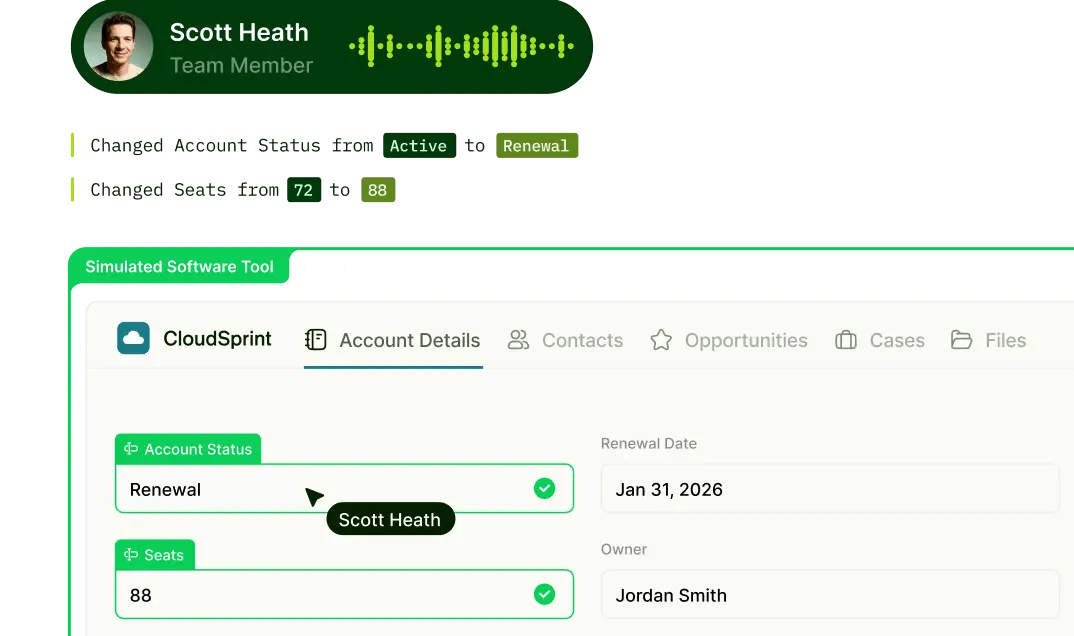
Agents need to say the right thing and complete the right workflow in the right system at the same time. A collections agent who handles the conversation correctly but fails to log the required notes in the CRM has still created a compliance failure.
ReflexAI's Prepare includes Software Simulations, overlays that let agents practice conversations while simultaneously navigating tools like CRMs or other systems, something conversation-only simulations miss entirely. An agent can nail the tone and the disclosure language in a roleplay, then freeze the first time they have to do it while also logging notes and pulling up an account screen. Practicing both together is what makes the rehearsal match the real job.
How can firms measure readiness and choose AI roleplay software?
Knowing how to build a simulation is one problem. Knowing whether it worked is another. Here's what you need to measure and what to look for in a platform.
Look for repeatable voice and chat practice
The single most important capability in an AI roleplay platform for compliance training is the ability to run the same scenario repeatedly, in both voice and chat, without any drop in quality or realism. A single practice run doesn't build the muscle memory required to handle a complaint call from an angry customer at 4pm on a Friday. Employees need to run the scenario until the correct response is automatic, not effortful, and the platform needs to hold up under that repetition.
Many compliance conversations happen by phone, and the dynamics of a voice conversation- tone, pacing, silence- are different from a text-based exchange. A platform that only supports chat practice leaves teams whose primary channel is voice without a way to rehearse the conversation as it actually happens.
ReflexAI's Prepare supports voice-first and multi-language simulations in 25+ languages, which matters for financial services teams with multilingual customer bases or phone-first service models.
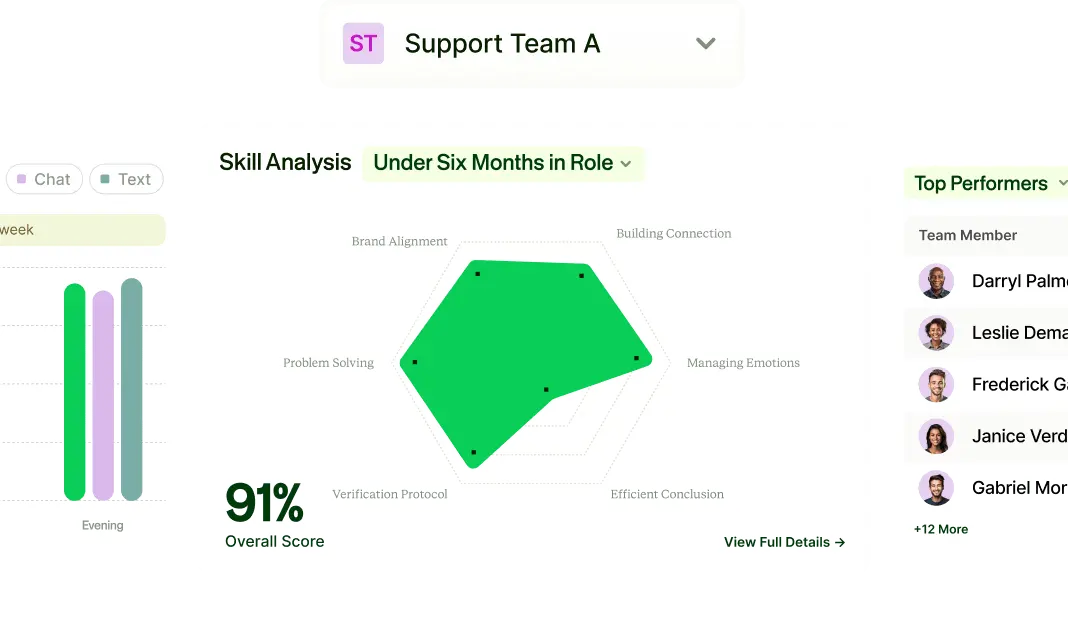
Track readiness by cohort, role, and risk area
Readiness data is only useful if it reaches the right person in the right form. A training manager needs to know which agents aren't yet ready for live calls. A compliance officer needs to see which conversation types are producing consistent errors across the team. A team leader needs to know which individuals need targeted coaching before a regulatory review. Three levels of tracking cover this.
- Individual level: Is this specific agent ready to handle a vulnerable customer conversation?
- Cohort level: Are new hires in this onboarding batch hitting the required standard before they go live?
- Risk area level: Are there specific scenario types, complaints, AML, disclosures, where the team is consistently underperforming?
ReflexAI's Assure supports cohort tracking and collaborative workspaces so teams can monitor performance patterns across groups and coach proactively rather than reactively.
Connect simulation results to QA across live interactions
Most AI roleplay platforms stop at the simulation. They tell you how an employee performed in practice, but not whether that performance translated to live calls. ReflexAI connects Prepare (simulations) with Assure (automated QA) so training outcomes can be measured against real interaction data.
The regulator doesn't care how an employee performed in training. They care how the employee performed with a real customer. Most compliance training programs are missing a way to connect what happens in practice to what actually happens on the call.
Here's an example. A team of agents completes a complaints-handling simulation and scores well. Two weeks later, your QA tool flags a pattern of complaints being mishandled on live calls. Without connecting simulation performance to live QA data, you have no way to know whether the training failed, the scenario was unrealistic, or the agents reverted under pressure.
Check security, privacy, and governance standards
Financial services firms operate under strict data governance requirements. Any AI roleplay platform that ingests real customer data, employee performance data, or proprietary compliance materials needs to meet enterprise security standards before it reaches procurement. This is a procurement requirement.
FINRA Regulatory Notice 24-09 backs this up directly. The notice states that FINRA's rules and securities laws remain fully applicable when firms use AI tools, and it flags accuracy, data privacy, bias, and governance as active risk areas. It also makes clear that outsourcing AI to a vendor doesn't shift the firm's supervisory obligations under Rule 3110. Vendor due diligence stays the firm's responsibility either way.
Standards a compliance-conscious buyer should confirm:
- SOC 2 certification: Confirms the vendor has controls in place for security, availability, and confidentiality.
- GDPR compliance: Required for any firm operating in or serving customers in the EU.
- HIPAA: Relevant if the platform is used by teams that also handle health-related financial products.
- Data residency: Where is employee and simulation data stored, and who can access it?
ReflexAI meets SOC 2, HIPAA, HITRUST, GDPR, and ISO 27001 standards, built in from the start rather than retrofitted.
FAQ
Can AI roleplay replace annual compliance training in financial services?
AI roleplay isn't a replacement for formal compliance certification programs. It is the practice layer that sits alongside them, giving employees repeated opportunities to apply what they have learned before they handle live interactions.
Can simulation performance data be used as audit evidence?
Simulation performance records, including scores, scenario completion, and improvement over time, can support an audit trail that demonstrates a firm's commitment to staff competency, though they should be paired with live QA data to show that trained behaviors transferred to real interactions.
How often should financial services firms update AI roleplay scenarios?
Scenarios should be reviewed whenever a relevant regulation changes, a new product is launched, or QA data reveals a pattern of errors in a specific conversation type, not on a fixed annual cycle. The ability to update and redeploy scenarios quickly is one of the practical advantages of AI roleplay platforms over traditional training content, which can take weeks to rebuild.
Can AI scoring be trusted for compliance training evaluation?
AI scoring should be measured against the alternative most firms actually use, periodic manual review of a small sample. Consistent evaluation against defined scoring dimensions across every practice attempt gives managers a more complete picture than spot-checking a handful of sessions each quarter.
How should financial services firms pilot AI roleplay before a full rollout?
Start with one conversation type that carries clear compliance risk and a defined standard, such as complaints handling or fee disclosures, and run a small cohort through the simulation before expanding. This approach lets teams validate that the scoring dimensions reflect their actual compliance standards and that the personas produce realistic enough pressure to be useful, without committing the full training program to a new tool.
How ReflexAI helps teams prepare for compliant conversations
ReflexAI is built around the problems this piece has been describing. Prepare delivers AI Training Simulations with configurable personas, custom scoring dimensions, voice and chat support, and software overlays for CRM simulation. Assure provides Automated Quality Assurance with 100% QA coverage of live interactions, cohort tracking, and a direct connection between simulation performance and live call data. ReflexAI Studio enables self-serve scenario building from any script, policy document, or prompt, deployable without engineering support. The platform meets SOC 2, HIPAA, HITRUST, GDPR, and ISO 27001 standards.
Are you looking to move your compliance training from annual modules to continuous, measurable practice? Schedule a demo