











Sales and services teams at financial services organizations, whether it’s a bank or wealth management firm, operate under a unique set of pressures.
They’re expected to do what all sales and service teams do: deliver an excellent customer experience, build trust, and drive growth. But they also have to operate within the constraints of a highly-regulated environment.
The stakes are real. A report found that global regulatory penalties against financial institutions totaled $4.6 billion in 2024 alone, which helps explain why the U.S. market for compliance training in the industry is projected to grow by $1.68 billion between 2024 and 2028.
What this ultimately means is that every conversation, every interaction, and every recommendation carries disproportionate weight. And it’s this combination that makes training in financial services fundamentally different – and far more complex – than in most other industries.
Why service and sales in financial services is uniquely challenging – and why it demands a specific type of training
Great service and effective sales depend on human judgment, adaptability, and trust. Regulation, by contrast, demands precision, consistency, and defensibility.
This push and pull – between what great service and sales require and what a highly regulated environment demands – is what makes financial services uniquely challenging. It’s also what fundamentally changes how sales and service teams must be trained.
Below are some of the core tensions that sales and service teams in financial services navigate every day:
Adaptability and accuracy
Financial services work is full of edge cases that require judgment: unexpected questions, incomplete information, and situations that don’t have simple yes-or-no answers.
At the same time, responses have to be precise, defensible, and aligned with approved language – whether it’s from an agent offering account support or a bank teller interacting face-to-face with a customer.
Example
During a discovery conversation, a prospect might ask how a certain type of account might perform in a market downturn or whether it would still make sense if their financial situation changes. The rep has to tailor the conversation to the individual’s concerns while avoiding hypotheticals that could be interpreted as guarantees or recommendations not fully supported by disclosures.
Compliance and empathy
Conversations about money are rarely neutral. They often surface anxiety, frustration, or fear – especially when something goes wrong. Sales and service teams are expected to meet those emotions with empathy, even as they operate within tight compliance boundaries.
This is especially important for financial services, which only narrowly entered the "trusted" category globally in 2024 and is still ranking near the bottom of all industries measured. Empathy is critical for bridging that trust gap
Example
A customer calling about a disputed charge, a frozen account, or suspected fraud is often stressed or upset. In these scenarios, the agent has to acknowledge those emotions and de-escalate the situation – without assigning blame, admitting fault prematurely, or deviating from established policy.
Speed and process discipline
Customers expect fast, efficient resolution when it comes to their finances, especially when something has gone wrong. At the same time, the compliance burden required to support those decisions has grown significantly.
According to the Bank Policy Institute, employee hours dedicated to compliance increased 61% between 2016 and 2023. And the same trend could be seen across C-suite time, board time, and IT budgets.
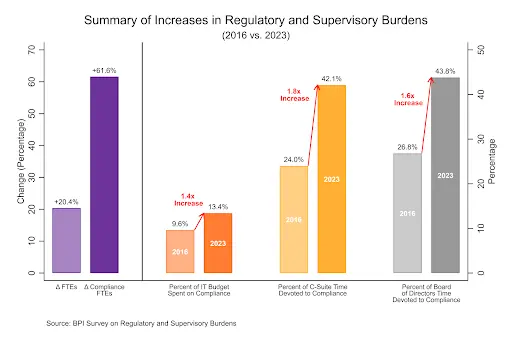
Financial services organizations rely on defined processes to make sure decisions are consistent and defensible, and that infrastructure doesn't disappear just because a customer is in a hurry.
Example
In high-volume service environments, agents often feel pressure to resolve issues as quickly as possible. But it’s critical for every interaction to be documented accurately: what was asked, what was said, and what actions were taken. Cutting corners to save time may speed up the moment, but it can create compliance gaps that surface later – during audits, investigations, or customer disputes.
AI-powered simulations: A new approach to training for sales and service teams in financial services
What these tensions reveal is that navigating financial services is ultimately a judgment problem, not a memorization problem. And it requires an approach to training that emphasizes the former.
This is where simulation-based training fundamentally changes what’s possible.
Unlike static training methods – such as module-based courses or scripted roleplay – AI simulations allow financial services organizations to train judgment under realistic conditions, and at scale. With the right platform, sales and service teams can:
- Practice realistic, regulated conversations end-to-end. Simulations can reflect real products, policies, disclosures, and workflows – while also capturing the emotional nuance of customer conversations. This gives sales and services teams the opportunity to practice full interactions in relevant contexts, rather than generic roleplays.
- Experience consequences in a safe environment. Instead of being told what could go wrong, learners can experience it firsthand with AI-powered simulations. Whether it’s a missed disclosure, a poorly handled objection, or an escalation that came too late, understanding exactly what the area for improvement looks like is a powerful way to build intuition and practice skills.
- Build compliance muscle memory under pressure. Repeated exposure to high-stakes scenarios also helps agents internalize compliant behavior, even when those conversations become complex or emotionally charged. Immersive learning programs have been shown to reduce time-to-competency by up to 60%, which in a regulated environment means less time to risk and faster value for the business.
Choosing the right simulation platform for your financial services organization
Not all simulation platforms are built for highly-regulated environments. When evaluating a platform, there are three areas that matter most:
- Security and compliance
- Auditability & reporting
- Functionality & realism
- Scalability & deployment
- Customization & configurability
- Vendor maturity & support
Category | What to evaluate | Why it matters in financial services |
Security & compliance | SOC 2 Type II, ISO 27001, and emerging AI-specific certifications (e.g., ISO/IEC 42001) | Table stakes for any vendor touching sensitive data — and increasingly expected by procurement and risk teams in regulated institutions. |
GDPR/CCPA compliance and clear data residency controls | You need to know exactly where data lives, how it moves, and that customer or employee data is never used to train underlying models. | |
Alignment with financial services-specific regulations (NYDFS 23 NYCRR 500, DORA, FFIEC) | Generic security postures aren't enough. Vendors need to understand the regulatory environment you operate in and be ready for your due diligence process. | |
Auditability & reporting | Timestamped, immutable records of training completion and scenario-level performance | Regulators may ask you to prove what training was in place at the time of an incident or complaint. "We trained them" isn't sufficient — you need specifics. |
Reporting that maps to risk categories (e.g., AML, UDAAP, fair lending, complaints) | Training programs should tie directly to the risks flagged in internal assessments. If you can't show that link, you have a gap. | |
Exportable, examiner-ready data and version-controlled content histories | When auditors come in, you need clean data you can pull on demand — not screenshots from a vendor dashboard. You also need to show what content was live when. | |
Functionality & realism | Ability to simulate real customer scenarios with policy-accurate responses | If the training doesn't mirror the actual conversations your teams have — with the right disclosures, holds, escalation paths — it's not preparing anyone for the real thing. |
Support for complex, branching interactions (not just scripted role-plays) | Financial services conversations are rarely linear. A customer calling about a fee dispute may surface a fraud concern mid-call. The platform needs to handle that. | |
Feedback and coaching tied to specific regulatory or quality behaviors | Generic "good job" feedback doesn't move the needle. Platforms should be able to flag when someone missed a required disclosure or handled an escalation incorrectly. | |
Scalability & deployment | Ability to roll out across multiple lines of business, geographies, or regulatory environments | A platform that works for one team but can't scale across retail banking, wealth, and insurance — or across US and EU regulatory contexts — creates more problems than it solves. |
Speed of onboarding and time-to-value for new teams or use cases | In financial services, product and regulatory changes happen fast. If it takes months to stand up a new training scenario, you'll always be behind. | |
Performance and reliability under volume (e.g., annual compliance training cycles) | When 10,000 people need to complete training in the same two-week window, the platform can't buckle. | |
Customization & configurability | Ability to embed your own policies, scripts, disclosures, and escalation logic | Off-the-shelf scenarios won't reflect your institution's specific procedures. The platform should bend to your policies, not the other way around. |
Ease of updating content as regulations or internal procedures change | Regulations shift, products change, and compliance teams issue new guidance constantly. If every update requires a vendor engagement or dev cycle, you'll fall behind. | |
Configurable scoring and evaluation criteria by role, LOB, or regulatory focus | What "good" looks like for a teller handling a cash transaction is different from a wealth advisor discussing suitability. One-size-fits-all scoring doesn't work. | |
Vendor maturity & support | Track record with financial services clients and understanding of the regulatory landscape | A vendor that's never worked in FS will underestimate the complexity. Look for evidence they understand model risk, examiner expectations, and the pace of regulatory change. |
Dedicated support, implementation resources, and a named account team | Financial services deployments are not self-serve. You need a partner who will show up for your compliance reviews, not just your renewal conversations. | |
Product roadmap transparency and willingness to co-develop for regulated use cases | The best vendors will tell you where their product is going and build with you — not just sell to you. In a fast-moving regulatory environment, that matters. |
Use ReflexAI’s AI-powered simulations to train your sales and service teams
Sales and service excellence in financial services isn’t about knowing more rules. It’s about making better decisions in complex, regulated conversations.
That’s why many financial services organizations are moving toward simulation-based training. With ReflexAI, you can give your teams the ability to practice critical skills, understand their roles, and build confidence – all without putting customers or compliance at risk.
To learn more, request a demo.