










Training is supposed to prepare agents before they go live. But most onboarding practice looks nothing like the calls agents actually take, so the real learning still happens on live customers.
Let's say a new hire completes onboarding and takes their first call, a customer disputing a charge while requesting account closure. Without guided practice on that exact scenario, the agent improvises through a high-stakes interaction.
New hires complete onboarding, check the boxes, and take their first live call still unsure how to handle the scenarios that actually come in. Unguided AI role play doesn't help much here. It gives agents practice talking, not practice meeting the QA standards and compliance requirements they'll be scored against.
The stakes aren't abstract. In Mata v. Avianca, lawyers filed court papers with nonexistent citations generated by ChatGPT and were sanctioned by the court (Mata v. Avianca, Inc., S.D.N.Y. 2023). A tool that produces confident, wrong output in a legal brief will do the same thing in a training environment with no guardrails.
Guided call simulations built around specific call types, real scoring rubrics, and defined readiness thresholds change that. Here's how to know when you need them and how to build them right.
What are guided call simulations for AI role play training?
Guided call simulations are AI role play scenarios built around specific call types, scoring rubrics, and feedback rules that mirror the standards agents face on live calls. Unlike unguided AI role play, where an agent enters a free-form conversation with no defined scoring or call-type context, guided simulations are configured with a specific scenario, a rubric tied to your actual QA standards, and structured feedback the agent can act on immediately.
Both modes have legitimate uses. The difference is whether the gap between practice and live performance is one your team can afford to leave open.
When do you need guided call simulations?
Your agents are taking live calls before they are ready. Training happened, but the practice just didn't reflect the calls they are actually handling. These are the signals that tell you guided simulations are necessary.
When calls carry compliance or customer risk
When agents handle calls governed by protocols, such as crisis lines, healthcare intake, financial services disclosures, or regulated customer support, unguided practice creates real exposure. A generic AI role play will not enforce required disclosures or flag protocol deviations.
The compliance stakes are concrete:
- HIPAA civil monetary penalties range from $145 minimum to $2,190,294 maximum per violation depending on culpability tier (HHS 2025 inflation-adjusted amounts, effective Jan. 28, 2026).
- FTC Health Breach Notification Rule allows civil penalties of up to $53,088 per violation for certain health apps not covered by HIPAA (FTC.gov).
- SEC recordkeeping failures resulted in combined penalties of more than $1.1 billion across 16 firms (SEC press release 2022-174).
Generic AI tools compound this risk. The U.S. Department of Health and Human Services prohibits entering protected health information into ChatGPT, and HHS guidance on HIPAA cloud computing requires a HIPAA-compliant business associate agreement when a cloud provider creates, receives, maintains, or transmits electronic PHI on behalf of a covered entity. FINRA reminds firms that existing rules apply when firms use generative AI, and firms must maintain compliant supervision systems for business use of those tools. The Mata v. Avianca sanction cited earlier makes the same point in a legal context: confident output is not the same as verifiable correctness.
When onboarding depends on live customer calls
In fast-scaling contact centers, new agents often go live before they are ready because there is no structured practice alternative. Guided simulations give new hires a safe environment to reach a defined readiness threshold before their first live interaction.
The cost of slow ramp is measurable:
- 55% of contact centers spend 6 to 12 weeks in combined training and nesting (ProcedureFlow, 2021).
- Fewer than 10% of centers report agents reach proficiency in under 2 months, with 42% taking 2 to 4 months and over a third taking 5 to 7 months (ProcedureFlow, 2021).
When QA scores vary by team or reviewer
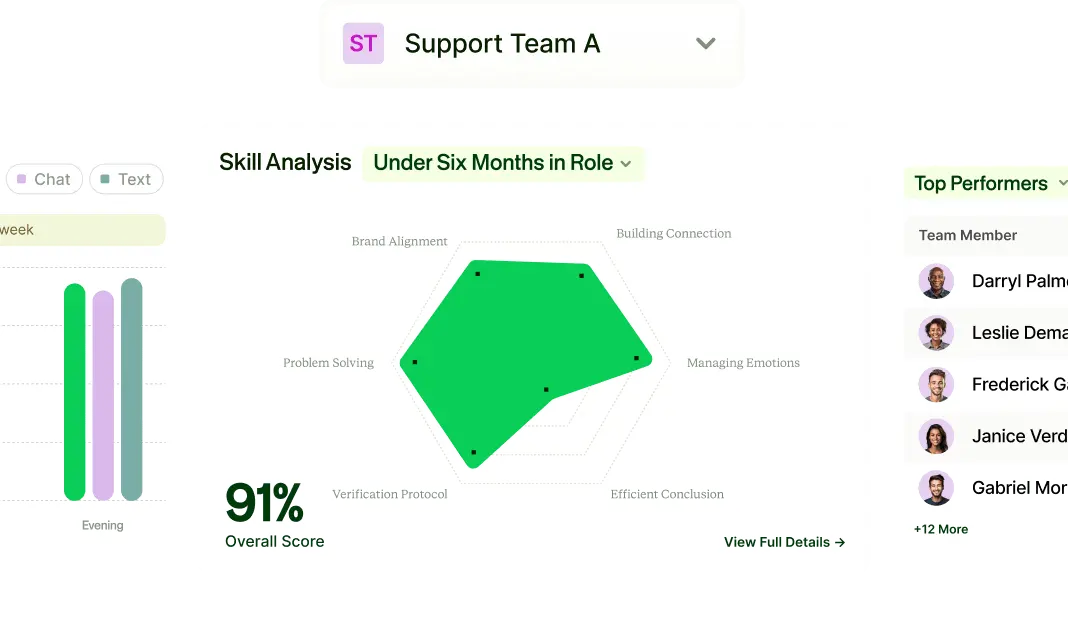
Inconsistent QA scoring across reviewers or teams usually means practice has not been calibrated to the same standards as evaluation. Guided simulations use the same rubric in training that QA uses in review, so practice and evaluation hold agents to the same standard, before the difference shows up in your scores.
When escalations reveal missing skills
A pattern of escalations is a reliable indicator that agents need structured practice on specific call types, not just more general exposure. SQM reports that 93% of customers expect their issue resolved on the first call, and each 1% improvement in first-call resolution reduces operating costs by approximately 1%. SQM also attributes 38% of non-first-call-resolution calls to the agent, versus 13% to the customer and 49% to the organization (SQM Group). Guided simulations can be built around the exact scenarios driving those escalations.
When unguided AI role play is enough
Unguided AI role play works for low-stakes skill-building where there is no protocol to enforce and no measurable readiness threshold to hit. A retail associate rehearsing a friendly greeting, or a new hire getting comfortable saying their intro out loud, doesn't need a scored simulation. There's no protocol to enforce and no readiness threshold to clear. The risk is low. When the goal is exposure rather than readiness, generic practice is sufficient.
What should guided call simulations include?
Four components separate structured practice from open-ended conversation. Each one brings practice closer to what agents actually face on live calls.
Realistic customer personas
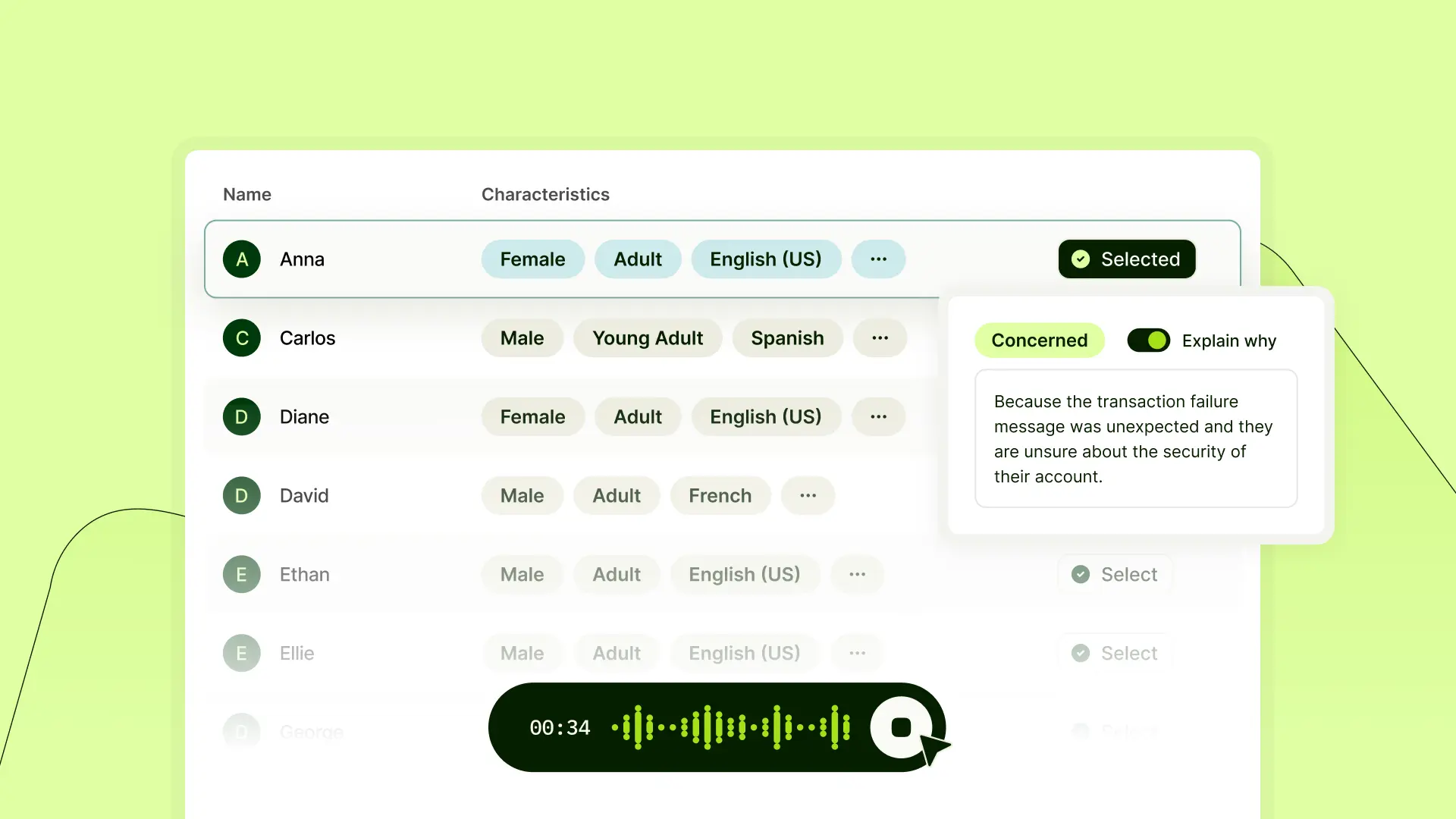
Personas should reflect the actual caller types agents will encounter, not generic "angry customer" archetypes. If your agents handle insurance claims, an effective persona might be a policyholder who filed a claim two weeks ago, is frustrated by lack of updates, and tends to interrupt when hearing scripted responses. Effective personas include a backstory, an emotional state, a specific issue, and behavioral cues like hesitation or escalation triggers that mirror real call patterns.
ReflexAI's Prepare product supports configurable personas built from a single prompt, with custom backstories, tones, and emotional responses that adapt in real time to a trainee's words, tone, hesitation, and emotions.
Custom scoring tied to QA standards
If agents are scored on empathy, protocol adherence, and resolution accuracy in production, those same dimensions should appear in simulation feedback. Generic scoring ("good job / needs improvement") does not prepare agents for how their live calls will actually be evaluated.
Research on rubric-based grading finds that LLM alignment degrades as rubric granularity increases, exactly the situation in contact centers where QA scorecards have many fine-grained behaviors like required disclosure wording, verification steps, and prohibited phrases. The same research finds robustness issues with synonym substitutions, a practical problem when agents paraphrase appropriately but a scoring model inconsistently penalizes them.
ReflexAI's Prepare supports custom scoring dimensions so organizations can mirror their evaluation criteria rather than forcing a generic rubric, and connects training outcomes to live QA results through the Assure product.
Voice, chat, and software workflow practice
Many contact center calls require agents to simultaneously manage a conversation and navigate a tool, whether a CRM, an EHR, or a ticketing system. A guided simulation that only covers the dialogue half of the job leaves agents fluent in the conversation but fumbling the workflow on their first live call, exactly when a missed field or a slow lookup derails the interaction.
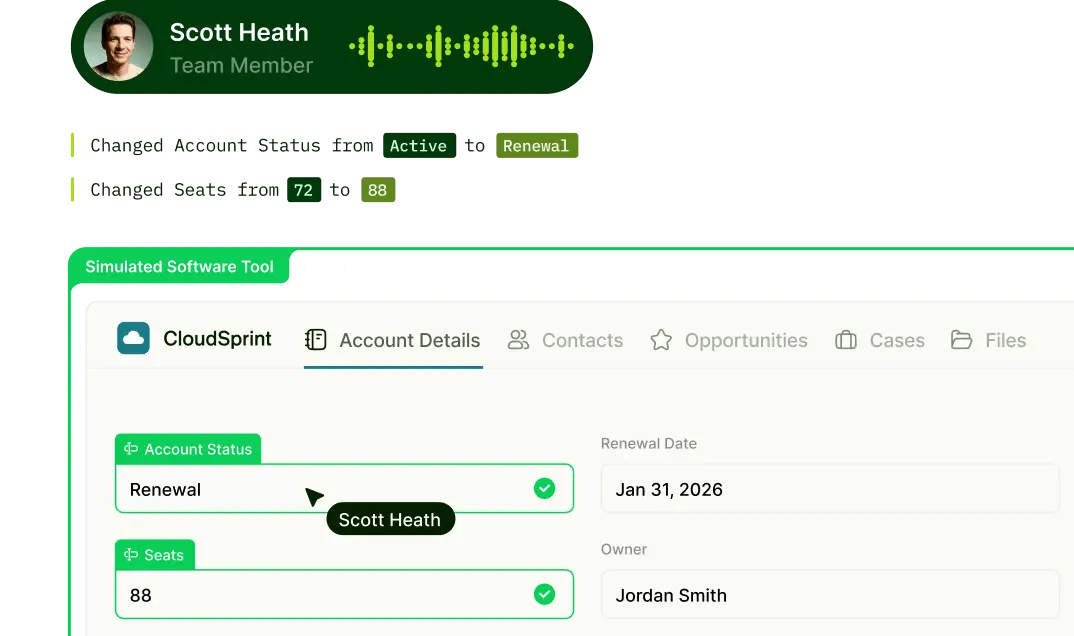
ReflexAI's Prepare includes software simulations that overlay CRM and EHR environments, allowing teams to simulate tools simultaneously with the conversation and bringing practice closer to the actual conditions of live work.
Feedback agents can use on the next attempt
Feedback should be specific, tied to the moment in the call where performance diverged from the standard, and actionable enough to change behavior on the next attempt. Imagine a scenario where an agent skipped the required fraud disclosure at the 2:15 mark. Effective feedback pinpoints that moment and provides the exact language needed, rather than a generic note to 'improve compliance.' A large-scale empirical analysis of GPT-4 feedback (Liang et al., 2023) shows the model is more likely to identify issues that multiple human reviewers also raised, and less likely to catch specialized or idiosyncratic critiques. In contact center QA, the highest-risk misses are often edge-case compliance and process exceptions, exactly the ones generic feedback skips.
How should teams launch guided AI role play training?
Getting guided simulations off the ground does not require a large team or a long build cycle. The fastest path to measurable impact follows four steps, starting with the call types that carry the most risk.
1. Start with high-risk call types. Identify the two or three call types with the highest escalation rate, most compliance sensitivity, or most common source of QA failures, and build simulations around those first.
2. Define readiness criteria before practice. Readiness criteria, the specific score or behavioral threshold an agent must hit before taking live calls, should be set before simulations go live. Without a defined pass threshold, teams have no way to know whether practice is translating into readiness.
3. Pilot one cohort and calibrate scores. Running a pilot with a small group of agents before full rollout allows teams to validate that simulation scoring aligns with live QA results. If agents who score well in simulation are still struggling on live calls, the scoring rubric needs adjustment.
4. Turn QA trends into targeted simulations. Teams with QA data can use it to identify the specific call types, behaviors, or protocol misses driving poor scores, then build simulations directly from those findings.
ReflexAI's Assure product automatically QAs 100% of conversations, surfaces the exact moments that impact scores, and converts flagged interactions into personalized simulations in Prepare. This closes the loop between measurement and practice so training stays aligned with live performance data.
How should leaders measure readiness?
Simulation completion is not the same as readiness. These six metrics tell you whether guided simulations are translating into live-call performance.
Metric | What it tells you |
Scenario pass rate | Whether agents can meet the defined readiness threshold in practice |
First attempt completion | Whether agents can perform without repeated attempts or coaching prompts |
QA score trend | Whether simulation performance is translating to improvement on live calls |
Escalation rate | Whether agents are resolving calls that previously required escalation |
Ramp time | Whether new hires are reaching live-call readiness faster than before |
Coaching hours per agent | Whether managers are spending less time on remediation and more on development |
If simulation scores are improving but QA scores and escalation rates are not moving, the simulation rubric likely needs to be recalibrated against live call data. CAQH Index reports providers and staff spend approximately 24 minutes on average requesting prior authorization using phone, fax, or email (2024 CAQH Index Report). Patient access and registration errors are a leading driver of claim denials, a front-end error that creates back-end cost when arguing for workflow-faithful simulations for intake and eligibility verification conversations.
FAQ
What is the difference between guided call simulations and standard AI role play training?
Guided call simulations are configured around specific call types, scoring rubrics, and readiness thresholds. Standard AI role play is open-ended practice without structured evaluation criteria. In a call where an agent needs to practice HIPAA-compliant patient verification, a guided simulation would score them on required identity checks, while standard role play would just let them talk through the call without measuring compliance.
Can AI call simulations replace human coaches in a contact center?
AI simulations handle the repetitive practice volume that human coaches cannot scale to. A single coach might observe 5-10 practice calls per day, while AI can deliver hundreds. Human coaches remain essential for nuanced feedback, motivation, and handling edge cases that fall outside a simulation's configuration.
How often should contact center agents practice with guided call simulations?
Practice frequency depends on the complexity of the call type and the agent's current readiness level. New hires typically need 3-5 simulation sessions per week during their first 30 days, while experienced agents benefit from 1-2 targeted sessions when new protocols or call types are introduced.
Do guided call simulations work for voice and chat channels?
Yes. Guided simulations can be configured for both voice and chat interactions, and the most effective programs practice agents on the specific channel mix they will handle in live work.
How secure should AI role play training platforms be for contact centers handling sensitive data?
Contact centers handling sensitive customer data in healthcare, financial services, or crisis support should require platforms that meet relevant compliance standards (SOC 2, HIPAA, HITRUST) before allowing any call content or customer scenario data to be used in training environments. ReflexAI meets the highest global standards, including SOC 2 Type 2, HIPAA, HITRUST, GDPR, and ISO 27001.
How ReflexAI helps teams prepare before live calls
ReflexAI's Prepare product delivers AI-powered conversation simulations built for high-stakes, high-volume environments, with configurable personas, custom scoring dimensions, and realistic call scenarios tailored to your team's context. Agents walk into their first live call ready, and leaders can see that readiness in the data before it shows up in results.
Prepare is built to work alongside Assure, our QA and conversation intelligence platform, so training and real performance are always speaking the same language.