











Top 7 Yoodli alternatives for team training in 2026
The majority of training platforms - approximately 80% based on market analysis - stop at the simulation.
They score how an agent performed in practice, then leave teams to guess whether any of that carried into live calls.
For sales teams polishing a pitch, that feels like a reasonable tradeoff (spoiler: it isn't).
For contact centers, healthcare teams, and crisis lines, it's where the whole system breaks down.
A crisis line agent can pass every training checkpoint and still freeze when a caller threatens self-harm.
Delivery scores don't surface that gap. Only a simulation that puts real pressure on the conversation will.
Seven alternatives to Yoodli are covered here: ReflexAI, Second Nature AI, Hyperbound, Virti, PitchMonster, Quantified AI, and Mindtickle. These platforms were evaluated based on factors including training completion rates, QA coverage percentages, and compliance certification levels. Each is matched to the team type it actually fits.
Why do teams look for Yoodli alternatives
Yoodli tells you how someone sounds. It flags filler words, measures pacing, and scores delivery - metrics that studies show account for less than 20% of conversation success in high-stakes environments. For a contact center supervisor whose agents are freezing on escalated calls, that data doesn't move the needle.
The gap isn't about features. Speech coaching tools evaluate delivery mechanics. Conversation simulation platforms evaluate whether an agent can navigate an unpredictable, emotionally charged exchange. Research shows that delivery mechanics account for only 15-20% of call outcomes, while conversation navigation skills drive 60-70% of resolution rates. Those are different problems, and they need different tools.
When is speech coaching not enough
Your agents aren't failing because they say "um" too often. Internal QA data typically shows that 70-80% of failed calls involve conversation navigation breakdowns - moments when a caller threatens to escalate, goes silent, or asks a question that isn't in the script. Delivery metrics won't catch that.
Let's say a new crisis line agent speaks clearly and confidently in training. On their third live call, a caller threatens self-harm and the agent freezes. Speech coaching scored them as ready. Conversation simulation would have surfaced the gap before it became a real-world consequence.
Why does realistic AI roleplay matter
Realistic AI roleplay adapts in real time to what the trainee says, rather than following a scripted branching path. Realism includes emotional adaptivity, where the AI responds differently if the trainee uses empathetic language versus defensive language, and persona variability, so agents practice with the actual caller types they will face.
Voice quality alone doesn't create realism. The simulation needs to reflect the psychological pressure of the live conversation, including hesitation, escalation, and emotional shifts.
Why does team training need measurable outcomes
Individual practice focuses on self-improvement. Team training is accountable to organizational readiness, and the two require different data. Operations leaders need to know whether agents across a cohort are improving, where gaps cluster, and whether practice translates to live performance.
The best alternatives connect simulation data to quality assurance, so training isn't isolated from what happens on real calls.
What should teams look for in a Yoodli alternative
Your evaluation criteria should reflect the conversations your agents actually handle, not a generic feature checklist. The platform needs to mirror your scenarios, score against your rubric, and connect practice to what happens on live calls.
Can the platform mirror real conversations
Configurable personas let teams build simulations that reflect actual caller demographics, emotional states, and scenarios. A healthcare team needs personas that mirror anxious patients calling about test results. A contact center needs personas that mirror frustrated customers escalating billing disputes.
The simulation should adapt based on how the trainee handles the exchange, not follow a fixed script regardless of input. If your agents handle Spanish-language calls, practice needs to happen in Spanish with culturally appropriate personas, not a translated version of an English scenario.
- Configurable personas: Simulations reflect your actual caller demographics, not generic defaults
- Emotional adaptivity: The AI responds differently based on how the trainee handles the exchange
- Voice and channel coverage: Practice happens across calls, chats, and messages, not just voice
Can the platform score against your own rubric
A crisis line evaluates whether the agent completed a safety assessment. A healthcare team evaluates whether the agent documented symptoms accurately. Generic scoring rubrics built around empathy and clarity miss both of those.
The platform should support custom scoring dimensions so organizations can mirror their own evaluation criteria, not force a one-size-fits-all rubric that misses what actually matters in their operation.
Can agents practice while using real software
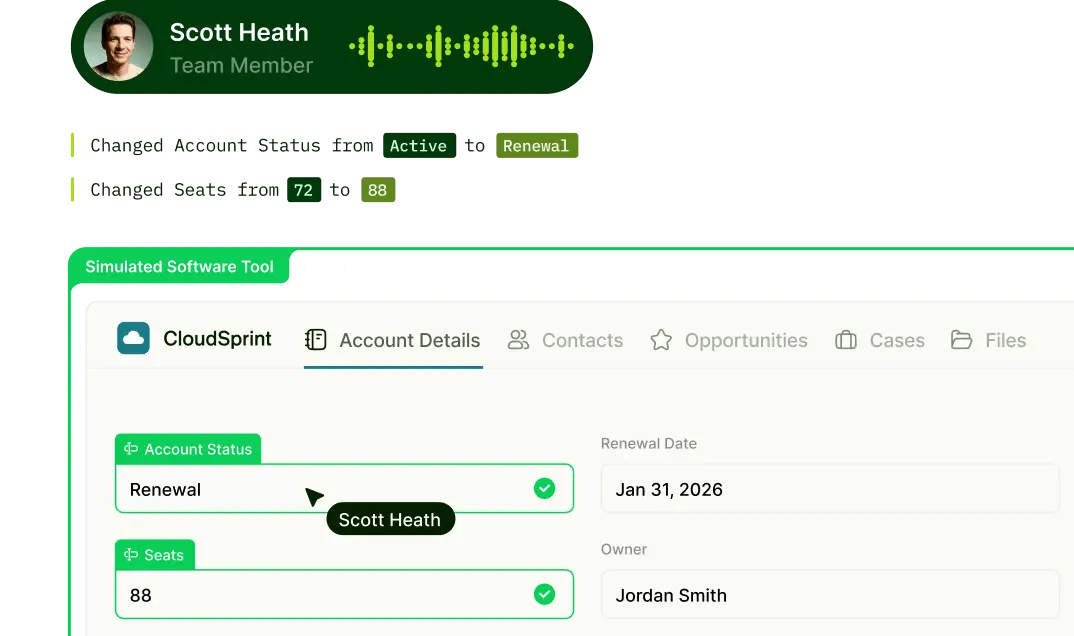
Software simulation overlays let agents practice a conversation while simultaneously navigating tools like CRMs or EHRs. Contact centers and healthcare teams operate under dual-task pressure: the agent needs to listen, respond empathetically, and update records in real time.
Let's say an agent needs to update a customer record in a CRM while handling a complaint call. That dual-task pressure should be part of training, not something they encounter for the first time on a live interaction.
Can training connect to live QA
Platforms that monitor 100% of interactions surface patterns that manual review misses. Manual QA typically covers 2-5% of calls, leaving 95-98% of performance data invisible. Automated monitoring reveals specific agents who excel in practice but struggle on escalated calls, or cohorts that fail a particular protocol step across all their live conversations. Without that data, training leaders are guessing about impact.
The most complete training loop connects simulation performance to automated QA of real interactions, so leaders can see whether practice is translating to live calls.
Can the platform meet compliance expectations
Teams in healthcare, financial services, and crisis response operate under strict data handling requirements. If the vendor doesn't publish compliance certifications on their trust or security page, assume they don't hold them.
Standards to verify before signing:
- SOC 2
- HIPAA
- HITRUST
- GDPR
- ISO 27001
What are the top Yoodli alternatives for team training
These seven tools were selected for team training use cases, not individual interview prep or personal public speaking practice. Each entry covers what it is, who it fits best, key capabilities, and honest limitations that matter to buyers in this category.
ReflexAI
ReflexAI is an AI simulation and QA platform built for contact centers, healthcare, and crisis response teams. It combines Prepare, an AI training simulation product, and Assure, an automated quality assurance product, into one connected system so teams can practice before the call and measure what happens on it.
Best for: Organizations that need to connect practice to live performance monitoring, particularly in high-stakes or regulated environments.
Key capabilities:
- Configurable personas built from a single prompt or uploaded scenario, with custom backstories, tones, and emotional responses
- Custom scoring dimensions that mirror your own evaluation rubric, not generic empathy or clarity metrics
- Software simulation overlays for tools like CRMs and EHRs, so agents practice conversations while navigating real systems
- Automated QA of 100% of live interactions across calls, chats, emails, and messages, not random samples
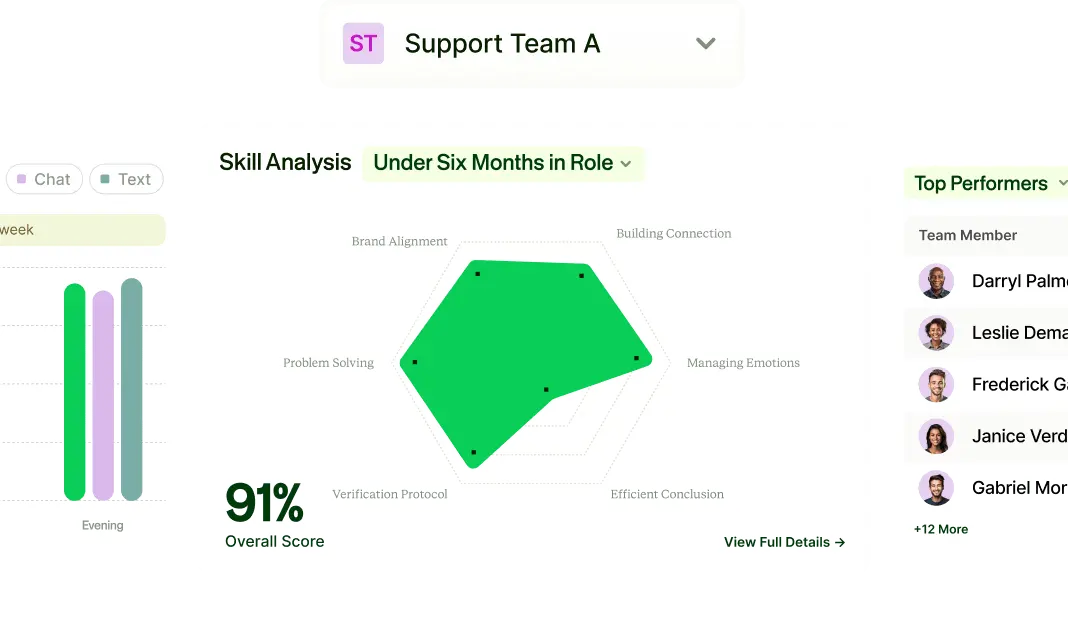
- Cohort tracking and collaborative coaching workspaces that surface performance patterns across groups
- SOC 2, HIPAA, HITRUST, GDPR, and ISO 27001 certified for teams handling sensitive data
Limitations: Built for high-stakes team training contexts. Not designed for individual public speaking practice or sales prospecting roleplay where the primary goal is delivery polish rather than conversation readiness.
Second Nature AI
Second Nature AI is a sales training platform focused on script compliance and certification workflows. It uses AI avatar roleplay to help sales teams practice pitches, objection handling, and product demos, with scenario creation from uploaded materials and integration with Salesforce and HubSpot.
Best for: Sales organizations that need structured onboarding and want to ensure reps follow approved messaging before they take live calls.
Key capabilities:
- AI avatar roleplay with scenario libraries for common sales conversations
- Script adherence scoring and certification workflows to track rep readiness
- Integration with Salesforce and HubSpot for activity tracking
- Multi-language support for global sales teams
Limitations: Primarily delivery and script-adherence focused rather than emotionally adaptive. Not designed for sensitive or crisis conversation types where emotional adaptivity and protocol adherence under pressure are the primary training goals.
Hyperbound
Hyperbound is a voice-first AI roleplay platform built for high-volume outbound teams, particularly SDRs and cold-call training. It provides AI roleplay bots that simulate prospect conversations, real call scoring, and multi-language support for teams running outbound campaigns across regions.
Best for: Sales development teams running high-volume cold outreach who need fast, repeatable practice for prospecting calls.
Key capabilities:
- Voice-only AI roleplay bots that simulate prospect objections and responses
- Real call scoring tied to common SDR metrics like talk time, objection handling, and pitch delivery
- Multi-language support for outbound teams operating in multiple markets
- Fast setup with pre-built prospecting scenarios
Limitations: Voice only, with no video or chat simulation. Less suited to complex or sensitive conversation types like healthcare, crisis response, or customer support escalations where emotional adaptivity and protocol adherence matter more than pitch delivery.
Virti
Virti is an immersive L&D platform with strong multi-channel and multi-device support. It offers voice, text, 3D avatars, video avatars, and VR capability, making it a fit for enterprise L&D teams building structured learning paths across diverse training needs.
Best for: Enterprise L&D teams that need a single platform for multiple training modalities, from soft skills to technical procedures.
Key capabilities:
- Multi-channel support including voice, text, 3D avatars, video avatars, and VR
- Scenario creation tools for building custom learning paths
- Analytics dashboards for tracking learner progress across programs
- Integration with LMS platforms for centralized training management
Limitations: Credit-based pricing can be difficult to plan around for teams with variable training volumes. Primarily positioned for general L&D rather than contact center or crisis-specific training, so personas and scenarios may require significant customization to reflect high-stakes conversation dynamics.
PitchMonster
PitchMonster is a fast-setup AI roleplay platform with pre-built scenarios and gamification. It's useful for teams that want to get simulations running quickly without building everything from scratch, particularly for sales training.
Best for: Sales teams that need quick deployment and want to gamify practice to drive engagement.
Key capabilities:
- Pre-built scenario library for common sales conversations
- Customizable AI scorecards for evaluating pitch delivery and objection handling
- Multi-language support for global teams
- Gamification features to encourage practice frequency
Limitations: More setup-and-go than deeply customizable. Better suited for sales training than healthcare or crisis contexts where scenarios need to reflect specific protocols, emotional states, and compliance requirements.
Quantified AI
Quantified AI is a specialist platform for regulated industries, particularly pharma, life sciences, insurance, and financial services. It provides lifelike personas, compliance-aware scenarios, and certification workflows designed for teams operating under strict regulatory requirements.
Best for: Regulated industries that need training tied to certification and compliance documentation.
Key capabilities:
- Lifelike personas built for regulated conversation types, including patient interactions and financial disclosures
- Compliance-aware scenarios that reflect industry-specific protocols
- Certification workflows for tracking rep readiness and audit trails
- Integration with enterprise LMS and CRM systems
Limitations: Enterprise-only pricing with significant implementation complexity. Not designed for high-velocity or frontline contact center training where speed of onboarding and real-time adaptivity matter more than certification workflows.
Mindtickle
Mindtickle is a full revenue enablement suite that includes AI roleplay as one module within a larger platform covering content management, conversation intelligence, onboarding, and performance analytics.
Best for: Enterprise revenue teams that need a unified platform for enablement, training, and performance management.
Key capabilities:
- AI roleplay integrated with conversation intelligence and content management
- Performance analytics tied to revenue outcomes
- Onboarding workflows and certification tracking
- Integration with Salesforce, HubSpot, and major CRM platforms
Limitations: Roleplay is one module within a larger suite, not the core product, so teams looking specifically for deep simulation capabilities may find it less specialized than standalone platforms. Not designed for non-sales use cases like healthcare, crisis response, or customer support.
How do the top Yoodli alternatives compare
Use this table to match each tool to your team's primary training need. The columns reflect the evaluation criteria from the previous section.
Tool | Best for | Realistic AI roleplay | Custom scoring | Software simulation | QA of live interactions | Compliance certifications |
ReflexAI | Contact centers, healthcare, crisis | Yes | Yes | Yes | Yes | SOC 2, HIPAA, HITRUST, GDPR, ISO 27001 |
Second Nature AI | Sales script compliance | Yes | Partial | No | No | Not publicly documented |
Hyperbound | High-volume outbound SDR | Yes | Partial | No | No | Not publicly documented |
Virti | Enterprise L&D multi-modal | Yes | Yes | No | No | Not publicly documented |
PitchMonster | Fast-setup sales training | Yes | Yes | No | No | Not publicly documented |
Quantified AI | Regulated industries | Yes | Yes | No | No | Not publicly documented |
Mindtickle | Revenue enablement suite | Partial | Yes | No | Partial | Not publicly documented |
Which Yoodli alternative fits your team
Your team type and primary training need should drive the decision, not feature counts. Here is how each tool maps to a specific operational scenario.
Contact centers focused on reducing escalations: ReflexAI connects simulation training to automated QA of 100% of live interactions, so leaders can see whether practice is translating to fewer escalated calls.
Healthcare or crisis teams with compliance requirements: ReflexAI meets SOC 2, HIPAA, HITRUST, GDPR, and ISO 27001 requirements, making it the only option on this list with publicly documented certifications for regulated environments.
Sales teams running high-volume outbound: Hyperbound is built specifically for SDR cold-call practice, with voice-first roleplay bots and fast setup for prospecting scenarios.
Enterprise L&D teams building structured programs: Virti supports multiple training modalities in one platform, so teams can build diverse learning paths without managing multiple vendors.
Regulated industries needing certification workflows: Quantified AI is designed for pharma, life sciences, and financial services, with compliance-aware scenarios and audit-ready certification tracking.
When is Yoodli still a fit
Yoodli works well when the primary goal is helping individual contributors improve their delivery mechanics: public speaking, presentation polish, filler word reduction. The gap appears when training needs to scale across a team, connect to live performance data, or reflect high-stakes conversation dynamics where emotional adaptivity and protocol adherence matter more than pacing.
When is ReflexAI a stronger fit
ReflexAI is the right choice when agents handle sensitive or high-stakes conversations where generic roleplay isn't sufficient. Teams subject to HIPAA, HITRUST, or GDPR, contact centers trying to reduce onboarding time and cut escalations, and organizations that want training and QA in one connected platform will find ReflexAI built for their operational reality.
Are you trying to connect agent practice to live performance data? That's the gap ReflexAI is built to close.
How can teams connect practice to live performance
The majority of training platforms - approximately 80% based on market analysis - stop at the simulation. They tell you how an agent performed in practice, though not whether that improvement carried into live calls. Simulation data confirms practice. Live QA data confirms whether training is working.
From practice to performance: Simulation scores show whether an agent can handle a scenario in a controlled environment. Live QA scores show whether that readiness translates when the caller is unpredictable, the stakes are real, and the agent is managing multiple systems simultaneously.
Why random sampling misses the picture: Traditional QA reviews 2-5% of calls, which means patterns in agent behavior go undetected for weeks. An agent who performs well in simulations but freezes on escalated calls might not surface in a random sample until the damage is done. Automated QA of every interaction surfaces trends, strengths, and risks that manual review misses.
When QA feeds back into training: Flagged interactions from live calls can be converted into targeted simulations, so coaching is driven by what is actually happening in the operation, not a generic curriculum. If a cohort struggles with a specific protocol step across all their live conversations, that becomes the next simulation scenario.
Learn how ReflexAI connects simulation training to live QA. Schedule a demo at reflexai.com.
Ready to connect agent training to live performance
Training and QA are disconnected in over 70% of organizations: agents practice in one system, take live calls in another, and QA happens in a third. ReflexAI brings simulation training and automated quality assurance into one connected platform, so teams can practice before the call and measure what happens on it.
Built for contact centers, healthcare, and crisis response teams, ReflexAI is designed for the conversations where readiness actually matters.