











Top 6 Solidroad alternatives for team training in 2026
Most contact centers are only able to review 3 to 5% of live calls.
The other 95% goes unmonitored, which means coaching decisions get made from a thin slice of data that may not reflect what's actually happening across the team. By the time a pattern shows up in that sample, it's already compounded.
Solidroad tries to address this, but it has limits - particularly for teams that need agents to practice CRM or EHR navigation alongside the conversation itself, or for organizations operating under HIPAA and HITRUST requirements.
The six platforms in this article - ReflexAI, Observe.AI, Playvox, Rippit, Mursion, and Rehearsal - each take a different approach to closing that gap, with coverage capabilities ranging from partial text-only QA to 100% automated evaluation across all channels. Here's what each one actually does and where it falls short.
Why teams look for Solidroad alternatives
Most contact center leaders searching for Solidroad alternatives have hit one of two walls: agents are going live underprepared, or QA is reviewing 3 to 5% of calls while the other 95% goes unmonitored. When training and QA live in separate tools, coaching is based on outdated snapshots rather than real performance data, and gaps compound before anyone catches them - often taking 2-4 weeks to surface in sampled reviews.
Why training and QA need the same readiness loop
Agents practice scenarios in one tool and get scored on live calls in another, and the two datasets never connect to show whether practice transferred to performance. The result is a readiness gap that only becomes visible after a customer escalation, with studies showing up to 40% of early-tenure escalations trace back to training gaps.
When Solidroad may not match your training model
Solidroad is built for B2C contact center teams handling general customer experience interactions. Several scenarios push teams toward alternatives:
- Regulated industries: Teams subject to HIPAA, HITRUST, or ISO 27001 audits need a compliance posture Solidroad does not publicly confirm
- Voice-first, multilingual training: Organizations running simulations in 25+ languages need a platform built for voice, not just text
- High-stakes conversations: Crisis lines, behavioral health teams, and sensitive financial services operations need simulations designed for emotional complexity, not general CX
- Software simulation requirements: Teams that need agents to practice CRM or EHR navigation alongside the conversation itself will not find that capability in Solidroad
What to look for in a Solidroad alternative
Five capabilities separate platforms that close the readiness gap from those that just add another dashboard to manage - and teams that implement all five see 30-50% faster time-to-proficiency. Each one addresses a specific failure point in how most teams currently train and measure performance.
Realistic AI training simulations
An AI training simulation is a practice environment where agents interact with a configurable AI persona before handling live conversations, with the simulation adapting in real time to the agent's words, tone, and hesitation. Generic roleplay with scripted responses does not prepare agents for live unpredictability - research shows realistic simulations improve skill transfer by 25-40% - so realism, including emotional adaptivity and voice support, determines whether practice actually transfers.
Custom scoring and QA rubrics
Scoring models built from your own SOPs and evaluation criteria ensure QA results align with what leadership actually measures, while generic scorecards create a gap between what gets scored and what gets coached. Custom rubrics also reduce reviewer bias by up to 35% and make performance data defensible during audits.
Software simulations for live workflows
Software simulations layer the actual tools agents use (CRMs, EHRs, ticketing systems) alongside the conversation during practice. Approximately 80% of training platforms omit this entirely, leaving agents to navigate multiple screens and update records mid-call for the first time during a live interaction.
Automated QA across every interaction
Teams cannot coach what they cannot see, and random sampling at 3 to 5% coverage misses the patterns that drive escalations. Automated QA at 100% coverage enables cohort tracking and surfaces performance trends across teams and regions 10x faster than relying on a handful of reviewed calls.
Enterprise security and compliance
Teams in healthcare, crisis, and financial services need certifications such as SOC 2, HIPAA, HITRUST, GDPR, and ISO 27001 because compliance gaps disqualify vendors in over 60% of enterprise evaluations before the process even begins.
At a glance
Platform | AI Training Simulations | Custom Scoring | Software Simulations | Automated QA (100%) | Compliance |
ReflexAI | Yes | Yes | Yes | Yes | SOC 2, HIPAA, HITRUST, GDPR, ISO 27001 |
Observe.AI | Partial | Yes | No | Yes | SOC 2, HIPAA, HITRUST r2, GDPR, ISO 27001 |
Playvox | No | Yes | No | Partial (text only) | SOC 2 Type II |
Rippit | No | Yes | No | Partial (human-driven) | SOC 2, HIPAA, GDPR, ISO 27001 |
Mursion | Yes (human-led) | No | No | No | SOC 2, GDPR |
Rehearsal | Partial (async video) | No | No | No | Not publicly confirmed |
The top Solidroad alternatives for team training
Each platform below addresses a different operational priority. Some focus on QA and coaching workflows, others on pre-live practice, and a few attempt to bridge both.
1. ReflexAI
ReflexAI is a simulation and QA platform purpose-built for high-stakes conversations in crisis, healthcare, and contact center environments. Its two products, Prepare (AI Training Simulations) and Assure (Automated Quality Assurance), run on a shared platform so QA findings from live calls feed directly into personalized practice scenarios.
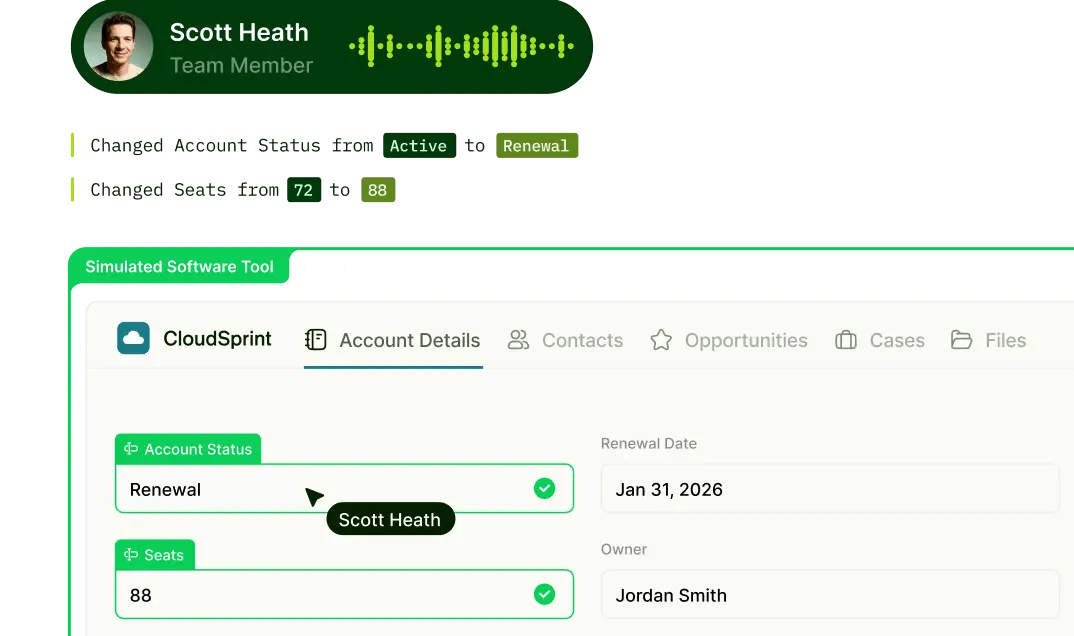
What it does well: Prepare delivers voice-first AI simulations in 25+ languages with configurable personas that adapt in real time to an agent's tone, hesitation, and emotional cues. Teams build scenarios from a single prompt using ReflexAI Studio, a no-code system that generates simulations and scoring models from any script, file, or protocol document in minutes. Software simulations overlay CRM, EHR, or ticketing system navigation alongside the conversation, so agents practice both the dialogue and the workflow in the same session. Assure automatically evaluates 100% of calls, chats, emails, and messages using custom scoring dimensions that mirror each organization's rubrics and protocols, and flagged interactions convert automatically into personalized simulations in Prepare.
Where it falls short: ReflexAI is purpose-built for high-stakes, complex conversations and may be more than general CX teams need if their interactions are low-complexity and do not require software overlay simulations or multilanguage support.
Best fit: Organizations handling crisis calls, behavioral health conversations, healthcare interactions, or sensitive financial services where a poorly handled exchange has real consequences, and teams that need both pre-live simulation practice and 100% automated QA in one platform.
2. Observe.AI
Observe.AI is a conversation intelligence and QA platform designed for large contact centers that prioritize real-time agent guidance during live calls alongside post-call quality evaluation.
What it does well: Auto QA analyzes every call, chat, and message, giving leadership full visibility into agent performance patterns across teams and regions. Real-time agent assist features provide in-call guidance based on conversation context. Observe.AI holds SOC 2, HIPAA, HITRUST r2, GDPR, and ISO 27001 certifications, making it a strong option for regulated industries that need defensible QA coverage.
Where it falls short: Training simulation capability is more limited compared to platforms purpose-built for pre-live practice. Teams that need agents to practice CRM navigation or EHR workflows alongside conversational skills will not find that capability in Observe.AI's public product offering.
Best fit: Large contact centers focused on in-call coaching and post-call QA rather than pre-deployment simulation readiness. Choose Observe.AI when 100% automated QA coverage and strong compliance posture are the primary requirements and pre-live AI roleplay is secondary.
3. Playvox
Playvox is a workforce management and QA platform that combines scheduling, performance management, and automated quality evaluation in one system.
What it does well: AutoQA delivers insight into 100% of text-based interactions (email, chat, social), eliminating the blind spots of random sampling for digital channels. Coaching workflows route QA findings to supervisors and managers, and workforce management features handle scheduling and adherence tracking alongside quality evaluation.
Where it falls short: The "100% coverage" claim is explicitly anchored in text-based interactions, not voice. Playvox does not offer AI-driven training simulations or software overlay simulations as core products. Compliance certifications beyond SOC 2 Type II are not publicly confirmed, which may disqualify Playvox for teams in healthcare or crisis environments.
Best fit: Teams that need QA and scheduling in one place and are not prioritizing simulation-based pre-training. Avoid Playvox when voice channel coverage or HIPAA and HITRUST compliance are non-negotiable requirements.
4. Rippit (formerly MaestroQA)
Rippit rebranded from MaestroQA in February 2026, repositioning from quality management software to a broader conversation analytics platform spanning VoC, RevOps, and customer success use cases. That shift matters for buyers evaluating long-term vendor commitment to contact center QA, as platform pivots correlate with 20-30% feature deprecation within 18 months.
What it does well: Rippit provides quality management, coaching workflows, and conversation analytics with workflow automations that route findings to supervisors and managers. The platform holds SOC 2 Type 2, HIPAA, GDPR, and ISO 27001 certifications.
Where it falls short: Rippit explicitly references "human-driven assessments" rather than fully automated QA, so teams still rely on manual review capacity to scale quality coverage. The rebrand signals that long-term product investment may prioritize analytics use cases over agent training and quality management. HITRUST certification is not publicly listed on Rippit's trust center.
Best fit: Teams that need conversation analytics across VoC, RevOps, and customer success, not just agent training and QA. Choose Rippit when coaching workflow infrastructure and analytics breadth matter more than pre-live simulation readiness.
5. Mursion
Mursion is a human-in-the-loop simulation platform that uses live human simulators (called Simulation Specialists) rather than fully automated AI personas, with sessions running approximately 25 minutes each.
What it does well: The human-driven approach produces emotionally nuanced practice for sensitive interpersonal skill development - with learner satisfaction scores averaging 15-20% higher than AI-only simulations - particularly for leadership training, DEI programs, or scenarios requiring deep empathy and judgment. Mursion holds SOC 2 and GDPR compliance.
Where it falls short: Each session requires a live facilitator, so teams cannot run simulations on-demand at scale. Mursion does not publicly claim HIPAA, HITRUST, or ISO 27001 certifications, and the platform does not offer automated QA across live interactions or software overlay simulations.
Best fit: Organizations that require human-facilitated roleplay for sensitive interpersonal skill development rather than high-volume frontline agent readiness. Avoid Mursion when scalability, on-demand availability, or regulated industry compliance are primary requirements.
6. Rehearsal
Rehearsal is an asynchronous video-based practice platform where learners record responses to prompts and receive peer or manager feedback after the fact, not in real time.
What it does well: Rehearsal provides structured video practice for sales enablement and onboarding teams focused on pitch delivery, product demos, or presentation skills. The asynchronous format lets learners practice on their own schedule without coordinating live sessions, increasing practice completion rates by up to 40%.
Where it falls short: Recording a response to a static prompt does not prepare agents for live conversations where tone, objections, and emotional cues shift mid-interaction - agents trained only on static prompts show 25-35% lower first-call resolution rates. Rehearsal offers no software overlay simulations, no automated QA across live interactions, and no publicly confirmed compliance certifications for regulated industries.
Best fit: Sales enablement and onboarding teams focused on pitch delivery and presentation skills rather than real-time conversational readiness for high-stakes customer interactions.
Which Solidroad alternative fits your team
The right platform depends on the stakes of your conversations, the gap in your current process, and whether your team needs training, QA, or both in one system.
- If high-stakes conversations drive risk: Let's say your team handles crisis calls, behavioral health conversations, or sensitive financial interactions where a poorly handled exchange has real consequences, including regulatory violations, patient harm, or escalations that damage brand reputation. ReflexAI is the only platform in this set that meets SOC 2, HIPAA, HITRUST, GDPR, and ISO 27001 simultaneously, and its software overlay simulations prepare agents for both the conversation and the workflow before they take a single live call.
- If QA coverage is the primary gap: Let's say your team reviews fewer than 10% of interactions manually and leadership has no visibility into what drives escalations across the rest. ReflexAI (Assure) and Observe.AI both deliver 100% automated QA coverage across calls, chats, emails, and messages, though ReflexAI also connects QA findings to pre-live training simulations while Observe.AI focuses on production-interaction evaluation and in-call coaching.
- If coaching workflows matter most: Let's say your QA process surfaces findings but those findings rarely reach agents in a structured way. Playvox and Rippit both offer coaching workflow infrastructure that routes QA results to supervisors and managers, though neither platform offers integrated simulation-based practice, so training and QA remain separate processes.
- If human-led practice is required: Let's say your organization requires a human facilitator in the loop for compliance, accreditation, or learner preference reasons. Mursion is the fit, though the tradeoff is real: human-driven simulations limit availability and scale, and the platform does not offer automated QA across live interactions or software overlay simulations.
Which of these scenarios matches where your team is today?
How ReflexAI connects training and QA
ReflexAI Studio powers both Prepare and Assure, enabling teams to build simulations and scoring models from any script, file, scenario, or prompt with no code. A training manager uploads a protocol document and Studio generates a configurable AI persona and scoring rubric in under 10 minutes, without engineering support - compared to 2-4 hours with traditional authoring tools.
When Assure flags an interaction for a protocol violation or escalation risk, that interaction converts automatically into a personalized simulation in Prepare, so the agent practices the exact scenario they struggled with in a live call. The loop closes between live performance and targeted practice without any manual handoff between systems.
Key capabilities that set the platform apart:
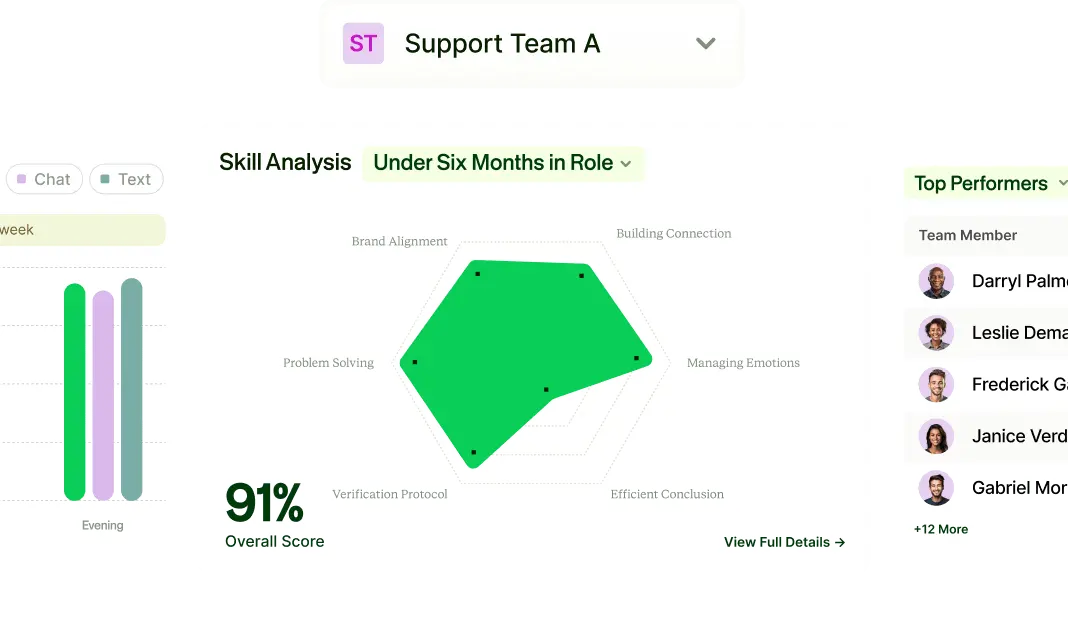
- Cohort tracking: Compare performance patterns across training groups, regions, or onboarding classes to identify which cohorts need additional support
- Collaborative QA workspaces: Supervisors, trainers, and quality analysts work together on coaching and improvement rather than operating in silos
- Sentiment trajectory tracking: Visualize how customer emotion shifts across the conversation to surface the exact moments that drive satisfaction or escalation
- Topic identification and filtering: Analyze performance by conversation type (billing, technical support, cancellation) rather than treating all interactions as equivalent
- Real-time trend alerts: Notify leadership when escalation rates, protocol violations, or sentiment scores cross thresholds so coaching happens before patterns compound
ReflexAI is built for teams where the stakes are high and the margin for error is narrow. If your conversations carry real consequences, let's talk about how simulation and QA work together to close the readiness gap.
Over 70% of teams searching for Solidroad alternatives have hit the same wall: training and QA are disconnected, coverage is too low to catch patterns early, and agents go live without practicing the actual conditions of the job. ReflexAI closes both gaps in one platform, with simulation and QA built for real-world readiness and proven in high-stakes environments.