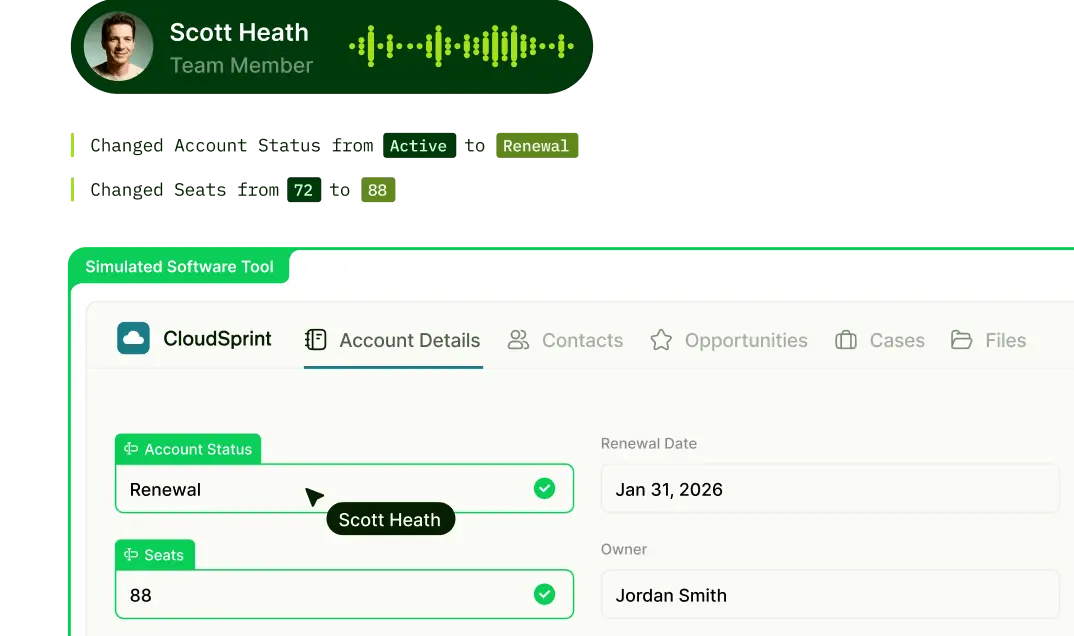
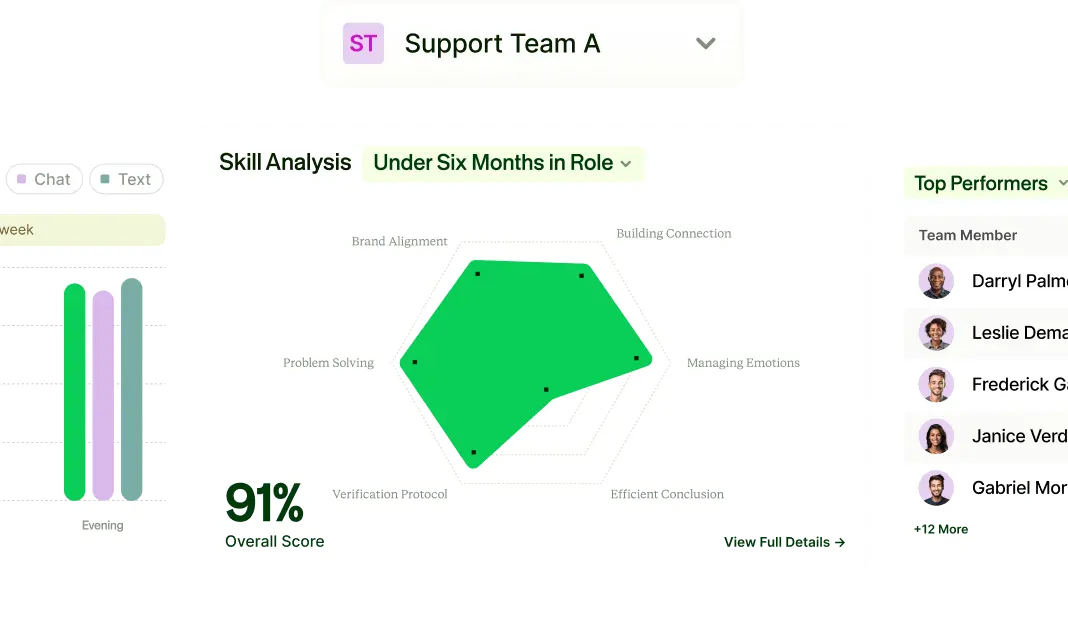



Call center simulation software uses AI to help agents prepare for live calls. A configurable AI persona plays the customer, by video, voice, or chat. After each session, the agent gets a score and feedback on what to work on next.
Experienced agents use it for ongoing practice, and new hires use it to get needed experience before their first live calls and during their initial training period. Agents can practice without a trainer present, which cuts the time call center operations leaders spend running roleplays.
How we selected these call center simulation platforms
A note on bias. ReflexAI publishes this guide and appears first on the list. Its entry is judged on the same criteria and uses the same fields as every other platform.
The information about each platform was verified against its own website and G2 profile. To make the list, a platform needed:
- A documented simulation or roleplay feature for call center and customer-facing teams
- Public product positioning
- At least one verifiable strength and one verifiable limitation
Each platform was then judged on:
- Audience fit
- Persona and scoring mechanics
- Review evidence
- Pricing model
How does call center simulation software work?
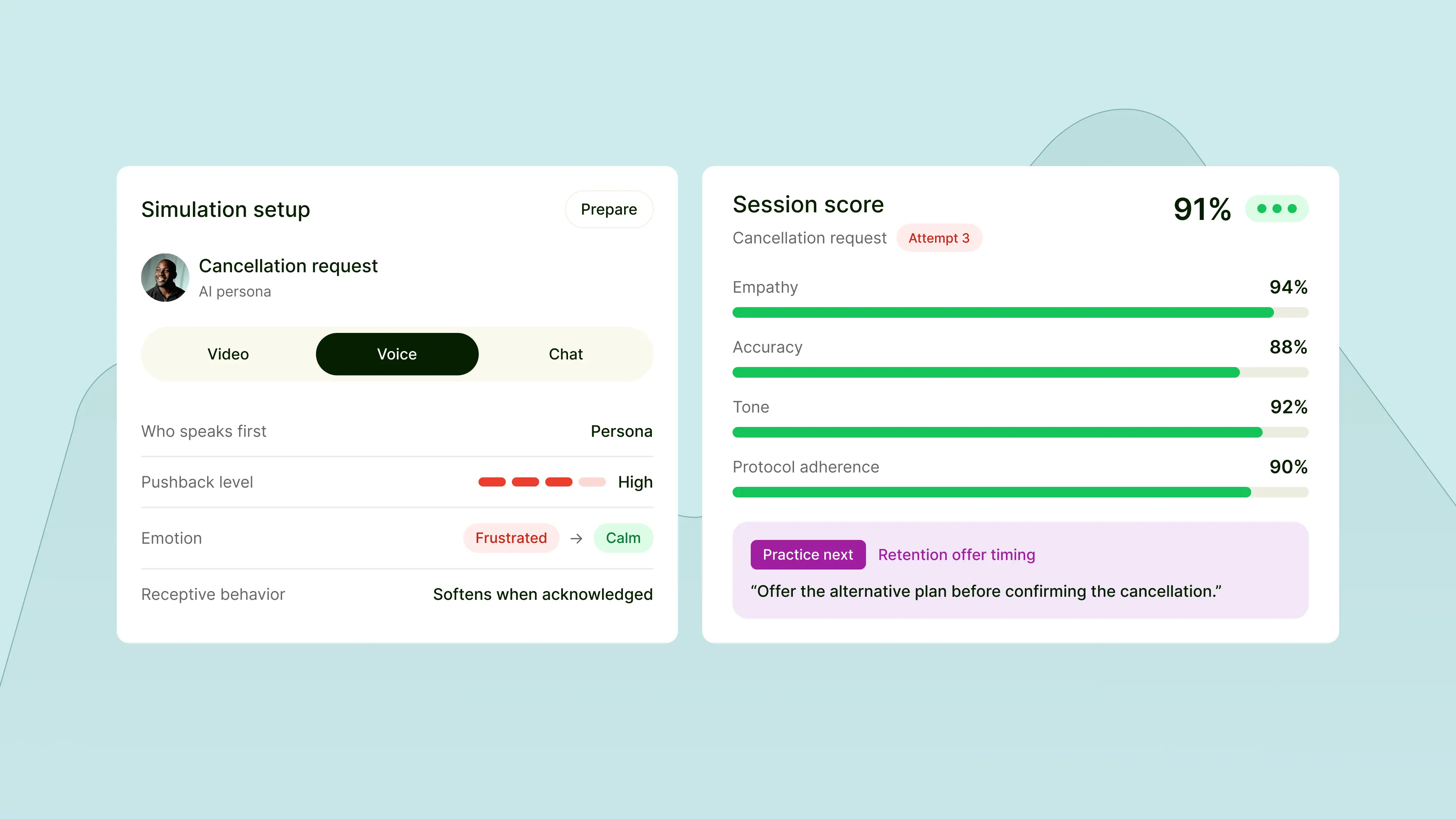
Call center simulation software works by letting a trainer set up a call center simulation scenario with an AI persona the agent talks to by video, voice, or chat. The persona responds to what the agent says and to cues like tone and hesitation. When the session ends, the software scores the agent's performance on dimensions such as empathy, accuracy, tone, and protocol adherence. The agent gets feedback right away.
ReflexAI's Prepare roleplay simulation software lets agents practice difficult conversations in video, voice, or chat before they have a live call. In Prepare, trainers set six persona fields:
- Issue description: the reason for the call, such as a billing dispute or cancellation request
- Who speaks first: the agent or the persona
- Pushback level: how much the persona pushes back when challenged
- Emotion: both at the start and as the conversation progresses in response to cues
- Receptive behavior: how the persona responds to desirable agent statements
- Pushback behavior: how the persona responds to undesirable agent behavior
These fields collectively set the difficulty of a given scenario. A cancellation scenario with low pushback and a calm opening emotion gives a new hire room to work through the retention conversation. With a higher pushback level, the same scenario then becomes a de-escalation test for a tenured agent. Prepare simulations adapt in real time to tone, hesitation, and emotion. Teams can customize the scoring dimensions for each session.
Benefits of call center simulation software
Call center simulation software gives teams a structured way to help agents prepare for their hardest calls from day one. With AI simulation, agents can:
- Practice difficult calls with no risk to customers. They can gain experience managing an angry caller or a cancellation request, where a mistake costs nothing, and repeat the call until they handle it well.
- Be scored fairly against their peers. Every agent gets matching persona settings, so trainers can compare results across the class.
- Get feedback while the call is still fresh. Scores arrive as soon as a session ends, so agents know what to fix before the next attempt.
- Rehearse rare calls before they happen. Agents can practice compliance-heavy or high-stakes calls they may face only a few times a year, so they're prepared when a tough call comes in.
- See which skills they still need to work on. Practice scores show where each agent needs more coaching before taking live calls.
Where call center simulation software fits in the market
As AI takes over more routine service work, Gartner expects agents to spend more of their time on complex and emotionally sensitive conversations. In a fall 2025 survey of 321 service and support leaders, Gartner reported that nearly 80% of organizations plan to give at least some agents new roles, and 85% of those leaders are adding new tasks to frontline roles. Experienced agents need practice on those harder calls, too.
Customer service representatives usually receive 2 to 4 weeks of on-the-job training, according to the U.S. Bureau of Labor Statistics. Agents often need more training as their responsibilities grow. Call center simulation software lets them practice new types of calls before they handle them live.
A Gartner survey of 199 service leaders, fielded from April to May 2026, found AI spending rose 38% while total service and support budgets grew 2%. With more of the budget going to AI, call center operations leaders need proof that simulation software improves how agents handle live calls. A study of 174 call center agents, published on ReflexAI's blog, found that agents with high simulation use met the highest organizational standards in 17% more conversations and raised their protocol compliance scores by 18%.
Many call centers already have some kind of call practice built into another tool, like roleplay modules in a learning management system or coaching features in a QA platform. The table below shows how those tools differ from dedicated simulation software.
Tool type | When it acts | What it tells the team |
Learning management system (LMS) | Before or between shifts, through courses | Who completed which training |
QA platform | After a conversation happens | How that conversation scored against the standard |
Real-time assist | During a live call | What to say or do next in that moment |
Simulation software | Before the conversation happens | How an agent handles a rehearsed scenario and what to practice next |
7 call center simulation software tools: a comparison
Platform | Best for | G2 Rating | Practice mechanic | Live QA coverage | Pricing |
ReflexAI (publisher) | Call center teams scoring practice and QA together | 4.7/5 for Prepare (37 reviews, Oct. 2026) | Video, voice, and chat roleplay with six configurable persona fields | Assure QA on the same scoring framework as practice | Four plans; rates not published |
Zenarate | Enterprise teams running routine service simulation | 4.8/5 (48 reviews, Oct. 2026) | Branched and generative simulations plus avatars | QA in a separate product (Analyze) | Not published |
Second Nature | Sales teams building a roleplay library | 4.7/5 (437 reviews, Oct. 2026) | Sales roleplay generated from uploaded content | No comparable live QA layer | Not published |
Cresta | High-volume teams needing live-call guidance | 4.3/5 (46 reviews, Oct. 2026) | Training simulator built from conversation data | In-call guidance plus automated QA | Not published |
Hyperbound | B2B sales teams using CRM data | 4.9/5 (40 reviews, Oct. 2026) | AI buyer bots and prebuilt sales packs | Sales call scoring in Perform tier | Free tier; paid tiers priced per user |
Solidroad | Commercial CX teams hiring at volume | 4.5/5 (3 reviews, Oct. 2026) | Simulation training and candidate screening | None since AutoQA was retired in September 2026 | Not published |
Yoodli | Training teams coaching communication delivery | 4.8/5 (62 reviews, Oct. 2026) | Custom roleplays with delivery feedback | No comparable live QA layer | Free tier; $8 to $20/month for individuals |
1. ReflexAI: Best for call center operations leaders who need practice and QA scored against the same standard
ReflexAI, the publisher of this guide, is the conversation performance platform for high-stakes work. Its Prepare roleplay simulation software lets agents practice conversations with compliance, safety, or retention stakes.
Its Assure automated QA tool turns scored calls, chats, and messages into QA insights on what to coach and practice next. It can score up to 100% of interactions, well beyond the sub-10% sample typical of manual QA, so teams capture more meaningful signal without paying to score every call. ReflexAI began in crisis intervention, where a mishandled conversation has real consequences, and now serves healthcare, financial services, sales and enrollment contact centers, and other regulated industries.
Key features.
- Video, voice, and chat practice with the six persona fields described earlier
- Simulations and scoring dimensions built from any file, script, scenario, or prompt
- Software overlays, so agents practice inside simulated versions of the CRM, EHR, or ticketing tools they use on live calls, in more than 25 languages
- A shared scoring framework that compares practice performance with live-call performance
- QA insights from Assure that inform what to coach next, with personalized simulations that teams can generate from Assure feedback
- Built for regulated environments: SOC 2 Type 2, HIPAA, HITRUST, GDPR, and ISO 27001
What we like. Agents can run simulations on their own schedule without a live partner or manager present and get scored feedback right after each session. ReflexAI reports that Cortland, one of the largest apartment operators in the U.S., used Prepare to train the leasing associates who take calls from prospective residents. In the 30 days after deployment, those associates made 4X more cross-sell attempts on live calls than in the 30 days before. At Verstela, a staffing services firm, outbound sales reps complete two roleplays at the start of each workday, and managers build their own scenarios in ReflexAI Studio.
Watch out for. ReflexAI is built for contact centers and frontline teams. B2B software sales teams that want roleplay tied to MEDDPICC or CRM deal data may find a sales-specific tool a closer fit. Its G2 review count is also smaller than that of some older tools on this list.
Pricing. Rates aren't listed. Essential, Growth, and Pro plans are priced by conversation length, modality access, and administrative controls, with custom Enterprise pricing above them. Growth and Pro plans include a library of pre-built scenarios.
Reviews. As of October 2026, ReflexAI's Prepare has a G2 rating of 4.7 out of 5 from 37 reviews, with 86% five-star and 13% four-star reviews.
2. Zenarate: Best for enterprise contact centers running customer-service simulation at scale
Zenarate focuses on routine customer-service simulation training for enterprise contact centers. The company was founded in 2017, and the website notes that its AI simulation training supports 79 languages.
Key features.
- Branched and generative voice and chat simulations
- Software-system simulation for training agents on internal tools
- AI avatar roleplay with video analysis
- Email and back-office simulations
What we like. Authoring depth and language range make Zenarate a practical fit for large, multilingual teams that need to standardize service calls across sites.
Watch out for. Zenarate sells practice (Perform) and QA analytics (Analyze) as separate products, and its site says that each product stands on its own. Its site notes that both judge skills like empathy the same way. Teams that want practice and live-call QA scored together need both products and should confirm in a demo how scores carry from one to the other.
Pricing. Not publicly listed.
Reviews. As of October 2026, Zenarate has a G2 rating of 4.8 out of 5 from 48 reviews, with 89% five-star and 10% four-star reviews.
3. Second Nature: Best for sales teams that need a dedicated roleplay library
Second Nature is an AI roleplay and coaching tool built mainly for sales teams. It uses avatar-based roleplay to simulate sales conversations, including cold calls, discovery, and objection handling. It also markets roleplay for customer support and call center teams.
Key features.
- Roleplays generated from uploaded content in minutes
- Support for more than 30 languages
- Automated post-session feedback and performance tracking
- Configurable persona moods for each scenario
What we like. Trainers can vary scenarios and persona moods, so reps practice reacting to what the simulated buyer says and can't rely on a memorized script. Its G2 profile has more reviews than any other platform in this guide.
Watch out for. Second Nature is a standalone practice environment without a comparably developed QA layer for live customer interactions.
Pricing. Not publicly listed.
Reviews. As of October 2026, Second Nature (listed as Second Nature AI on G2) has a G2 rating of 4.7 out of 5 from 437 reviews, with 88% five-star and 9% four-star reviews.
4. Cresta: Best for enterprise teams prioritizing real-time, in-call agent guidance
Cresta is a platform for human and AI agents whose core strength is real-time coaching during live calls and chats. It grew from research at Stanford's AI Lab and counts United Airlines and Cox among its customers.
Key features.
- Live-call guidance and next-best-action prompts
- Automated QA (Cresta Quality Management) and after-call summaries
- A Training Simulator that builds practice scenarios from real customer conversations
What we like. Agents get real-time prompts during live calls and chats, while the customer is still on the line. G2 reviewers also like being able to review their call transcripts afterward to see where they can improve.
Watch out for. Cresta has historically centered on the live call, and its Training Simulator launched in July 2026. Cresta says the simulator serves new hires and tenured agents, so teams that need dedicated practice for high-stakes conversations should test scenario depth before buying. Some G2 reviewers say transcription accuracy can be inconsistent, so details from a call can be missed.
Pricing. Not publicly listed.
Reviews. As of October 2026, Cresta has a G2 rating of 4.3 out of 5 from 46 reviews, with 58% five-star and 28% four-star reviews.
5. Hyperbound: Best for B2B sales organizations tying roleplay directly to CRM and deal data
Hyperbound offers sales roleplay and coaching for B2B sales organizations, built around AI buyer bots, scorecards tied to sales methodologies, and prebuilt roleplay packs. Customers include Amazon, Workday, and Intel.
Key features.
- AI buyer bots and prebuilt packs for outbound, objection handling, and competitive positioning
- Custom scorecards tied to methodologies like MEDDPICC
- A Perform tier that adds real call scoring, deal coaching, and CRM insights
What we like. Over 100,000 reps have used the platform, according to Hyperbound. A team can build its first bot and scorecard in under 10 minutes, and full setup of personas, modules, and real call scoring takes about two weeks on average.
Watch out for. Hyperbound's scenarios and scoring focus on sales conversations like discovery, objection handling, and deal progression. It also markets training for banking and financial advisors, but that use case centers on prospecting.
Pricing. A free tier includes prebuilt roleplays and example scorecards. The paid Practice and Perform tiers are priced per user, with custom enterprise pricing.
Reviews. As of October 2026, Hyperbound has a G2 rating of 4.9 out of 5 from 40 reviews, with 95% five-star and 5% four-star reviews.
6. Solidroad: Best for commercial CX teams combining simulation training and candidate screening
Solidroad describes itself as the AI training platform for customer experience teams. Agents practice with AI customer simulations over chat, email, phone, or video, in more than 90 languages, and get feedback when each session ends.
Key features.
- AI customer simulations across chat, email, phone, and video
- System simulations on interactive copies of the software agents use
- Hiring assessments that score candidates in simulated conversations
What we like. G2 reviewers describe the interface as simple and say the AI simulations feel close to real customer conversations. At Ryanair, Solidroad reports a 50% drop in interview time and 38 hours saved per hiring cycle from using simulations to assess candidates.
Watch out for. Solidroad retired AutoQA, its QA product, in September 2026, and no longer sells automated scoring of live customer conversations. Teams that want live-call QA alongside practice will need a separate QA tool. Its G2 profile has only three reviews, and one reviewer says the AI sometimes responds before the agent finishes speaking.
Pricing. Not publicly listed.
Reviews. As of October 2026, Solidroad has a G2 rating of 4.5 out of 5 from 3 reviews, with 66% five-star and 33% four-star reviews.
7. Yoodli: Best for enterprise training and sales enablement teams that want AI roleplay with delivery feedback
Yoodli calls itself "The AI Platform for Human Skills." It offers AI roleplays for sales enablement and other team training, from individual speaking practice to company-wide rollouts. Named customers include Google Cloud, Salesforce, and Snowflake.
Key features.
- Roleplay scenarios built from a company's personas, context, rubric, and objections
- Slides, PDFs, and documents the AI can present during a roleplay, plus two-way screen share for demo practice
- A personalized AI coach that supports learners in the flow of work
- SSO, SCIM, and integrations with learning platforms like Docebo and Workday, plus Yoodli-reported SOC 2 Type 2 certification and GDPR compliance
What we like. G2 reviewers consistently praise Yoodli's real-time feedback and customization options, and they value its speech analysis for giving actionable insights.
Watch out for. The product centers on roleplay practice and delivery feedback, without a comparably built QA layer for live customer interactions. Some G2 reviewers mention a learning curve with the interface and say the reporting could be more customizable.
Pricing. Starter is free (up to five lifetime roleplays), Pro costs $8 per month billed annually (up to 10 roleplays per week), and Advanced costs $20 per month billed annually (unlimited roleplays). Business and Enterprise plans are priced per seat, and rates aren't listed.
Reviews. As of October 2026, Yoodli has a G2 rating of 4.8 out of 5 from 62 reviews, with 96% five-star and 4% four-star reviews.
How to choose: by company size
Company size can help you determine the call center simulation software that works best for your team and company goals.
Company size | Best-fit option | Why |
Small and mid-sized businesses (SMB) | Hyperbound, Yoodli | Both have free tiers. Hyperbound prices paid tiers per user, and Yoodli's individual plans cost $8 to $20 per month |
Mid-market | ReflexAI (publisher), Solidroad | ReflexAI offers Essential, Growth, and Pro plans below its custom Enterprise tier. Solidroad offers self-serve sign-up, and its hiring assessments suit teams that hire agents often |
Enterprise | ReflexAI (publisher), Zenarate, Cresta, Second Nature | ReflexAI's Pro plan includes administrative controls like SSO, SCIM, and IP restrictions, with a custom Enterprise plan above it. Zenarate says it's trusted by more than 200 enterprise CX teams. Cresta's real-time guidance is built for high-volume teams like United Airlines and Cox. Second Nature names enterprise customers including Zoom, Oracle, and SAP |
How to choose: by priority
The picks below group the platforms by what a team needs most.
Priority Best-fit option Why | Best-fit option | Why |
Customer service and contact center practice | ReflexAI (publisher), Zenarate, Cresta, Solidroad | All four build scenarios around service calls and support conversations, and ReflexAI adds regulated, high-stakes conversations from its crisis-intervention origin |
B2B sales roleplay | Second Nature, Hyperbound, Yoodli | All three focus on sales conversations, from cold calls and objection handling to pitch delivery |
Sales and enrollment contact centers | ReflexAI (publisher), Cresta | Practice built around high-volume inbound and outbound calls. |
Practice and live-call QA together | ReflexAI (publisher), Zenarate, Cresta, Hyperbound | ReflexAI scores practice and live calls in one platform on the same scorecards. Zenarate and Cresta sell QA as a separate product or module, and Hyperbound's Perform tier scores sales calls only |
See how practice and QA scoring connect for your agents
The conversations left to human agents are getting harder, so agents should keep practicing difficult calls in simulation long after onboarding ends. When you evaluate simulation software, check how well it supports the whole agent lifecycle, from new-hire ramp to the de-escalation, compliance-heavy, and cross-sell conversations experienced agents take on as their roles expand.
ReflexAI connects practice in Prepare with QA insights in Assure on one scoring standard. A training manager can use the feedback Assure captures on live calls to build new Prepare simulations. Call center operations leaders comparing contact center training and QA software can schedule a demo to see how practice and QA scoring work together today for their own agents.
Frequently asked questions about call center simulation software
What software do most call centers use?
A typical call center stack combines a telephony or contact center platform, a CRM, workforce management software, a QA tool, and a learning management system (LMS). Simulation software adds a way for agents to rehearse calls with an AI customer before they handle those calls live. The phrase "call center simulation" also describes staffing and workflow simulation tools that model call volume and queue times, which are a separate category from agent training.
How can I simulate a phone call for agent training?
Pick a scenario, like a billing dispute or a cancellation request, and set how the AI customer behaves, including its emotion and how hard it pushes back. The agent then handles the call by voice while the AI plays the customer, and reviews the scored feedback afterward. Many platforms also let agents practice the same scenario over chat or email. Repeating the scenario at a higher difficulty shows if the agent can still use the skill under pressure.
Is call center simulation software suitable for experienced agents?
Yes. Raising persona difficulty gives tenured agents an opportunity to rehearse de-escalation, compliance-heavy, and cross-sell conversations. It's also a helpful training resource for frontline agents as they absorb new responsibilities. Ongoing practice keeps these experienced agents ready for new scenarios.
How do you know whether simulation practice changed live calls?
Pick the skills agents will work on over a set period, like building rapport or completing a verification step, and track how agents handle them on live calls before and after that period. If practice and QA grade a skill differently, the two sets of scores can't be compared, so agree on how each skill is graded before you start.