












We're kicking off a series on the tools we build for ourselves at ReflexAI. First up: Scout, the system that turns every sales and customer call into intelligence our product team can act on.
One of our earliest customers at ReflexAI once described our products this way: “You’d have to pry these tools out of my cold, dead hands.”
That is the kind of product we have always aspired to build: one that solves real problems, delights the people using it, and becomes difficult to imagine working without.
Reaching that standard requires more than having good ideas ourselves. It requires understanding what customers and prospects need, where their existing workflows break down, and which problems are most important enough to solve.
Though our product team conducts ongoing customer research, our sales and customer success teams will always have far more conversations with the market than anyone else at ReflexAI. Every week, those teams hear customers describe their workflows, prospects explain their pain points, and users reflect on what they wish our products could do.
For years, much of that information reached the rest of the company through call notes, internal summaries, and Slack conversations.
That worked to some degree, but it introduced a persistent delay between a customer expressing a need and the people building our products understanding it.
So we built Scout.
Why build anything?
Call-recording and transcription tools are everywhere. They are good at capturing what happened during a conversation, producing a transcript, and sometimes generating a summary.
But recording a conversation is not the same as understanding it.
A transcript does not inherently know whether the person speaking is a new prospect, a longtime customer, or a customer still implementing the platform. It does not understand whether a mentioned piece of software is simply part of the customer’s technology stack or is being used as a workaround for a gap in our product.
Most importantly, it does not automatically transform thousands of individual observations into useful product and market intelligence.
We did not need another place to store calls. We needed a system that understood the context around those calls, identified the signals inside them, and delivered those signals to the people who could act on them.
Meet Scout
Scout is ReflexAI’s internal customer and market intelligence platform.
Its original goals were straightforward:
- Understand market trends and unmet needs from prospects.
- Identify product gaps and workflow challenges affecting customers.
- Make those insights accessible to the teams that need them, through the tools and formats that make the most sense for their work.
- Protect sensitive information through the same security and compliance standards we apply across ReflexAI.
Scout connects customer conversations with the business context surrounding them. It does not analyze each call as an isolated transcript. It understands who participated, where the organization is in its relationship with ReflexAI, and what different kinds of feedback mean at that stage.
That context is what makes Scout valuable.
Prospects and customers are telling you different things
Scout connects to HubSpot and identifies whether a conversation involves a prospect or an existing customer.
When the conversation is with a prospect, Scout associates it with the relevant deal and deal stage. This allows us to understand how needs change throughout the buying process.
The questions raised during an initial discovery call may be very different from the concerns that emerge during technical validation, security review, or final evaluation. By preserving that context, Scout can identify patterns that might otherwise be obscured when all sales conversations are grouped together.
When the conversation is with a customer, Scout determines whether it is part of an implementation or kickoff process, or a later-stage customer check-in.
That distinction matters.
Early in an implementation, customers often discuss gaps in their current processes, internal readiness, or the operational changes required to adopt a new platform. Later, they may describe limitations in our product, opportunities to expand usage, or new workflows they want ReflexAI to support.
Without that context, it is easy to confuse a customer’s existing operational challenge with a ReflexAI product gap. Scout helps us distinguish between the two.
From conversations to structured intelligence
For both prospects and customers, Scout identifies and categorizes three particularly important types of information:
- Pain points
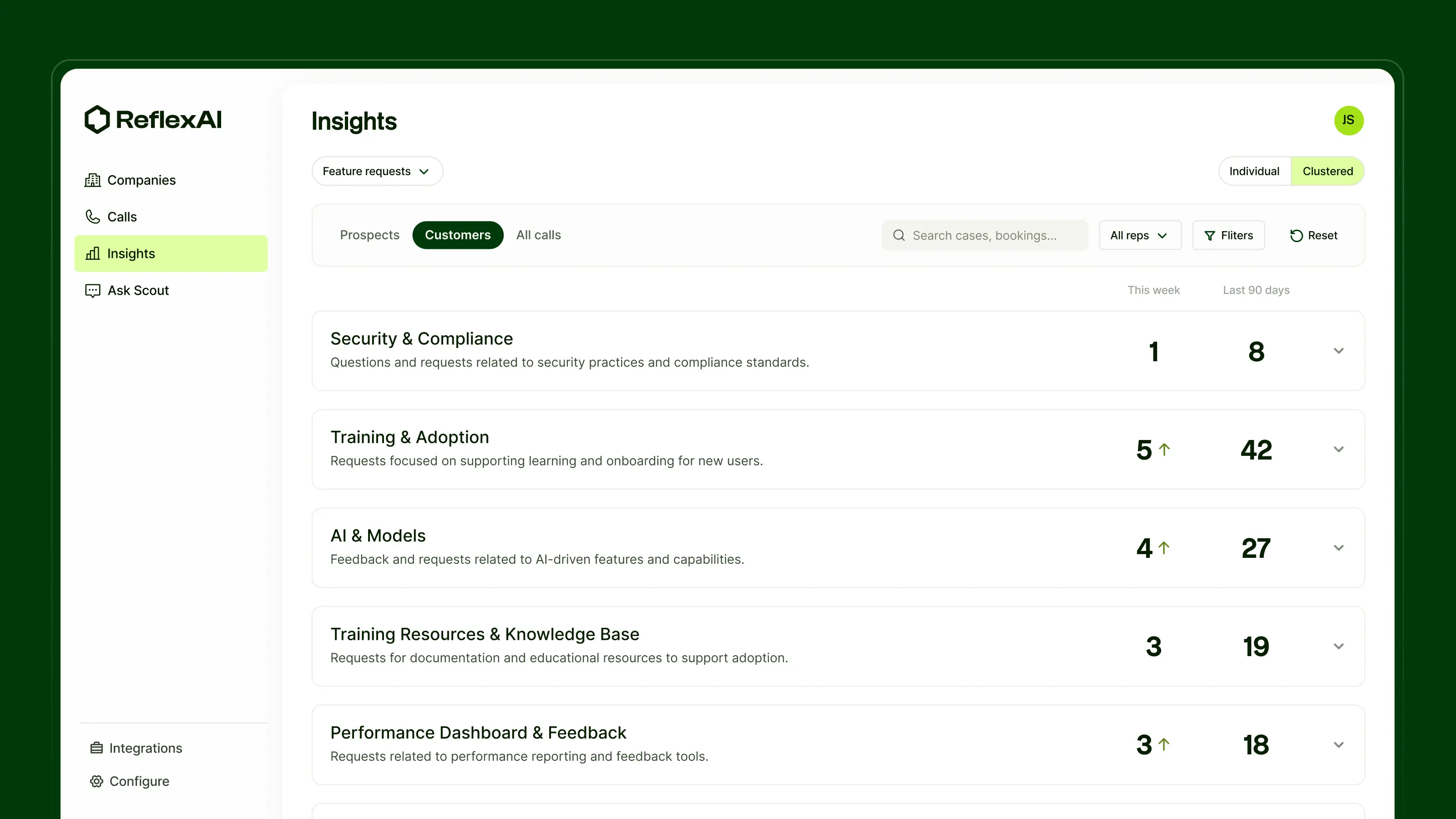
- Feature requests
- Software and internal tools
Scout then uses machine-learning clustering techniques to group related signals and surface broader trends.
A single feature request may be anecdotal. The same underlying request appearing across multiple customers, industries, or stages of the sales process may represent a meaningful product opportunity.
Scout helps us find the signal.
It also understands that these categories mean different things depending on who is speaking.
In a prospect conversation, Scout may hear about the organization’s existing technology ecosystem, the weaknesses in its current workflow, and the capabilities it wishes it had.
In a customer conversation, Scout may identify friction within the ReflexAI platform, limitations in the customer’s own processes, integrations the customer wants, or software being used to compensate for functionality that ReflexAI should provide.
Simply put: it is impossible to reach this level of insight by reviewing a single call (or part of a call).
Finding the workaround behind the feature request
From six months of using and refining Scout, we have seen that some of the most valuable product insights do not arrive as explicit feature requests.
Customers do not always say, “Here is the feature you should build.” Instead, they describe the extra steps they take, the spreadsheets they maintain, or the internal tools they have created to complete their work.
Scout is designed to identify those signals.
It can distinguish between software that is simply part of a company’s normal technology stack and software being used to fill a gap in the ReflexAI platform.
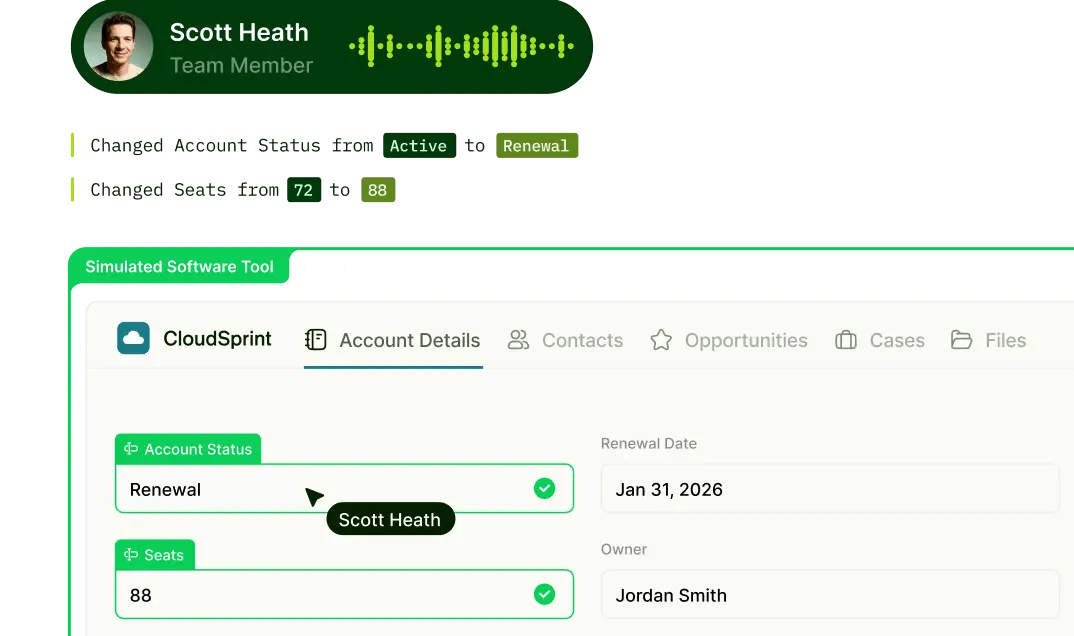
One of my favorite examples came from a customer check-in. Scout identified that the customer was copying transcripts out of our platform and pasting them into an application the customer had built using Lovable. The customer was not merely mentioning another tool. They had created a workaround for a gap in our feedback experience.
Scout surfaced that behavior to our product team within hours of the conversation. The team created a prototype, showed it to the customer during a follow-up two days later, and had a feature-ready solution the following week.
That is the feedback loop we want: not simply collecting customer feedback, but rapidly converting real customer behavior into a better product.
Making customer intelligence accessible
A customer intelligence system only creates value when people can use what it learns.
Scout was never intended to become another dashboard that employees had to remember to check. Its purpose is to make customer and market context available wherever decisions are being made.
Different teams need different views of the same information.
A product manager may want to explore a cluster of related feature requests. A sales leader may want to understand which pain points are most common at a particular deal stage. A customer success leader may want to identify emerging adoption challenges across implementations. An executive may want to understand how the market is changing over time.
Scout structures the underlying intelligence so it can be delivered through the medium and level of detail appropriate for each audience.
That also means Scout must operate with careful access controls. Customer conversations can contain sensitive business, operational, and personal information. Making insights more accessible cannot mean making the underlying data indiscriminately available.
Security and usefulness have to be designed together.
From insight to prototype
The first version of Scout included an integrated prototyping tool.
Next to each pain point and feature request was a Generate Prototype button. Anyone reviewing an insight could use it to create a contextual prototype directly inside Scout, then continue iterating on it without leaving the platform.
The goal was to reduce the distance between hearing a problem and exploring a solution.
Instead of translating a customer observation into a ticket, waiting for prioritization, and later asking a designer or engineer to interpret it, a team member could immediately make the idea tangible.
The prototype was grounded in the original conversation, the customer’s context, and the identified need. It gave teams something concrete to react to and made it easier to validate whether we had understood the problem correctly.
That capability taught us an important lesson: the most valuable part of Scout was not any individual interface or workflow. It was the context Scout had accumulated.
Scout is becoming a context layer
Scout is now evolving beyond its original form.
Rather than remaining a single destination where employees review customer intelligence and generate prototypes, Scout is becoming one of several context layers that can support other systems across ReflexAI.
The distinction is important.
A traditional internal tool asks employees to visit it, learn its interface, and incorporate it into their workflow. A context layer makes its knowledge available to the tools and agents employees already use.
Scout’s structured understanding of customers, prospects, conversations, pain points, feature requests, software, and market trends can help other systems produce better answers and take better actions.
A product-development agent could use Scout to understand how frequently a requested capability has appeared and which customer workflows it affects. A meeting-preparation tool could surface the most important themes from previous conversations. A prototyping system could generate a concept grounded not only in a single request, but in related needs expressed across the market.
Scout becomes more powerful when it is not the final destination. It becomes infrastructure for better decisions.
What we learned building Scout
Capture context, not just content
A transcript contains words. Intelligence requires understanding the circumstances in which those words were spoken.
The same statement can mean something entirely different depending on whether it came from an early-stage prospect, a customer in implementation, or a mature customer expanding its use of the platform.
Look for behavior, not only requests
Some of the clearest product opportunities appear in what customers do rather than what they explicitly ask for.
A workaround, manual process, spreadsheet, or internal application may be a stronger signal than a conventional feature request.
Aggregate without losing the source
Clustering helps identify trends, but teams still need to understand the original conversations behind them.
Good customer intelligence should make patterns visible while preserving the evidence and nuance required to evaluate them.
Bring intelligence into the workflow
Insights create little value when they live in a dashboard no one remembers to open.
The long-term opportunity is to make customer context available inside the systems where product, sales, customer success, and company decisions already happen.
Shorten the distance between learning and building
The faster a team can turn an observation into something customers can react to, the faster it can determine whether it truly understands the problem.
Prototypes are not merely a design artifact. They are a research tool.
Building products customers cannot live without
Our obsession has always been building products that solve meaningful problems and become indispensable to the people using them.
Scout helps us pursue that standard by allowing more of ReflexAI to learn directly from the conversations happening across our company.
It helps us identify needs that might otherwise remain buried in a transcript, recognize trends that no individual employee could see alone, and turn customer behavior into product improvements with far less delay.
Scout began as a way to understand calls.
It is becoming part of the context that helps ReflexAI understand its market, improve its products, and build a tighter connection between what customers experience and what we create next.
And it is only one of the context layers we are building.