










Somewhere in your organization, the right answer is already written down.
It's in the call script your top performers follow without thinking about it. It's in the SOP that spells out what to say when a customer pushes back, and what never to say at all. It's in the training handbook that took your team years to get right. Your organization already knows what a good conversation looks like. The problem has never been the knowledge. It's turning that knowledge into a working scorecard.
The setup tax every QA program pays
Building scoring from scratch is slow, and it's slow in a specific way: the cost shows up late.
A QA leader sits down with a stack of documents and starts translating them, line by line, into scoring dimensions. Which steps are required? Which ones can happen in either order? What counts as a pass? That's hours of manual work before a single call has been scored. Then the real cost arrives. A cohort of interactions runs through the new scorecard, and only then does anyone notice the dimension that's scored too strictly, the step that was missed, the protocol that does not account for a call that goes off-script. By the time the gaps surface, hundreds of conversations have already been evaluated against a rubric nobody fully trusted yet.
Multiply that by every call type, every update to a policy, and every new hire on the QA team who has to relearn how the scorecard was built, and the setup tax compounds. Teams often stay on a scoring system, they don't love simply because they've already paid that cost once and can't stomach paying it again.
Scoring, built from what you already wrote
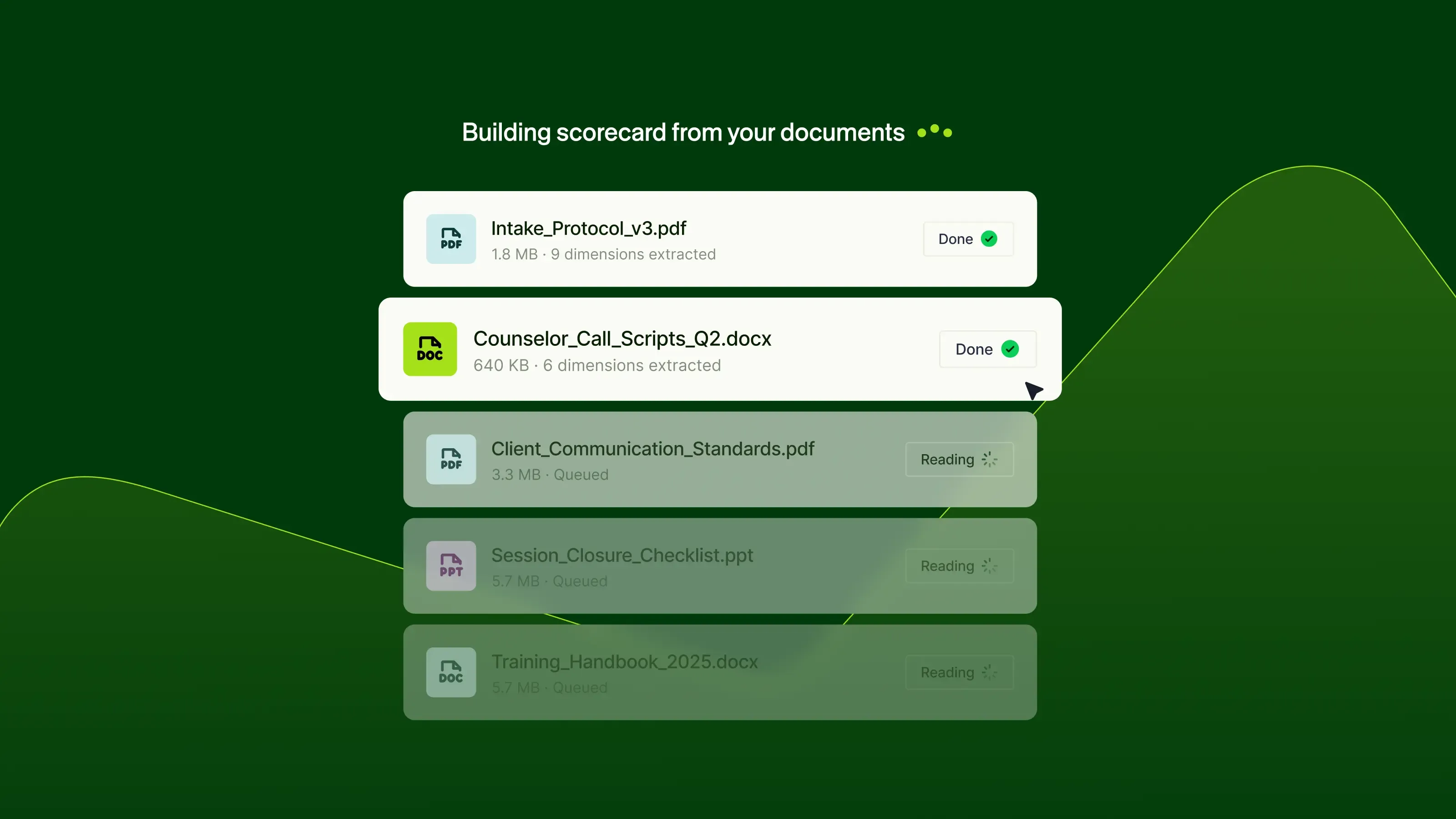
New instant scorecards in ReflexAI remove that translation step entirely. Upload the documents your team already relies on, whether that's a call script, an SOP, or a training handbook, and ReflexAI reads them and builds the scorecard for you.
Here's what that looks like in practice.
Protocols, skills, and knowledge checks, sorted automatically. ReflexAI reads the documents and identifies which parts describe a required sequence of steps (protocols), which describe a qualitative skill like tone or empathy (custom skills), and which describe factual claims an agent needs to get right (knowledge checks). A handful of documents can produce dozens of dimensions in the time it used to take to draft one.
Outcome-based, concept match or exact-quote matching steps. Older scoring approaches often required an agent to say something close to a specific phrase. Instant scorecards can be built to recognize the outcome, or even a concept, in addition to an exact-quote match. A required opening doesn't need to match a script word for word. It needs to convey the same idea, whether that's a greeting, a required disclosure, or letting a customer finish explaining what happened.
Branching, because real calls branch. Conversations don't always move in a straight line. If an issue gets resolved on the call, one set of steps applies. If it doesn't, another does. Instant scorecards can capture that logic directly, instead of forcing every interaction through a single linear checklist.
Difficulty, dialed in instead of hand-tuned. Every generated protocol comes with a sensible default: how many steps can be missed and still earn a strong score. QA leads can adjust it with a simple easy, medium, or hard setting, or edit the specifics by hand if a call type needs it.
Prohibited actions, flagged the moment they happen. Some documents don't just describe what to do. They describe what never to do. Instant scorecards carry that distinction forward, so a single disqualifying statement is caught as reliably as a missed step.
See it work before it scores a single real call. This is the part that closes the setup-tax problem for good. Instead of waiting for a cohort of real interactions to reveal a scoring gap, a QA leader can generate a sample transcript and watch the new scorecard evaluate it immediately, right down to which specific steps were followed and which weren't. Issues that used to surface after hundreds of calls now surface before the scorecard ever goes live.
From weeks to the same afternoon
None of this asks a QA team to think in a new language. It asks them to upload what they already have. The documents that already define what good looks like in your organization become the scorecard, instead of a translation project sitting between your team and a rubric you can trust.
That is the shift instant scorecards make: from a setup process measured in weeks and validated in hindsight, to one measured in minutes and validated before it ever touches a live conversation.
What's next
Instant scorecards are an early expression of a larger idea we're building toward called ReflexAI’s Intelligence Layer: your organization's own knowledge, connected once, powering every part of how ReflexAI trains and evaluates conversations. This enables routing generated dimensions into scorecards by call type automatically, and connecting directly to the knowledge bases teams already maintain, so an update to a policy in your own tools—like a Notion database— updates your scoring without anyone touching ReflexAI at all.
Want to see what your own documents would build? Schedule a demo and bring an SOP.