










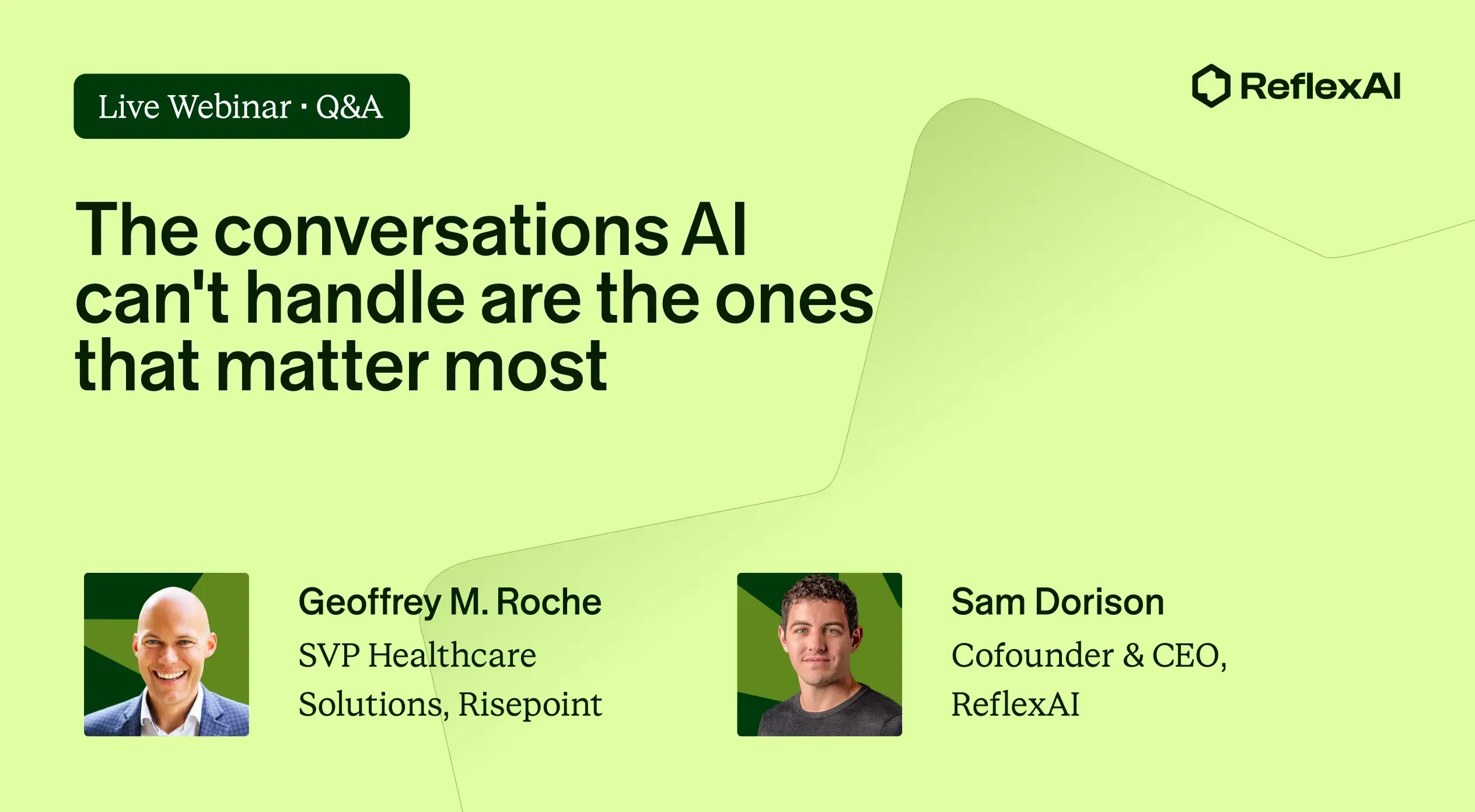

As AI takes on more of the routine, transactional work in customer support, hiring, and healthcare, the conversations left for humans are getting harder, not easier. That was the premise behind our recent fireside chat with Sam Dorison, cofounder and CEO of ReflexAI, and Geoffrey Roche, SVP of Healthcare Solutions at Risepoint and a nationally recognized healthcare and education workforce expert.
Geoffrey brings almost two decades of experience across hospital systems and higher education, and a long track record advocating for systemic workforce development. He's also, as he put it early in the conversation, the son of a nurse, and that lens shows up throughout his work: training isn't a checkbox, it's what determines whether people show up for each other when it counts.
Here's what stood out from the conversation.
Two kinds of critical conversations
Sam opened with a framework: critical conversations come in two forms.
Expected critical conversations are the ones organizations already prepare for: a tough performance review, a fraud call to the bank, an emergency call. Everyone recognizes these as high-stakes, and HR or leadership usually builds in some level of preparation.
Unexpected critical conversations are the less obvious ones, the kind that compound over time and rarely get the same training attention. A weekly check-in with a manager. A scheduling call where the specialist a patient wants is booked for eight weeks, but another provider has an opening next week.
That second example is a good one to sit with. As Sam described it, the same piece of information ("Dr. Jones isn't available for eight weeks") can be delivered two completely different ways, and one of them makes the patient feel like they're getting a downgrade while the other makes them feel taken care of. Same facts, different outcome, entirely dependent on how the conversation is handled.
A huge share of the interactions organizations write off as routine are actually shaping how people feel about the relationship, one call at a time.
Averages hide your best people
One of the more counterintuitive points discussed is that for standard, low-stakes conversations, the average tells you most of what you need to know about someone's performance. For critical conversations, the average is close to useless.
What matters instead is the floor (how bad is this person's worst performance) and how consistently they hit their peak. High performers don't just have a higher average, their floor is much higher and they reach their best work far more often. The distribution isn't a bell curve, it's heavily skewed.
That's a genuinely useful reframe for anyone building a coaching program. Instead of asking "how do we raise the average," the better questions are "where is this person's floor, and how do we raise it" and "how do we help them hit their peak more often." One of those is a much more actionable coaching conversation than the other.
Why your best managers stop giving feedback
Geoffrey and Sam's exchange on feedback examined why managers often stop giving specific feedback to the people who need it most.
Sam's observation: managers tend to stop giving specific feedback to employees who respond defensively to it, because it's human nature to avoid conflict. Meanwhile, employees who respond to feedback with constant apology tend to get their feedback softened and hedged over time ("you might want to improve X" instead of "I need to see improvement on X"). Very few employees respond to feedback the textbook way, which means most people are getting a version of feedback shaped by how they react to it rather than what they actually need to hear.
Geoffrey connected this back to healthcare specifically: organizations invest heavily in training leaders on crucial conversations, but frontline employees, the people actually on the phone or at the bedside, get far less. He pointed to a recent industry piece on the nurse manager pipeline as an example of what happens when that gap compounds over time.
How much conversation practice actually moves the needle
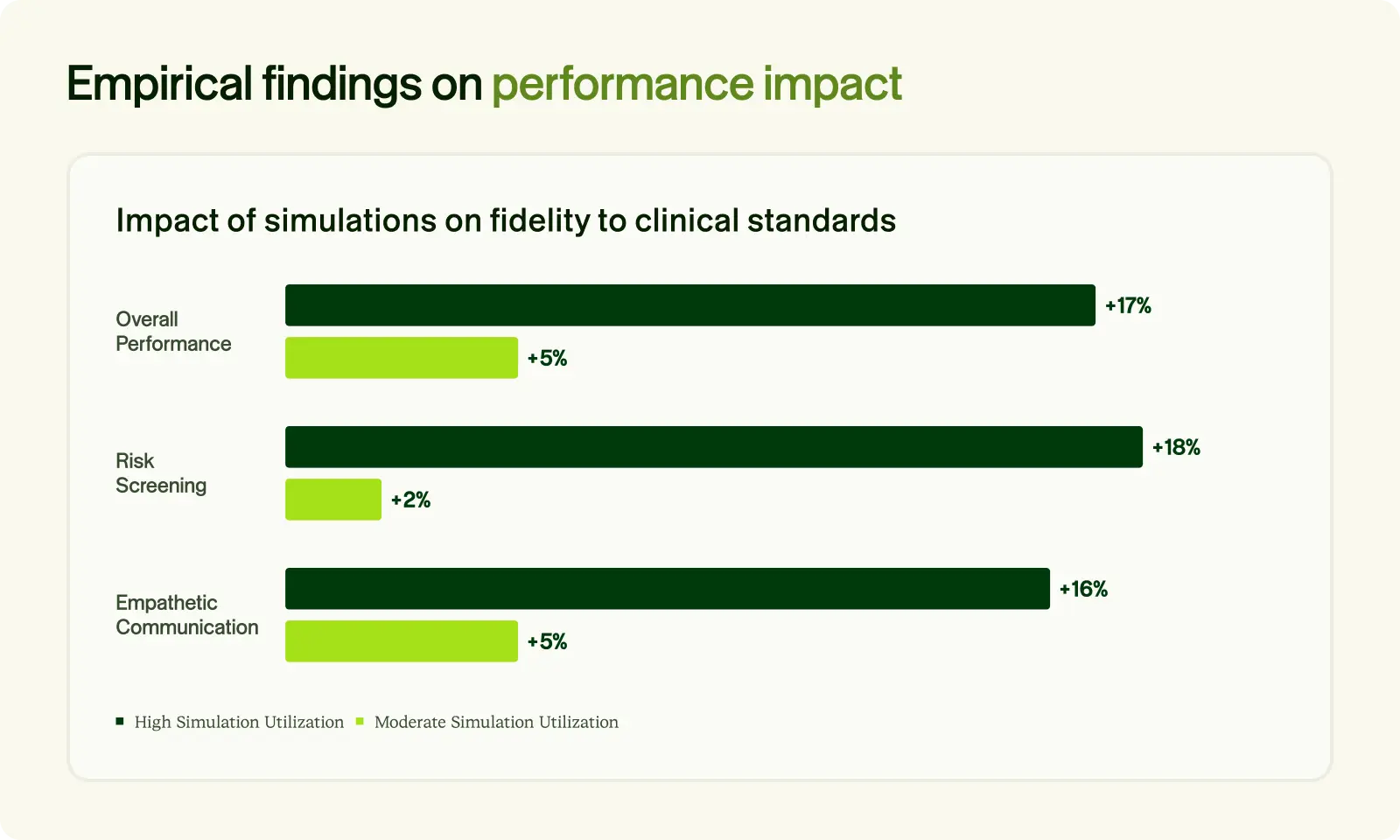
Sam shared data on simulation training that's useful if you're building a training program: even a small amount of structured practice produces a real improvement in skills like empathetic communication and risk screening. But the biggest gains showed up at higher levels of practice, where performance improvements roughly doubled compared to lighter training, and those gains held for over a year.
The chart below is from the underlying research brief. It's a useful reference point for anyone trying to make the case that "more training, forever" isn't the goal, but neither is "just enough to check the box."
Making the business case internally
The session closed on a practical question: how do you get your organization to actually invest in this? Geoffrey's answer was straightforward. People are the biggest line item in any organization's budget, so any credible case for training investment should be framed in terms your CFO already cares about: retention, attrition cost, and the downstream cost of getting critical conversations wrong. Pointing to even a small pilot that moves those numbers is often more persuasive internally than a case built purely on skill improvement.
Want to put this into practice?
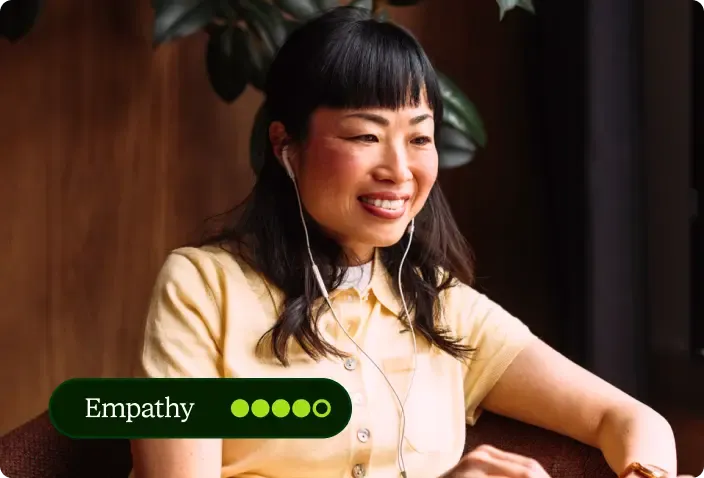
We put together a free guide on using empathy as a measurable performance driver, based on some of the same thinking Sam and Geoffrey covered in this session.

Empathy is a Performance Driver
A free training guide to help your team use empathy to drive measurable business outcomes