










When your simulation tool scores an agent 85% on empathy, that number does not tell you what most teams assume it does.
In our experience, 70% or more of QA leaders treat that score as a final verdict on the agent’s performance. It is not. The real question is whether that score tells you anything true about how the agent will perform on a live call.
This is a well-documented pattern in contact center QA:
- Two trained human reviewers scoring the same call can land 10 to 15 points apart on a 100-point scale
- Subjective dimensions like empathy or tone show the highest variance
AI scoring doesn't need to beat that bar to be useful. It needs to measure the right things and explain why it scored what it scored.
This article walks through how to evaluate whether your simulation scores can be trusted, where they fail without anyone noticing, and how ReflexAI's Prepare and Assure are built to keep simulation training performance connected to live QA outcomes.
What does "accurate enough" mean for AI simulation QA scoring?
Your simulation tool just scored an agent 85% on empathy. Before you use that number in a coaching conversation or a performance record, you need to know what it actually measured. Accuracy in AI simulation scoring has four dimensions, and in our experience, roughly 70-80% of teams only check one.
- Score agreement: Does the AI land in the same range a calibrated human QA reviewer would assign for the same interaction?
- Rubric alignment: Do the scoring dimensions match what your QA program actually cares about, such as protocol adherence, de-escalation, and empathy, rather than generic "professionalism"?
- Simulation realism: Does the scenario reflect the actual conditions, emotional range, and system demands of live work? A score from an unrealistic simulation tells you nothing useful about readiness.
- Explainability: Can the score be traced back to specific moments in the conversation so reviewers and agents can act on it?
Let's say your simulation gives an agent a perfectly consistent 90% protocol-adherence score - but the agent never looked up the customer's account or followed the required escalation path. The score looks good, but it missed half the job. The real question is not whether the number is right, but whether it predicts live performance and holds up in a coaching conversation or compliance audit.
How close are AI scores to calibrated QA reviewers?
As noted above, two trained human reviewers can land 10 to 15 points apart scoring the same call, with subjective dimensions like empathy or tone showing the widest variance.
AI scoring does not need to be perfect to be useful. It needs to be consistent and explainable.
Consistency is AI's core advantage: the same rubric, applied every time, without fatigue or mood variation. The risk is not inconsistency. The risk is consistent application of a poorly designed rubric. If your rubric defines empathy as "uses apologetic language," the AI will reliably reward agents who say "I'm sorry" even while escalating frustration, and penalize agents who de-escalate without using those exact phrases.
Does the score reflect your QA rubric, not a generic one?
Generic rubrics collapse complex competencies into surface-level proxies. Politeness becomes a stand-in for compliance. Longer answers get scored as "more helpful." Agents learn to hit keyword triggers without changing the underlying behavior.
ReflexAI's Prepare product supports custom scoring dimensions so organizations can mirror their own evaluation criteria rather than forcing a generic rubric. That is the standard to hold any simulation tool to: if you cannot define what "good" looks like in your environment, the AI cannot score it reliably.
Does the simulation reflect real agent work?
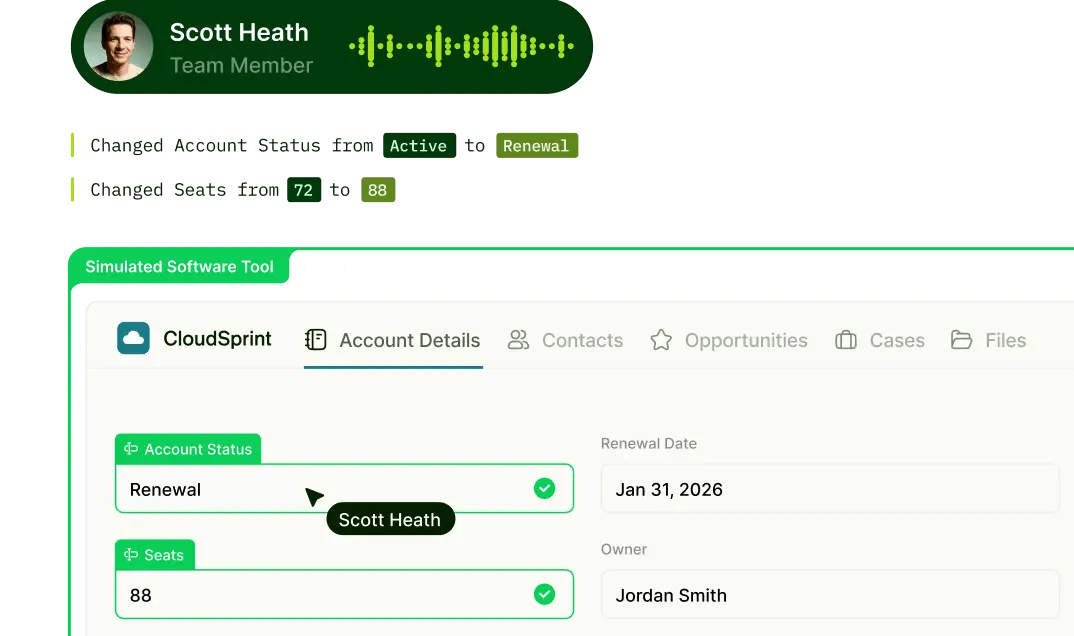
An agent can handle a billing dispute flawlessly in dialogue, apologizing, summarizing, and setting expectations, while still failing in real QA because they closed the wrong reason code or forgot to set a promised follow-up task. A dialogue-only simulation scores the conversation. It does not score the job.
ReflexAI's software simulation overlay feature allows teams to simulate the tools agents use alongside the conversation, bringing practice closer to real conditions and making scoring more predictive. If your simulation does not include the desktop, you are measuring "talking about case handling," not case handling.
Can the score be explained and audited?
Many AI tools provide fluent rationales like "the agent showed empathy and addressed the issue," but that is narrative explainability, not evidence-based explainability. Evidence-based explainability points to the exact utterance that satisfied criterion X and the system action or log proving criterion Y was completed.
In high-stakes environments like crisis lines or regulated contact centers, "just a number" does not hold up under audit. A score without evidence is just a number.
Where does AI simulation scoring break down?
In our experience, 60-70% of teams do not discover the failure modes until they are already using scores for coaching decisions or performance records. Each breakdown costs the QA program differently: some produce scores agents do not trust, some create compliance risk, and some reward the wrong behaviors at scale.
Vague or generic rubrics. The AI cannot distinguish between "good empathy" and "technically correct but cold" if the rubric does not define the difference. Agents who say the right phrases score well even when they escalate frustration, while agents who resolve the issue without using the magic words score poorly.
Simulations that skip workflow context. The conversation is only half the job. In most contact centers, agents also need to search the right record, verify identity, read the required disclosure, select the correct disposition, and document in the right fields. A simulation that skips the desktop skips the part of the job where most compliance failures actually happen.
Score variation across cohorts. Without cohort-specific calibration, what scores as "compliant" for one team may not reflect the same standard for another, especially when teams handle different product lines, customer segments, or regulatory requirements. You end up comparing scores that do not mean the same thing.
Policy, prompt, or model changes. When your QA rubric is updated, a new compliance requirement is added, or the underlying AI model is retrained, scores can shift without any change in agent behavior. Last quarter's "good call" becomes this quarter's "missed empathy" with no policy change, just a different evaluator. Teams that do not recalibrate after these changes are running trend analysis on numbers that no longer measure the same thing.
Let's say your AI scores an agent at 90% on empathy, but your QA team consistently rates similar calls at 75%. Are you seeing score patterns that do not match what your QA team observes on live calls? That is usually one of these four failure modes.
How should QA teams validate AI simulation scores?
Validation is not a one-time audit. It runs parallel to your QA program as an ongoing practice, and without it you are trusting a measurement instrument you have never calibrated.
Build a validation set from real interactions
Start with a set of real, already-QA'd interactions where human reviewers have scored and calibrated their scores. Run those same scenarios through your AI simulation scoring and compare. This gives you a ground truth baseline that reflects your actual QA standards.
The validation set should include a range of interaction quality, not just strong performers or clear failures, but the ambiguous middle where human reviewers themselves sometimes disagree. Let's say you have a call where the agent resolved the issue but skipped the empathy statement. That's exactly the type of interaction your validation set needs. That is where AI scoring is most likely to diverge, and where you need the most clarity about what the score actually measures.
Compare AI scores with human QA scores
Look for systematic gaps, not one-off disagreements. Does the AI consistently score lower on empathy than human reviewers? Does it miss protocol adherence on calls where the agent improvised?
What you're comparing | What a gap tells you |
AI score vs. human score on the same interaction | Rubric alignment or calibration issue |
AI score consistency across similar interactions | Model stability or prompt sensitivity |
AI score before vs. after a rubric change | Whether recalibration is needed |
If the AI scores a call as "pass" and your human reviewers consistently score it as "warning," you have a rubric definition problem. If the AI scores similar calls inconsistently, you have a model stability problem. Both are fixable, though only if you catch them before the scores are used for consequential decisions.
Set pass, warning, and fail thresholds
Not every interaction needs human review, though warning-level scores should always trigger a human check before being used for coaching decisions or performance records. Thresholds should reflect the stakes of the interaction type: a crisis line call warrants a tighter threshold than a routine account inquiry.
- Pass-level scores flow directly into performance dashboards and trend reports.
- Warning-level scores go into a review queue for human QA leads to audit before any coaching or documentation happens.
- Fail-level scores trigger immediate review and often block an agent from taking certain call types until remediation is complete.
Recalibrate after rubric or workflow changes
Any time the rubric changes, a new compliance requirement is introduced, or the simulation content is updated, the validation process should be re-run. Scores from before and after a rubric change are not directly comparable, which means you cannot use them together in trend analysis or performance tracking.
Recalibration is a quality control habit, not an extraordinary effort. If you change what you are measuring or how you are measuring it, you re-establish your baseline. Let's say you add a new disclosure requirement to your rubric - are you prepared to re-run validation before using the new scores in performance reviews?
When should humans stay in the QA loop?
AI simulation scoring handles volume, consistency, and pattern detection well. Human judgment is still required for specific decision types, and the goal is not to replace human judgment but to focus it where it matters most.
High-stakes or compliance decisions. Any score used to determine whether an agent is cleared to handle sensitive interaction types, such as crisis calls, clinical conversations, or financial disclosures, should have a human reviewer in the loop. The consequences of a false positive, clearing an underprepared agent, are too high to rely on AI scoring alone. Regulators and governance frameworks increasingly treat human oversight as something that must be designed into the system, not just promised as policy.
Warning-level scores. Scores in the warning band are the most dangerous because they look acceptable while hiding a real readiness gap. Warning-level outputs become review queues, not verdicts, because the cost of being wrong is too high to let the model be the final judge.
Coaching disputes and edge cases. When an agent disputes a simulation score, or when the scenario involved an unusual interaction pattern not well-represented in the calibration set, human review provides the judgment that AI cannot. Agents are more likely to trust and act on feedback when they know a human reviewed the edge cases, especially when scores affect performance records or continued employment.
Human-in-the-loop is not a workaround for AI inaccuracy. It is a design feature of a mature QA program. Let's say an agent disputes a simulation score on a complex de-escalation call. Would your current process surface that for human review? If not, it may be time to revisit your thresholds.
How ReflexAI connects simulation practice to live QA outcomes
Most QA programs treat simulation and live QA as parallel tracks. Scores in one don't tell you much about the other, so a strong simulation score can sit next to flat live performance with no way to explain the gap. Simulation scoring only earns trust when it's built on the same framework as live QA. That's what makes a passing score a real predictor of live performance, rather than a number in isolation.
Prepare and Assure share a scoring foundation
ReflexAI's Prepare and Assure products are designed to work together. Simulation scoring dimensions in Prepare can mirror live QA rubrics in Assure, so teams measure the same behaviors in practice as they measure on live calls. Assure scores every live interaction, giving teams a full baseline to validate simulation scores against.
Live QA insight can inform what agents practice next
Assure surfaces patterns in live QA data: a recurring empathy gap, a protocol issue tied to a specific scenario type. QA leaders can use those patterns to shape what gets built in Prepare, turning real performance gaps into targeted practice instead of generic role-play.
Cohort tracking connects simulation readiness to live performance
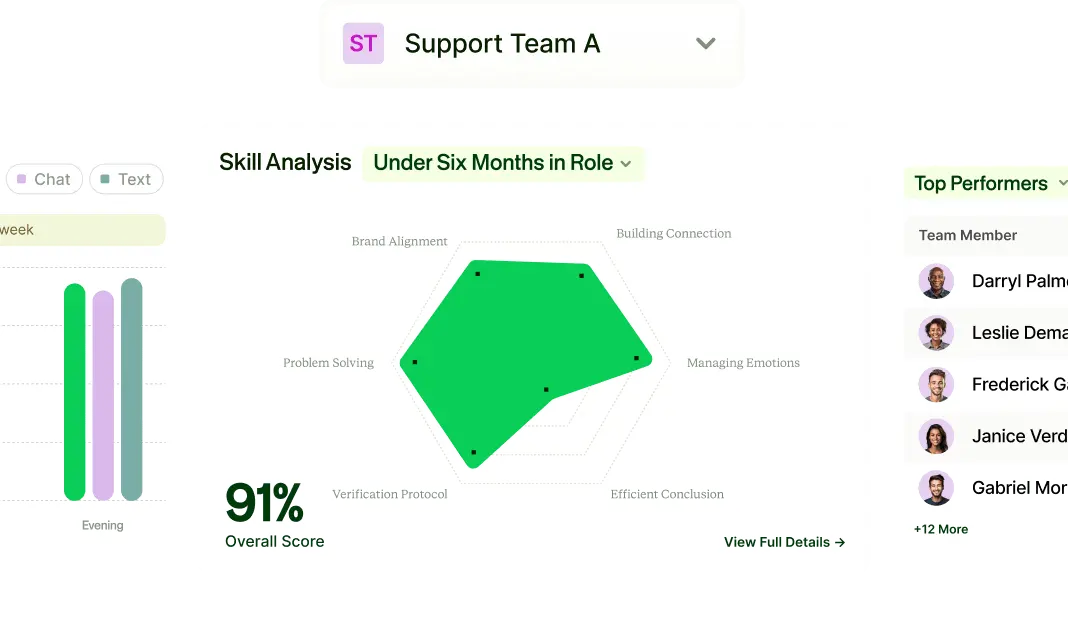
ReflexAI's cohort tracking lets QA leaders follow groups of agents from simulation performance through to live QA outcomes, so teams can validate over time whether strong simulation scores actually predict strong live calls. Without that link, simulation scores are a guess.
FAQ
Can AI simulation scores replace human QA reviewers entirely?
AI simulation scoring is best used to extend QA coverage and surface patterns at scale, not to replace human judgment on consequential decisions. Human reviewers remain essential for warning-level scores, compliance-sensitive interactions, and any score used for performance records or coaching.
How accurate is AI scoring compared to a trained human QA reviewer?
AI simulation scoring tends to be more consistent than human reviewers since it applies the same rubric every time without fatigue, though it is not inherently more accurate, especially on subjective dimensions like empathy or de-escalation. Accuracy depends heavily on how well the rubric is defined and how closely the simulation reflects real work conditions.
Does AI simulation scoring work for compliance-sensitive industries like healthcare or crisis services?
AI simulation scoring can be used in compliance-sensitive environments, though it requires tighter validation thresholds and mandatory human review for any score used in a clearance or performance decision. Organizations subject to HIPAA, HITRUST, or similar standards should also ensure the simulation platform meets the relevant data security certifications.
How often should AI simulation scoring be recalibrated?
Recalibration should happen any time the QA rubric changes, a new compliance requirement is introduced, or the simulation content is updated, not on a fixed calendar schedule. Scores from before and after a rubric change are not directly comparable and should not be used together in trend analysis.
What is the difference between simulation scoring accuracy and simulation realism?
Simulation scoring accuracy refers to how closely AI scores match calibrated human QA scores, while simulation realism refers to how faithfully the practice scenario reflects actual live work conditions. Both matter since an accurate score on an unrealistic simulation still does not predict live performance.
The most trustworthy simulation scoring is built on the same rubric as live QA. As a conversation performance platform, ReflexAI brings Prepare and Assure together so simulation readiness and live performance are measured against the same standard, and QA leaders can turn live gaps into targeted practice. If you're evaluating whether your simulation scores predict real outcomes, we can show you how cohort tracking and shared scoring frameworks make that connection visible.