


Every 988 counselor knows the feeling. You get a QA review on one call from weeks ago, and it becomes the verdict on your work.
Chris Nathe and his team at Lines for Life set out to change that. We're grateful to them for the work they do every day, and for how openly they shared it with us in our recent webinar. Thank you as well to everyone who joined live.
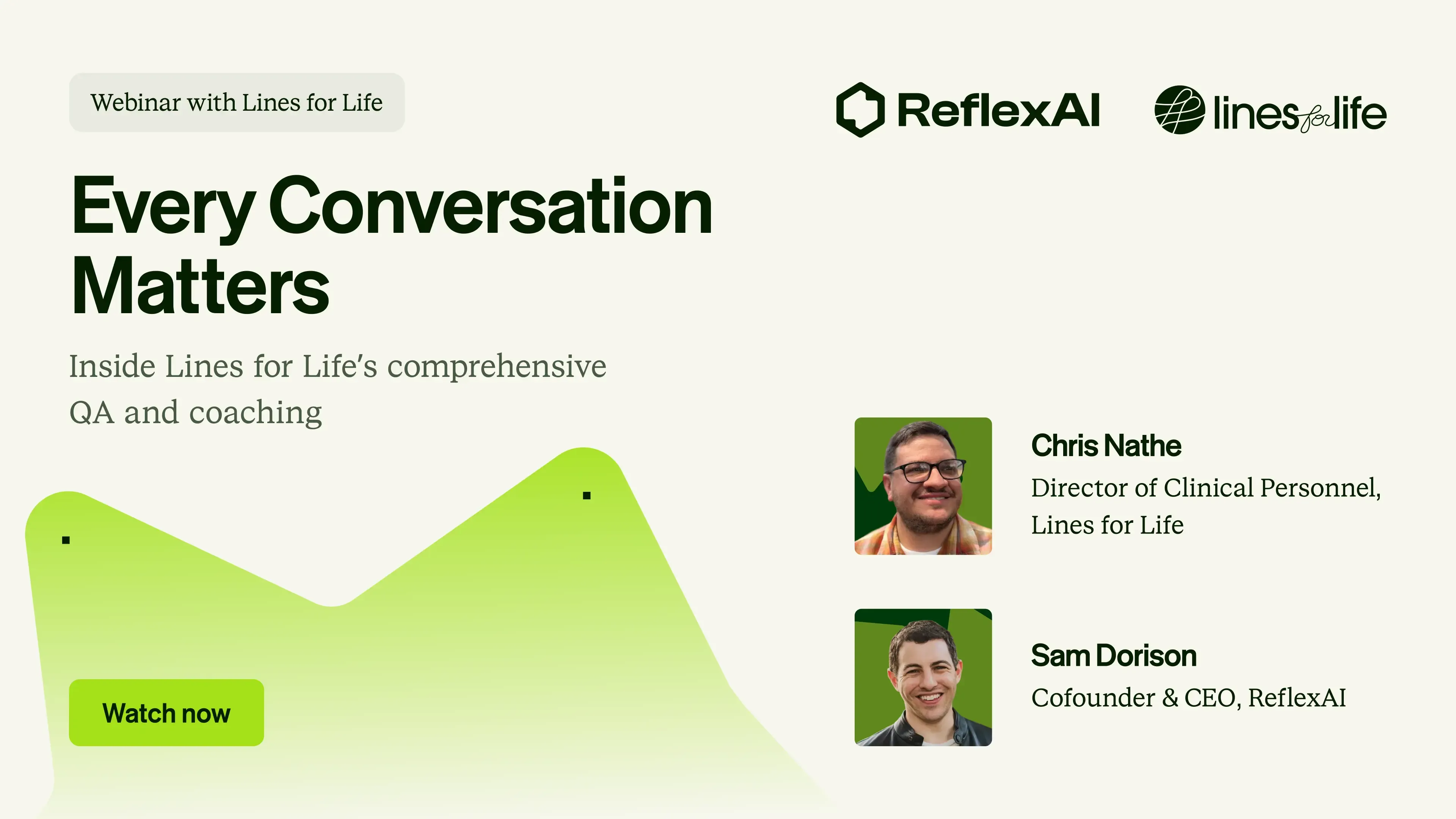
Lines for Life is a nonprofit in Portland, Oregon, that answers Oregon's 988 calls and runs several other crisis lines, including YouthLine, where trained teens support other teens. Chris Nathe started in 2016 as a volunteer on the National Suicide Prevention Lifeline, then worked as a crisis intervention specialist and supervisor before moving into quality assurance. Today he is Director of Clinical Personnel and oversees the crisis line staff.
In this webinar, Chris sat down with ReflexAI Cofounder and CEO Sam Dorison, a former crisis counselor at The Trevor Project, to go inside Lines for Life's QA and coaching program: what changed when the team went from reviewing a small sample of calls to reviewing every one with ReflexAI, and how they kept people at the center of it. Of all his past roles, Chris said QA was his favorite:
It's fun to listen to calls and give feedback and help people grow and really make them feel safe to be able to hear that feedback. I think that's probably my favorite part.
Before: one review per counselor, per quarter
QA at Lines for Life used to look like it does at most 988 centers. A single review could take up to an hour and a half, with nine or more sections and dozens of checkboxes. The early standard was to review 3% of interactions. It later became one review per counselor, per quarter, per modality, which at best still came out to about 3%. As Sam put it, "It was 3% on a good week."
Two problems came with the sample. Reviewers didn't always agree, especially on judgment calls like whether a risk assessment started at the right moment. And counselors heard about one call, then waited weeks for the next one.
The first response that they give is, this doesn't feel like it represents my entire work. And then they take that interaction and they have to sit with that for a good two weeks at best or longer.
Daily feedback instead of quarterly spot checks
Today every interaction at Lines for Life goes through ReflexAI. Supervisors spend less time hunting for examples and more time coaching. Chris described a supervisor who suggested a counselor use more empathetic reflections, met again a few days later, and could show the counselor how much more often they were using them.
The full picture also helps counselors see their own work more accurately. One counselor told their supervisor they didn't feel they were showing up well for callers who were using substances. The supervisor pulled up just those calls and found the counselor was doing better on them, and showing more empathy, than they thought. Under the old process, Sam pointed out, that answer would have taken about a month of waiting and listening.
Reflective empathy is the most common growth area
You think that folks get into this work because they're really empathetic, they're very much in touch with their feelings and emotions. And often we find that folks are a lot better at the logical aspects of interactions. They're really good at asking open-ended questions. They're really good at the who, what, when, where and why. And empathy is often the largest growth area.
Sam explained why. When a caller says something like "it might be better if I didn't wake up tomorrow," the instinct is to ask the next question before reflecting what they said. That makes it a training topic for the whole center. And it matters early: Sam shared that, in ReflexAI's experience, strong empathy in the first 100 seconds of a call makes a completed risk assessment and safety plan much more likely.
Insights beyond coaching: state funders and training
Lines for Life meets with its state funders every two weeks, and the questions often need answers fast. When the Oregon Health Authority asked what topics were coming up most on the crisis lines besides suicide, Chris searched and found housing instability had come up about 350 times in roughly a week. Another question, about how often kratom comes up, took one keyword search: 14 interactions in the past 30 days.
The same data now shapes training. Chris met with the training team right before the webinar to start planning next year's annual training. Training already draws on the situations counselors find hardest, like frequent callers and housing instability, with guidance on holding space before jumping to solutions.
It could be really easy, when someone says, "I'm really struggling because I don't want to sleep outside tonight," to instantly jump to how do I make it so you're not sleeping outside tonight. Rather than saying, tell me more about your experience and what that's like.Chris Nathe
Positive feedback, with no "but"
Sam shared a phrase one counselor used for feedback: "the big but." Whenever they got praise, they waited for the second paragraph about what to fix. Lines for Life makes a point of sending notes that are only positive. One anonymized example read: "Across all ten of your conversations, you fully completed the risk assessment and had an incredibly high level of empathy throughout."
Chris builds this into his routine. In his biweekly meetings with the day, swing and overnight team managers, the first thing he looks for is who did great that week, and those counselors hear about it. He opens leadership meetings with shout-outs too.
It's so easy to be critical, and the tools that we have are so powerful. I kind of think it's like a Spider-Man thing: with great power comes great responsibility. And that responsibility is you have to build folks up and make them feel like they're doing a good job so that they're able to hear that constructive feedback.
Time used to make that hard. Sam estimated a note like the one above would take about six hours of listening to write by hand, so supervisors spent their one review on what to fix. He pointed to psychology research suggesting five positive comments for every constructive one. In crisis work, he said, you were lucky to get one to one.
Building trust before rollout
Sam was direct about the starting point: AI doesn't have a positive reputation in high-risk work, and the concerns are well founded. Lines for Life took four steps to earn trust:
- Calibrate. The team ran about 50 calls through ReflexAI, half they considered strong and half that needed growth. The results lined up closely with the team's own assessments.
- Define the standard together. QA specialists, trainers and supervisors wrote out examples of strong and weak empathetic reflections and talked them through.
- Start with achievable goals. Early targets were simple, like answering with 988, name, county and phone number. Chris raised the bar once people understood the system.
- Talk with people. One-on-one check-ins and group conversations surfaced real fears. One supervisor worried the AI would make things up or start calling people on its own.
You show them the system and walk them through it. And they're like, oh, this is not what I thought we were doing at all. I had a very different picture of what AI is in my head.
Sam added a rule for borderline calls: when unsure if a call met the standard, score down, and when unsure if it was a serious problem, score up. That keeps a passing score meaningful and saves the most serious rating for calls that need a conversation.
The best AI tools replicate and enhance human judgment. They don't try to supplant human judgment.
Simulations in training and hiring
Lines for Life tailors simulations to what counselors will face. Before elections, counselors practiced with callers stressed about politics from both sides. The most recent annual training included a third-party caller asking for a mobile crisis referral.
Sam noted that Lines for Life was also the first center to use simulations in hiring. Candidates who can describe every skill in an interview sometimes fall back on sympathy or problem solving once they're talking with a high-risk caller. The reverse happens too:
You'll see folks who go in there and maybe aren't the best interviewers, and then you see them do a simulation, and you're like, oh, we need this person on our team.
Lines for Life also gives candidates feedback on their simulation in a follow-up interview. Sam recommends this to every center: the best way to learn whether someone is open to feedback is to give them some and watch how they respond.
Advice for QA leaders starting out
Chris's advice is to be intentional about who is in the room and when. Lines for Life is a unionized workplace, so early conversations covered how the tool fits the current feedback structure and how the team would use it.
Sam's addition: choose partners who understand crisis work and share your values, because they'll be working alongside your team.
Learn more about the work Lines for Life does every day at linesforlife.org.
To talk with ReflexAI about QA and coaching for your center, schedule a conversation with our team or email connect@reflexai.com.
FAQ
How does Lines for Life review every crisis call?
Every interaction goes through ReflexAI, which reviews skills like risk assessment and empathy against Lines for Life's standards. Supervisors use the results for daily coaching.
How did Lines for Life make sure it could trust AI-supported QA?
It calibrated about 50 calls against its own reviewers, defined strong and weak examples together, started with achievable goals, and talked through concerns one-on-one and in groups.
What is the most common growth area for crisis counselors?
At Lines for Life, it's reflective empathy. Counselors tend to be stronger at open-ended questions and gathering information.
Can smaller crisis centers use AI-supported QA?
ReflexAI works with crisis centers of all sizes and technical backgrounds, and is committed to making these tools accessible across budgets. Current customers can reach out to their ReflexAI point of contact, and anyone else can email connect@reflexai.com.