











Most implementation timelines are more within a team's control than they appear.
Enterprise contact center platform rollouts often stretch months beyond the original plan. In most cases, the delays come from unclear scope, integrations that weren't actually needed at launch, and compliance reviews that started after everything else was already built.
ReflexAI Prepare is designed so teams can run their first live simulations in about two weeks, the timeline ReflexAI customer Verstela hit for platform launch, simulation configuration, and scoring calibration.
Getting there requires three things: knowing which scenarios to build first, separating launch-critical integrations from post-launch ones, and running security review in parallel rather than after. This article covers how to do all three.
How long does implementation usually take?
Getting a first cohort live typically takes about two weeks, the timeframe ReflexAI customers have hit for initial platform setup and simulation configuration. Full enterprise rollout, including additional scenario libraries, system integrations, and compliance review, commonly extends toward 12 weeks for organizations with more complex requirements.
The range is wide because "implementation" means different things depending on your goals. For some teams it's the first pilot cohort completing scenarios. For others it's org-wide deployment with QA scoring connected to live call monitoring.
What can launch in the first two weeks?
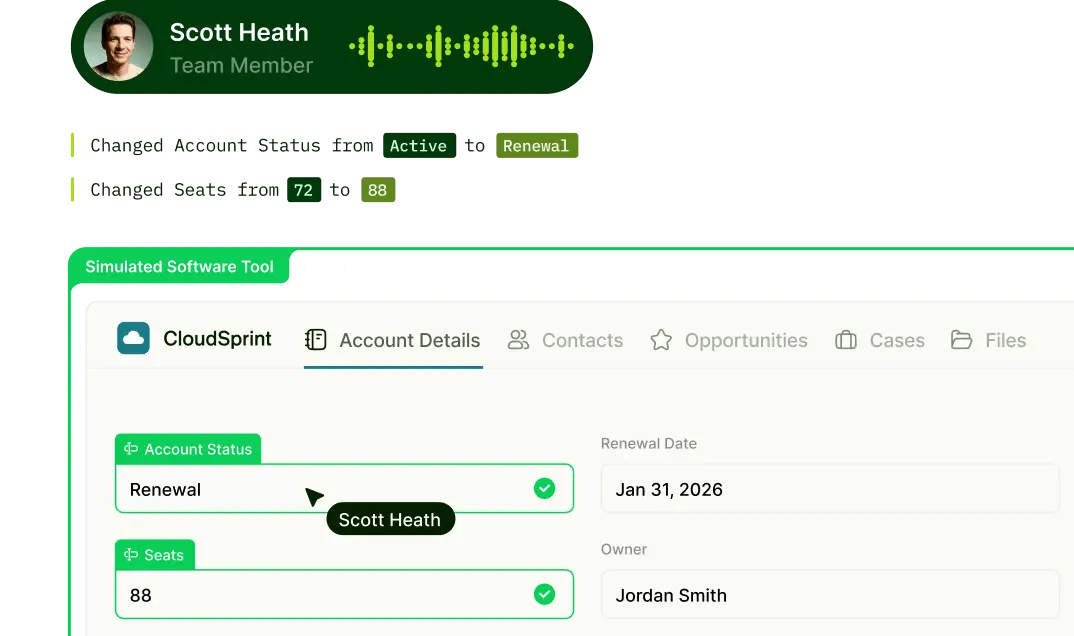
The pilot phase covers a small set of scenarios, a defined agent cohort, and basic scoring. Platforms designed for self-serve setup compress this phase significantly because training managers can build scenarios from a script or prompt without engineering support.
Before kickoff, your team needs three things:
- A list of high-priority call types: The five to ten conversations where agent mistakes are most costly
- Existing scripts or protocols: Raw material to seed scenarios without starting from scratch
- A content approver: One person who can review and sign off without escalation
- Realistic expectations on scoring: Your first scoring pass won't be final, and that's normal. Most teams refine their criteria once they see initial results, not before
What 'done' looks like at the end of week two: scenarios built and reviewed, agents completing simulations, supervisors confirming that scores reflect what they expect to see in live calls.
What takes teams toward full rollout?
This phase covers scaling beyond the pilot: additional scenario libraries, more agent cohorts, integration with CRMs or telephony platforms, and scoring calibrated to your QA rubric. Integration work runs in parallel with the pilot, not after it.
Regulated industries like healthcare, financial services, and crisis lines use this window to complete security reviews and compliance documentation. Initiating security review at the same time as scenario development, rather than sequentially, keeps this phase on track.
What pushes rollout past 12 weeks?
Three factors consistently extend timelines: deep IT integration dependencies, multi-region or multi-language deployments, and internal approval chains that weren't mapped at the start. These are organizational factors, not platform limitations.
Let's say a contact center needs to connect simulation training to three different CRM instances across regions, each with custom fields and different data governance rules. That integration work can take months if IT resources are shared across competing priorities. The same risk applies when legal or compliance teams discover the project late and require documentation that should have been requested during vendor selection.
What determines your implementation timeline?
Your timeline depends less on the platform and more on how you scope the launch. Teams that define scope clearly, prioritize ruthlessly, and separate launch-critical work from post-launch improvements consistently move faster.
Which training scenarios need to go live first?
Traditional eLearning development averages 184 hours of work per finished hour of interactive content, and advanced simulations with branching logic can require significantly more (Chapman Alliance research). A team trying to build 20 scenarios manually before going live is looking at a multi-month content project before a single agent practices.
Scope of the scenario library: Start with the conversations where mistakes are most costly: de-escalations, complex inquiries, protocol-sensitive calls. The rest of the scenario library can be built iteratively after agents are already practicing.
Scenario complexity: Simulations that include software overlays, where agents practice navigating a CRM or EHR alongside the conversation, require an additional configuration step beyond dialogue-only simulations. Most modern platforms allow teams to build scenarios from a single prompt, a script, or an uploaded file, which dramatically reduces content creation time compared to hard-coded branching logic.
How much QA scoring needs calibration?
Teams with well-documented rubrics move noticeably faster. Teams building scoring criteria from scratch take longer because they're defining what 'good' looks like at the same time they're configuring the platform.
Custom scoring dimensions: Organizations that already know which agent behaviors matter can configure scoring quickly.
Reviewer alignment: Scoring calibration makes sure the AI scores conversations the way a human reviewer would. Many contact centers run calibration sessions for manual QA, often weekly or monthly, as an ongoing operational cost. Automated scoring eliminates that recurring work, though the initial calibration round with supervisors is a one-time investment that pays off in consistency across 100% of interactions.
Which integrations are required at launch?
Enterprise platform rollouts that bundle migration, multiple integrations, and initial use case setup into a single launch often stretch well beyond what's actually required to get a training program live, which is exactly why separating launch-critical work from the rest matters.
Not all integrations are day-one requirements. Common launch-critical integrations include SSO for user authentication and LMS assignment for tracking completion. Post-launch integrations, like CRM data feeds for personalized coaching and telephony ingestion for QA scoring of live calls, can wait.
Some platforms require no IT integration at all for the simulation training layer, which removes this variable entirely from the pilot phase.
What security review does your team require?
For organizations subject to HIPAA, HITRUST, GDPR, or SOC 2 requirements, vendor security review adds time, though it runs in parallel with content build rather than after it. Platforms with pre-existing compliance documentation shorten the security review cycle considerably. ReflexAI holds SOC 2, HIPAA, HITRUST, GDPR, and ISO 27001 certifications, so security teams can review existing audit reports rather than conducting a full vendor assessment from scratch.
Waiting until scenarios are built to start the security review adds unnecessary calendar time. The two workstreams don't depend on each other.
What are the steps to launch simulation training?
Many of these steps run in parallel. The sequence below reflects what training leaders actually do, not a theoretical project plan.
1. Define success metrics and call types
Skipping this step is the single most common reason implementations stall. Teams start building before they know what they're building toward.
- Identify your top three KPIs: Speed to proficiency, escalation rate, QA scores
- Select the five to ten call types agents struggle with most: De-escalations, complex product inquiries, compliance-sensitive conversations
- Confirm who owns sign-off on scenario content: A senior agent, QA lead, or trainer who can approve without escalation
2. Build scenarios and personas
Upload scripts, protocols, or call recordings to seed the scenario library. ReflexAI Prepare's self-serve Studio lets teams build lifelike simulations and scoring models from any script, file, scenario, or prompt with no code. Configurable personas can be created in seconds.
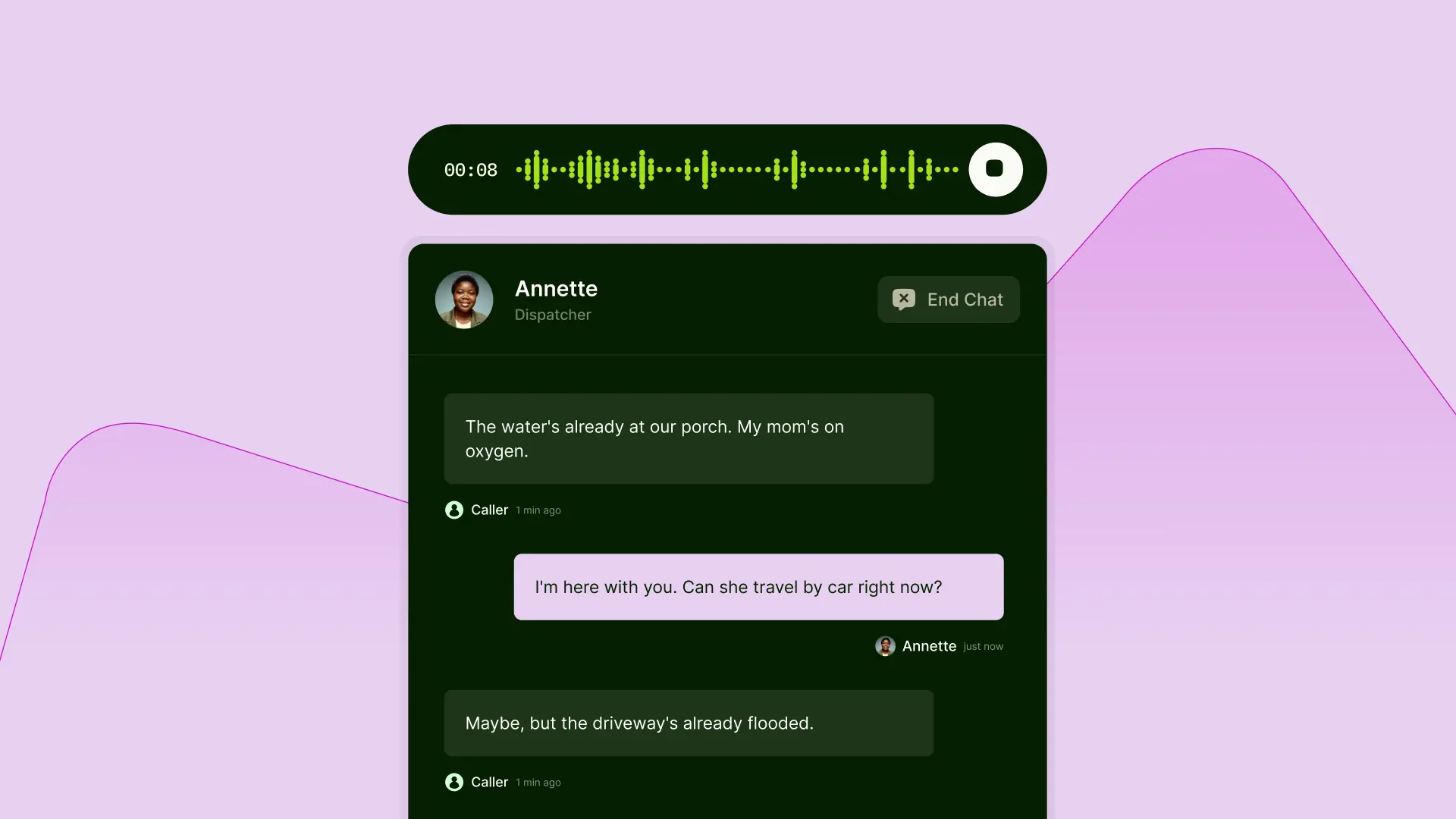
Persona configuration is what makes simulations feel realistic rather than scripted. Setting backstory, tone, emotional range, and escalation triggers takes time, though a persona that responds to empathy differently than one that escalates when interrupted creates practice conditions that mirror real caller behavior.
3. Calibrate scoring and feedback
Map your existing QA rubric to the platform's scoring dimensions. If no rubric exists, build one now. Run a calibration round: have supervisors score a sample set of simulations manually, then compare against the platform's automated scores and adjust until they align.
Scores tied to real QA criteria carry weight that generic rubrics don't. Calibration also surfaces disagreements about what "good" looks like, which is valuable to resolve before scaling.
4. Pilot with agents and supervisors
Launch with a small cohort before scaling. New hires in onboarding or a team preparing for a new call type are ideal pilot groups. Collect feedback from both agents (was the simulation realistic?) and supervisors (do the scores reflect what they see in live calls?).
A scenario that feels too easy or too scripted signals that persona configuration needs adjustment. A score that doesn't match supervisor judgment signals that calibration isn't complete.
5. Roll out by cohort
Expand in waves by team, region, or call type rather than all at once. ReflexAI supports cohort tracking so teams can monitor performance patterns across groups as rollout expands.
Set a clear definition of "launch complete" for each cohort:
- Agents have completed a minimum number of simulations: Typically three to five scenarios per agent
- Scores meet a threshold: Average scores above the organization's readiness benchmark
- Supervisors have reviewed results: QA leads confirm that simulation performance aligns with live call expectations
How can teams shorten implementation without added risk?
The answer is to sequence work differently and avoid the traps that add calendar time without adding value.
Start with high-impact conversations
A contact center handling billing inquiries, technical support, and account changes doesn't need all three call types ready on day one. Start with the one that drives the most escalations or where new hires struggle most, then expand the library once agents are already practicing.
Narrow the scope at launch: Pick the conversations where mistakes are most costly and build those first, then expand the library once agents are already practicing.
Reuse scripts, rubrics, and QA data
Most organizations have call scripts, QA scorecards, and recorded interactions sitting unused. A team with 20 documented call scripts can upload all of them and let the platform generate starting scenarios in minutes. A team without scripts needs to write them first, which adds meaningful time to the timeline.
ReflexAI Assure ingests interaction data from existing systems like Zendesk, Salesforce, HubSpot, and telephony platforms. Flagged interactions from QA can be converted directly into personalized simulations, closing the loop between what's failing in live calls and what agents practice.
Phase integrations after the pilot
Let's say a contact center wants to pull customer context from Salesforce into simulations so agents practice with realistic account details. That integration is valuable, though it's not required for agents to practice de-escalation techniques or compliance language. Launch the pilot without it, then add the integration in phase two.
Agents need a browser with working audio, not a fully connected tech stack, to begin practicing.
Set launch owners and acceptance criteria
Implementations without a clear internal owner consistently take longer because decisions queue up. Someone needs authority to approve scenarios, resolve scoring questions, and coordinate with IT without escalation.
Name a decision-maker: Define acceptance criteria before kickoff: what does a "ready" scenario look like, what score threshold signals agent readiness, and who signs off before rollout expands. Without these definitions, teams iterate endlessly because "good enough" is subjective.
How do you know agents are ready?
Readiness is not a subjective judgment. It's a set of conditions that can be verified.
Scenario realism passes trainer review
A senior agent or QA lead should be able to complete a simulation and say "yes, this is what the call actually sounds like" without hesitation. If they can't, the persona needs adjustment. On modern platforms this is a review-and-approve step, not a rebuild.
Scores match your QA standards
Run a side-by-side test: have three supervisors score the same five simulations manually, then compare their scores to the platform's automated scores. If the platform's scores fall within the range of human reviewer scores, calibration is working. This alignment is what allows simulation scores to be used as evidence of agent readiness, not just a training metric, but a performance signal leadership can trust.
Supervisors can coach from results
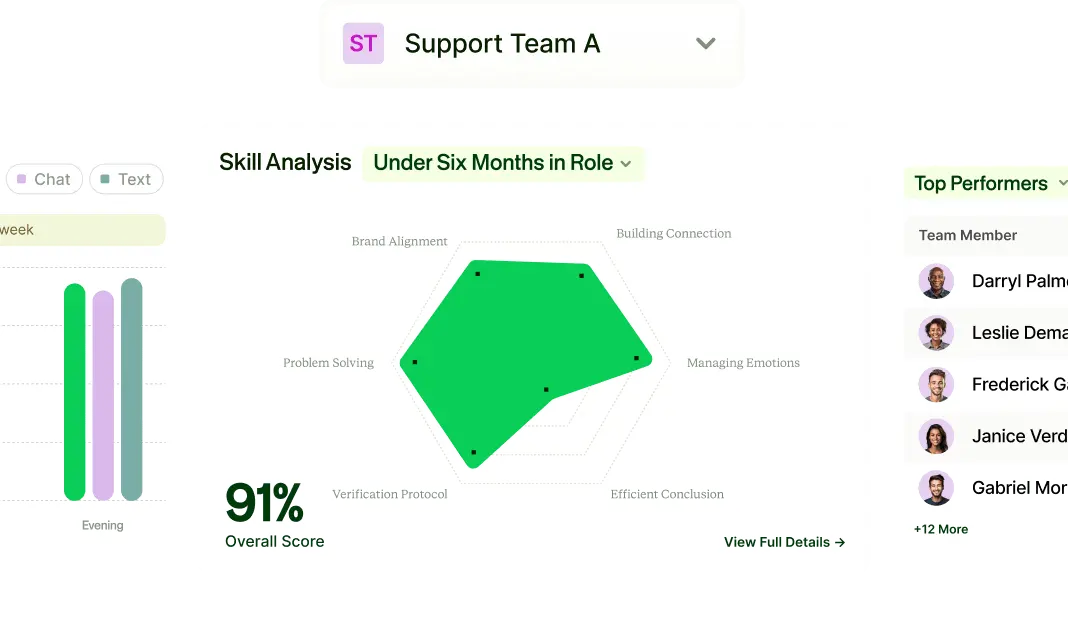
If supervisors can look at simulation results and immediately identify which agents need coaching and on which behaviors, the platform is working. ReflexAI surfaces trends, strengths, and risks that traditional QA methods miss. Supervisors can use cohort tracking and collaborative workspaces to monitor performance patterns and act on them.
A supervisor should be able to open the dashboard and answer these questions in under two minutes:
- Which agents are struggling with empathy or tone?
- Which agents are nailing compliance language?
- Which call types need additional practice scenarios?
Baselines track onboarding and escalations
Before rollout, record current onboarding time, escalation rate, and QA scores for the target cohort. Without a baseline, it's impossible to show impact even if performance improves significantly.
Let's say a contact center's average onboarding time is 12 weeks and escalation rate is 8%. After simulation training, onboarding drops to 9 weeks and escalations drop to 5%. That's a measurable outcome tied directly to the platform, and the number leadership will ask for.
Ready to see what readiness looks like in your organization?
How ReflexAI helps teams launch faster
The timeline and readiness challenges described above are solvable with the right platform design. ReflexAI's approach compresses the scenario-build phase, eliminates integration blockers at launch, and connects training outcomes to live call performance.
Create lifelike personas and scoring without code
ReflexAI lets teams build simulations and scoring models from any script, file, scenario, or prompt with no code required. Configurable personas with custom backstories, tones, and emotional responses can be built in seconds from a single prompt. A controlled MIT study on professional writing tasks found that generative AI reduced completion time by 40% (Noy & Zhang, Science, 2023), and scenario creation involves substantial writing work: prompts, branching paths, rubrics, and feedback text.
Practice tool navigation with software simulations
ReflexAI Prepare's software simulation capability lets agents practice conversations while simultaneously navigating tools like CRMs or EHRs through software overlays. Agents can practice the full workflow, not just the dialogue, without requiring a live integration at launch. Software overlays eliminate the gap between "I know what to say" and "I know how to document it in the system," which is where new hires slow down on live calls even when they handle the conversation well.
Connect simulation training to 100% QA visibility
Traditional QA coverage is limited:
- Only 2% to 5% of interactions are sampled
- 95% to 98% of agent performance goes unmonitored
ReflexAI Assure automatically scores 100% of live conversations so teams can track whether simulation training is moving the needle on real calls. Flagged QA interactions can be converted directly into personalized simulations, tying training directly to live outcomes.
FAQs
Can we launch simulation training without CRM or telephony integrations in place?
Yes. Simulation training requires only a browser with working audio, with no IT integration needed for the pilot phase. Integrations with CRM, telephony, or QA platforms can be added after the initial cohort is live and the scenario library is validated.
How many scenarios should a pilot include?
A pilot typically covers the five to ten call types that carry the most risk or where agent performance is most inconsistent. Starting with a focused library makes it easier to validate scoring, gather supervisor feedback, and iterate before scaling.
How much content does a team need before kickoff?
Teams need existing scripts, QA rubrics, or recorded call examples to seed the scenario library, though they do not need polished, finalized content. A rough call script or a list of common objections is enough to generate a starting simulation that trainers then review and refine.
Can regulated industries still move quickly on implementation?
Yes. Regulated teams can move at the same pace as others if they initiate security review and compliance documentation in parallel with scenario development rather than sequentially. Platforms with pre-existing certifications like SOC 2, HIPAA, and HITRUST shorten the vendor review cycle significantly.
Who should own implementation internally?
Implementation moves fastest when a single internal owner has authority to approve scenarios, align stakeholders, and make decisions without escalation. Without a named owner, decisions queue up and timelines extend.
What causes AI simulation implementation to stall?
The most common causes are trying to build too many scenarios before going live, waiting for all integrations to be complete before starting the pilot, and not defining acceptance criteria upfront. Each of these is an organizational decision, not a platform constraint.
Most teams are closer to launch than they think. The variables that extend timelines are solvable before kickoff: unclear scope, missing rubrics, sequential rather than parallel workstreams. ReflexAI's Prepare platform is built for teams that need to move from decision to live simulations without a lengthy professional services engagement. Want to see how fast your team could launch?