










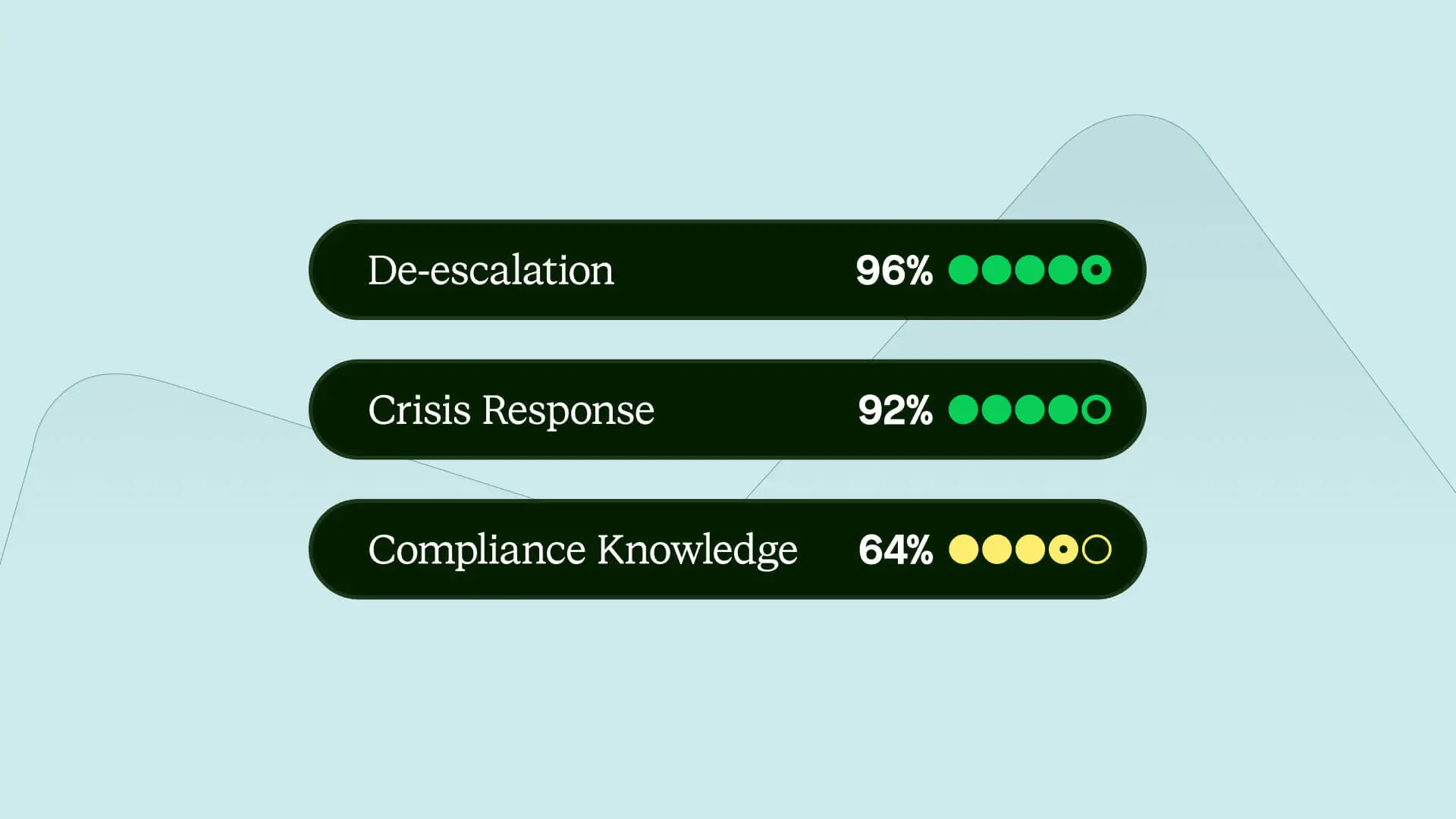

The conventional wisdom is that if agents pass the training modules, they're ready to take calls. But QA scores have a way of testing that assumption quickly. Agents who score well on LMS quizzes can still freeze, miss a disclosure, or lose control of a call the first time a caller pushes back.
Knowing the policy isn't the same as applying it under pressure.
Your LMS is the right place for compliance records, certifications, and learning paths. It's not designed to measure what an agent does when the conversation gets hard.
One thing to keep in mind as you evaluate options: SCORM lets your LMS track that a simulation was completed. It doesn't carry behavioral performance data across. That distinction matters when you're trying to connect training scores to QA scores.
Why this decision matters
Your LMS already tracks completions, certifications, and quiz scores. The question most training leaders hit is whether that coverage is enough, or whether a dedicated simulation platform belongs in the stack alongside it. The answer depends on what agents are being trained to do, not just what they need to know. An agent can pass every compliance module in your LMS and still freeze when a caller becomes hostile, mishandle a CRM lookup mid-call, or miss a required escalation step under pressure.
What is the real difference between an LMS and a call simulation platform?
An LMS (Learning Management System) organizes, delivers, and tracks training content: courses, compliance modules, certifications, and learning paths. It tells you what an agent completed. A call simulation platform gives agents interactive, realistic practice in live conversations, whether voice or chat, with feedback tied to how they actually performed. It tells you how an agent behaved under pressure.
The simplest way to draw the line: an LMS manages knowledge transfer, a simulation platform builds conversational readiness.
LMS | Call simulation platform | |
Primary purpose | Deliver and track training content | Build and assess conversational readiness |
Output | Completion rates, quiz scores | Behavioral performance scores |
Best for | Knowledge, policy, compliance | Practice, de-escalation, protocol under pressure |
Feedback type | Pass/fail, quiz results | Real-time, scenario-specific coaching |
Neither tool is superior across the board. The goal is knowing which one fits which part of your training stack.
When can your LMS handle it?
Your LMS is the right tool for a specific set of training needs, and recognizing those use cases matters before adding anything to your stack.
Knowledge and policy training
Product knowledge, policy updates, and process documentation belong in your LMS. Agents need to read, watch, or review content, not practice a conversation. Let's say you're rolling out a new billing policy - your LMS is the right tool because the goal is comprehension and reference, not behavioral fluency.
Compliance records and certifications
Compliance training (HIPAA, GDPR, financial disclosures) requires documentation and audit trails that LMS platforms are built to produce. An audit trail is the record of who completed what training and when, which regulators and internal auditors require during reviews. If a regulator asks who completed what training and when, your LMS answers that question.
Learning paths and completion tracking
LMS platforms excel at sequencing training: ensuring agents complete onboarding modules in order, gating advanced content behind prerequisites, and giving managers visibility into team-wide progress. The LMS tells you an agent finished Module 3 before starting Module 4, though it does not tell you whether that agent can apply Module 3 under pressure.
Is your training primarily about knowledge transfer and compliance documentation? If so, your LMS is likely sufficient. If agents need to apply that knowledge in high-pressure conversations, keep reading.
When do you need a dedicated call simulation platform?
Each of the following is a specific signal that your LMS alone is not enough. These are situations you can recognize in your own operation.
Agents need voice or chat practice under pressure
Static LMS content (slides, videos, quizzes) cannot replicate the pressure of a live call. LMS branching scenarios, where learners select from pre-written response options, are not the same as adaptive, real-time AI simulations. Adaptive simulation means the platform responds dynamically to what the agent says, including tone, hesitation, and phrasing, rather than following a fixed decision tree.
Branching scenarios face a structural limit called combinatorial explosion. Each added branch multiplies future content and maintenance, producing an authoring wall where it becomes too expensive to cover realistic variability. To feel realistic, a scenario must anticipate:
- Interruptions and off-script disclosures
- Partial compliance and misunderstandings
- Hostile responses and policy edge cases
Most LMS platforms also struggle to report which path learners took and how they performed within that path, so even when branching works, the measurement is shallow.
Scenarios need realistic personas and emotional variation
A caller who is frustrated, confused, or in crisis does not behave the same way twice. Dedicated simulation platforms allow teams to configure personas with distinct backstories, tones, and emotional responses, something a standard LMS quiz or branching module cannot replicate.
Real de-escalation, crisis response, or healthcare scheduling involves moment-to-moment phrasing, timing, clarification, and recovery after mistakes. Branching scenarios create a recognition-and-selection task (pick the right button), while real calls are generation-and-repair tasks (produce the right language and recover when it does not land). ReflexAI Prepare supports configurable personas built from a single prompt, including emotional variation, so teams can create realistic practice scenarios without instructional design expertise.
Scores need to match your QA rubric
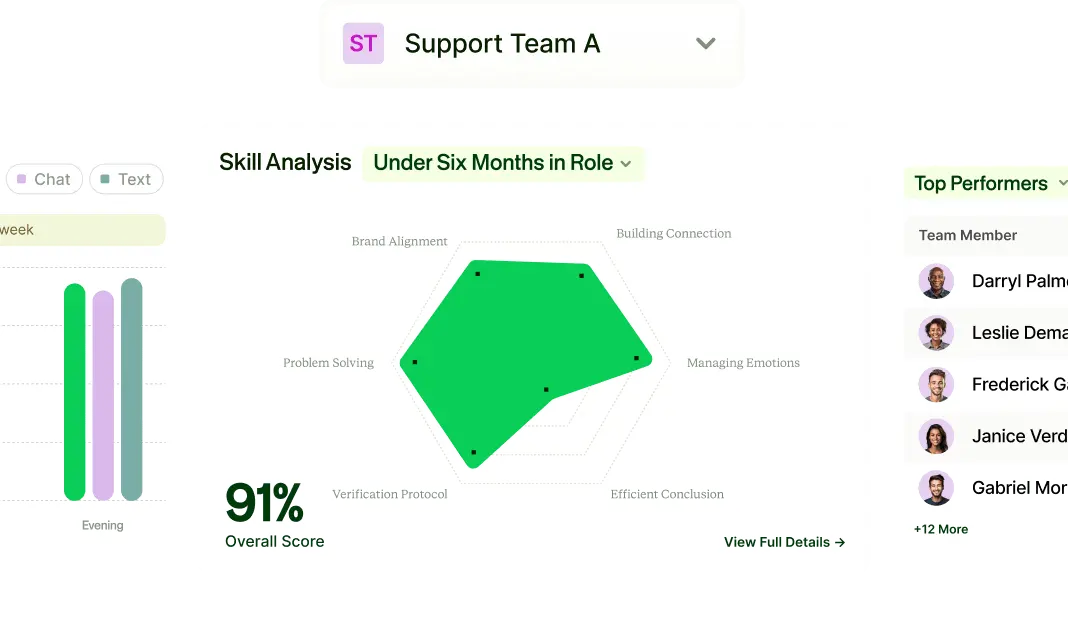
Most LMS platforms score on completion or quiz accuracy, while contact centers evaluate agents on empathy, protocol adherence, de-escalation technique, and accuracy. A widely used competence framework from medical education, directly transferable to contact centers, separates:
- "Knows / Knows how": knowledge and competence, what LMS quizzes measure
- "Shows how / Does": performance in scenario versus real-world action, what QA scorecards measure
If training scores and QA scores use different rubrics, leaders cannot connect practice performance to real-world outcomes. ReflexAI Prepare supports custom scoring dimensions that mirror an organization's own evaluation criteria, so training scores and QA scores use the same rubric.
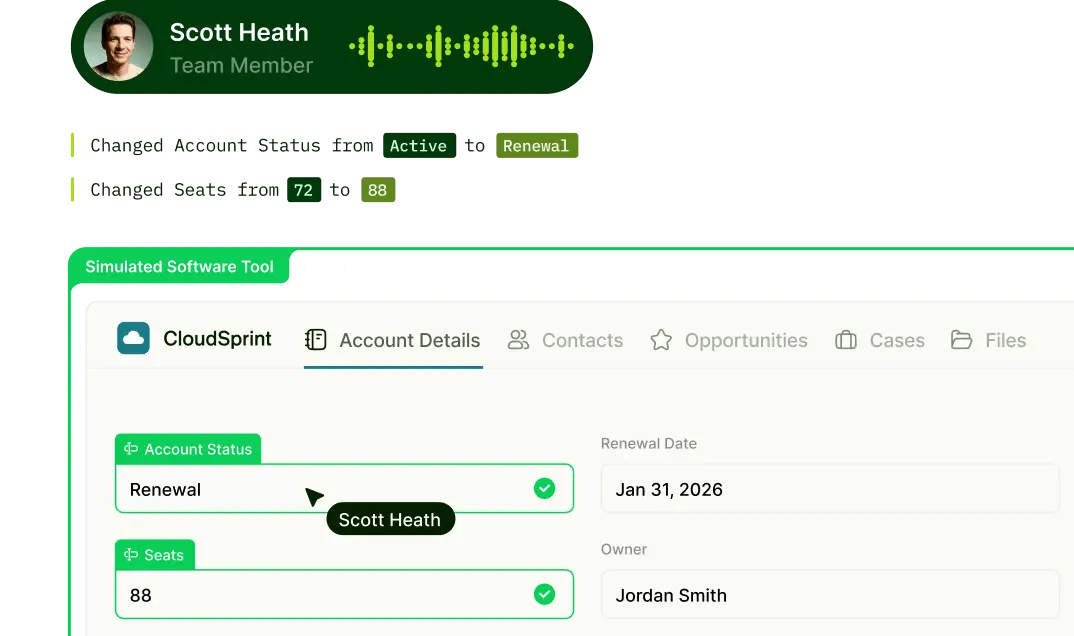
Agents need to practice inside CRM or EMR workflows
In many contact centers, agents are managing a conversation and navigating software simultaneously: a CRM, an EMR (electronic medical record), or a ticketing system. If training only covers the conversation and not the tool environment, agents face a gap the first time they go live.
Cognitive Load Theory distinguishes intrinsic load (the inherent difficulty of the task) from extraneous load (the difficulty added by split attention). In production, agents rarely just talk. They navigate multiple systems, search knowledge, document, and comply, all while maintaining rapport and control of the interaction. Industry commentary frames this as a context-breaking tax that increases cognitive load and burnout risk, explicitly linking app-toggling to workflow interruption and longer time-to-proficiency. ReflexAI Prepare's software simulation capability supports this use case, allowing agents to practice conversations while navigating tools like CRMs, EHRs, and ticketing systems.
Conversations carry compliance or escalation risk
In crisis lines, healthcare, financial services, and regulated contact centers, the cost of an unprepared agent is not just a poor CSAT score. It can mean a missed escalation, a compliance breach, or a harm event. When conversations carry that level of risk, readiness cannot be measured by module completion alone.
Contact centers acknowledge the classroom-to-floor gap through nesting, a supervised transition to production after classroom or LMS-style learning that typically lasts one to four weeks. Nesting exists because knowing is not yet fluent doing. QA programs are often sample-based and manual, which means quiz scores can appear high while QA lags, and the true performance picture stays both noisy and expensive to surface.
Let's say your agents consistently pass compliance modules but struggle when callers become hostile - that's a signal simulation practice is needed. Or if QA flags missed escalations despite 100% training completion, the issue isn't knowledge; it's application under pressure.
Are your agents freezing on escalations despite passing their training? Let's talk about how simulation can help bridge that gap. Schedule a demo
How should your LMS and call simulation software work together?
Most mature contact center training stacks use both. The question is not which one to pick, it is how to divide the work.
Keep the LMS as the learning system of record
The LMS remains the right place to house compliance documentation, certifications, learning paths, and training history. Simulation data (performance scores, scenario completion, behavioral trends) feeds into the LMS or sits alongside it, though the LMS owns the record.
Use simulations as the readiness layer
Simulations sit between training content and live calls. An agent completes knowledge modules in the LMS, then practices applying that knowledge in simulated conversations before going live. The sequence is: learn, practice, perform. Completing a module and taking a live call without the practice layer in between is where most onboarding gaps originate.
Connect QA findings to targeted practice
The most powerful integration is when live QA data flows back into simulation assignments. Let's say your QA team flags a pattern of missed escalations - that insight should trigger a targeted simulation assignment, not a generic refresher module. ReflexAI's Assure and Prepare products are built to do exactly this, where QA findings can directly inform simulation assignments, turning QA from a retrospective report into a driver of readiness.
Ready to connect your QA findings to targeted practice? Learn how ReflexAI makes this integration seamless. Schedule a demo
How do you evaluate the business case?
The metrics that make this case visible to operations and finance stakeholders are ones you are likely already tracking.
Compare ramp time and readiness scores
Nesting duration is a hidden cost. Industry guidance describes nesting as lasting one to four weeks because agents need supervised practice to bridge the gap between classroom learning and live production. If your nesting period runs longer than two weeks, agents are not arriving at nesting ready to perform. Simulation-based practice compresses ramp time by giving agents more repetitions before they go live.
Key metrics to track:
- Average nesting duration: Industry benchmark ranges from 1-4 weeks; organizations using simulation-based training report meaningful reductions in nesting time, though the exact percentage will depend on your baseline
- Time-to-proficiency: Days or weeks until agents reach target QA scores independently
- Cost per day of extended nesting: Calculate supervisor hours × hourly cost; typical range is $150-$300 per agent per day
- First-call performance scores: QA scores on agents' first unsupervised calls; simulation-trained agents typically score noticeably higher
Track QA scores, escalations, and CSAT
If QA scores are inconsistent across agents who completed the same LMS training - for example, a 15-20 point spread in scores among agents with identical module completions - the issue is not knowledge. It is application under pressure. Escalation rates and CSAT scores are downstream signals of training gaps that an LMS alone cannot close.
QA sampling is a structural limit. If you are only reviewing 2 to 5 percent of calls, you are making coaching and performance decisions based on a small, potentially unrepresentable sample. That makes it easy to miss patterns that only show up at scale.
Key indicators of training gaps:
- QA score variance: 15+ point spreads among agents with identical LMS completion rates
- Escalation rates: Above 8-10% in the first 30 days suggests agents aren't ready for complex scenarios
- CSAT scores: Below 85% despite 100% training completion indicates application gaps
- First-call resolution rates: Target 70-80%; lower rates suggest agents lack conversational control
Count coaching time and scenario maintenance
If supervisors are spending 5-10 hours per week running manual roleplays, coaching the same skills repeatedly, or rebuilding training scenarios from scratch after every policy change - at an estimated cost of $500-$1,000 per supervisor weekly - that is a hidden cost of not having a dedicated simulation platform.
Branching content faces exponential growth. Branching scenarios hit an authoring wall, making it costly to expand scenario coverage and to keep scenarios current as policies or products change. Even major e-learning vendors acknowledge that standard LMSs may struggle with granular branch or path analytics.
Cost factors to quantify:
- Manual roleplay time: Supervisor hours per week × number of supervisors × hourly cost
- Scenario rebuild cycles: Hours spent per policy change × frequency of updates per year
- Coaching repetition: Hours spent re-coaching the same skills × percentage of agents requiring repeated coaching (often 30-40%)
Let's say your nesting period runs four weeks instead of two - that's two extra weeks of supervisor time and delayed productivity per agent, which at $200 per day equals $2,000 in hidden costs per agent. Multiply that by your annual new-hire volume and the business case becomes clear.
What would a 50% reduction in nesting time mean for your operation? Let's calculate the impact together. Schedule a demo
What questions should you ask before a pilot?
These are vendor evaluation questions you can bring directly into a discovery call or RFP process.
Can we build scenarios from real scripts and prompts?
If scenario creation is slow or requires a specialist, the platform will not keep pace with operational changes. ReflexAI Studio allows teams to build simulations from any script, file, scenario, or prompt with no code, so scenario creation happens in minutes rather than weeks.
Can we use our own scoring rubric?
Generic scoring dimensions (was the agent polite?) do not map to the specific criteria your QA team already uses. Let's say your QA rubric includes a specific empathy dimension - ask whether the simulation platform can score against that exact criterion, not a generic substitute. If scoring cannot be configured to mirror your organization's existing evaluation framework, training scores and QA scores will never be comparable.
Calibration is a manual, ongoing requirement. CMS (Centers for Medicare & Medicaid Services) call center guidance specifies monthly calibration sessions and written records when multiple reviewers exist (CMS call center manual). A simulation platform that cannot mirror your QA rubric adds a second calibration process rather than reducing manual effort.
Can agents practice tools and conversations together?
Ask whether the platform supports software overlays or environment simulation, so agents practice navigating your CRM, EMR, or ticketing system at the same time as the conversation. Cognitive Load Theory finds that split attention and poorly integrated task demands increase extraneous load and can reduce performance. A platform that only simulates the dialogue leaves a gap.
Can QA data trigger targeted simulations?
Ask whether the platform integrates with your QA tool so that flagged interactions can be converted into simulation assignments. Contact center research describes coaching as among the most manual parts of QA operations, and leader confidence in manual sampling is only moderate. Closing the loop between live QA and simulation practice is where the most measurable improvement happens.
Can the platform meet our compliance standards?
Simulated conversations often involve sensitive data: patient information, financial details, crisis disclosures. ReflexAI meets SOC 2, HIPAA, HITRUST, GDPR, and ISO 27001, which represents a benchmark for what enterprise-grade compliance looks like in this space. If your contact center handles sensitive conversations, the simulation platform must meet the same standards as your production systems.
Planning a pilot? Let's talk about which scenarios will give you the clearest signal and fastest ROI. Schedule a demo
FAQ
Can my LMS host simulations built in another platform?
Most dedicated simulation platforms export content in SCORM format, which is compatible with standard LMS platforms, so completion can be tracked in the LMS even if the simulation was built elsewhere. Behavioral performance data (how an agent actually performed in the scenario) typically stays in the simulation platform and does not transfer through SCORM.
Does a dedicated call simulation platform replace my LMS?
No. The LMS manages knowledge delivery, compliance records, and certifications, while the simulation platform manages conversational practice and readiness assessment. They serve different functions and work best together.
Is branching dialogue in an LMS the same as AI call simulation?
No. Branching dialogue presents pre-written response options and follows a fixed decision tree, while AI call simulation adapts in real time to what the agent actually says, including tone, hesitation, and phrasing. The gap in realism is significant for high-stakes conversation training.
What data should flow between a QA platform, simulation platform, and LMS?
QA findings (flagged interactions, low scores, recurring skill gaps) should inform which simulations agents are assigned, simulation performance scores should feed into coaching records, and the LMS should hold completion history and certifications. When these three systems are connected, training becomes a continuous loop rather than a one-time event.
How many scenarios does a team need for a useful simulation pilot?
A useful pilot typically starts with the highest-volume or highest-risk call types your team handles, not a comprehensive library. Starting narrow and measuring impact on those specific scenarios gives clearer signal than building dozens of scenarios before going live.
What compliance standards should a call simulation platform meet?
For contact centers handling sensitive conversations (healthcare, crisis, financial services), look for platforms certified under SOC 2, HIPAA, HITRUST, GDPR, and ISO 27001. These standards govern how conversational data is stored, accessed, and protected.
How ReflexAI helps teams connect simulation and QA
ReflexAI brings simulation and QA together so performance is measurable and outcomes are tied to what matters in day-to-day operations. Prepare delivers AI-powered voice and chat simulations with configurable personas, custom scoring dimensions, and software overlays for CRM and EMR practice. Assure monitors 100 percent of live conversations and surfaces trends, skill gaps, and flagged interactions. The connection between Assure and Prepare means QA findings can directly trigger targeted simulation assignments, turning QA from a retrospective report into a driver of readiness.
ReflexAI Studio allows teams to build simulations from any script, file, or prompt with no code, in minutes. The platform meets SOC 2, HIPAA, HITRUST, GDPR, and ISO 27001 standards, so teams handling sensitive conversations can practice safely before real customer impact. If your team is weighing whether your LMS is enough or whether a dedicated simulation platform belongs in your training stack, ReflexAI can show you how both fit together.