










Most teams discover the limits of DIY roleplay tools after they've already rolled them out.
ChatGPT and Claude can run a persona, respond dynamically, and give qualitative feedback. That's enough for a one-off experiment. It's not enough when you need scoring to hold across hundreds of sessions, compliance documentation your legal team can actually sign off on, or any way to know whether practice is moving the needle on live call performance.
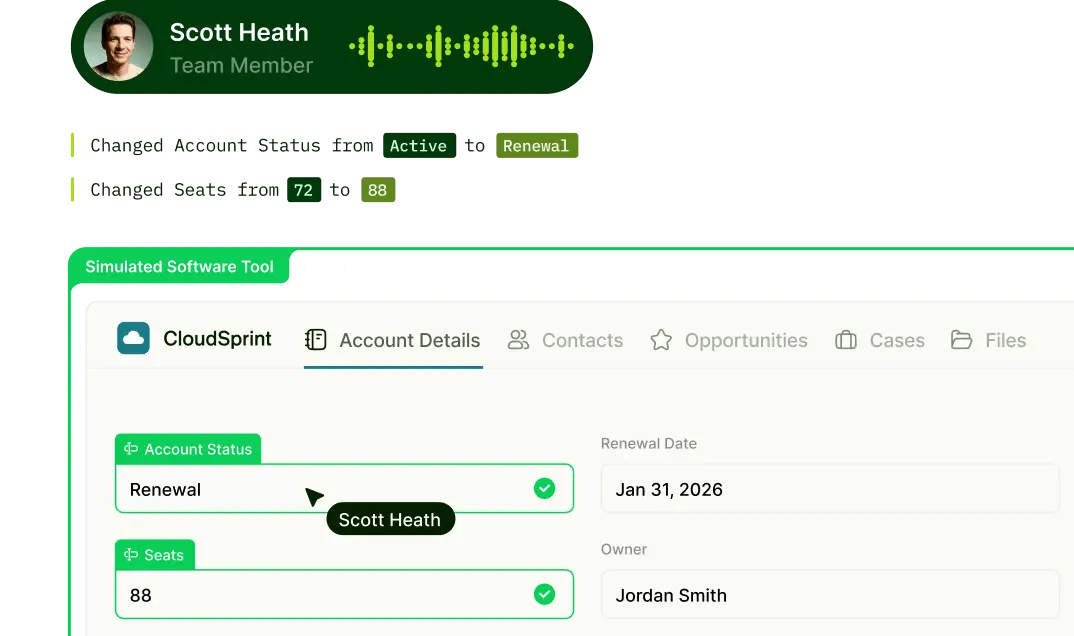
What’s missing is everything built around it: consistent scoring, session records, analytics, and the connection between what agents practice in ReflexAI Prepare and what ReflexAI Assure surfaces in their live interactions.
This article covers where DIY builds work, where they break, and what to look for when you're ready to move beyond them.
Can ChatGPT or Claude build a functional AI roleplay tool?
Yes, you can build a basic AI roleplay tool using ChatGPT or Claude, and for some small teams, that is enough. Paste a detailed system prompt into ChatGPT or Claude's chat interface, and the AI will adopt a persona and respond dynamically to whatever your trainee says. The distance between "it works in a demo" and "it works for high-stakes training at scale" is where most DIY builds run into trouble.
Three paths exist for building with these tools:
- Prompt-based roleplay: Paste a system prompt into ChatGPT or Claude's chat interface; the AI adopts the persona for that session with no setup required
- Custom GPT or Claude Project: Save a persona and instructions so the setup persists across sessions without re-entering prompts each time
- API-based tool: Use the ChatGPT or Claude API to build a lightweight internal app that delivers structured scenarios to multiple users simultaneously
What counts as an AI roleplay tool?
An AI roleplay tool puts a trainee in front of a persona that behaves like the people they'll actually talk to on the job, whether that's a frustrated customer, a hesitant patient, or someone calling in crisis. The persona responds dynamically to what the trainee says, but the goal isn't a good conversation. It's practice that holds up under pressure. That means a real scenario, a persona with behavioral constraints that don't bend just because the trainee is struggling, and a clear end condition. Done well, the AI pushes back when the trainee makes a mistake, escalates when the moment calls for it, and stays in character for the whole exchange.
What can you realistically build without a dedicated platform?
A solo trainer or small team can build something useful within a few hours. ChatGPT's Custom GPT interface lets you define a persona name, role, emotional state, and communication style in a single text box. Claude Projects support file uploads, so you can feed the AI your actual call scripts, compliance protocols, or product documentation.
What you can build without engineering resources:
- A customer complaint scenario with a defined persona tone and backstory
- A repeatable onboarding script practice session using a saved Custom GPT
- A basic scoring checklist a supervisor fills in manually after each session
- A Claude Project with uploaded call scripts or protocols for context
Manual scoring is the trade-off for that speed. A supervisor has to watch every session and fill in a checklist afterward, one trainee at a time. That's fine at five sessions a week. It stops being fine once you're running fifty.
When is a DIY roleplay tool enough?
Your team is onboarding three new customer support agents and wants them to practice handling a shipping complaint before their first week on the floor. A well-crafted ChatGPT Custom GPT can play the resistant customer while a trainer watches and debriefs afterward. No scoring automation needed yet.
A DIY approach makes sense when:
- You are running low-volume practice with a small cohort
- You are testing whether AI roleplay fits your training model before committing budget
- You are working in a non-regulated environment where compliance controls are not a procurement requirement
- A trainer can manually review every session and provide feedback
The tool becomes a liability when you need to scale beyond manual review, track performance trends across agents, or operate under HIPAA or SOC 2 requirements. Is your team approaching that threshold?
Low-risk practice and early experiments
A DIY tool works when the stakes are low enough that inconsistent persona behavior or missing analytics will not create operational risk. The trainer becomes the quality control layer that a production tool would automate. When volume increases, that setup collapses: onboarding 20 agents per quarter turns manual session review into a full-time job.
Prompt-based roleplay for simple, single-scenario practice
The quality of the persona depends entirely on the quality of the prompt. Vague instructions produce vague characters. A strong system prompt includes:
- Persona definition: Name, role, emotional state, and communication style
- Scenario context: "You are a customer who received the wrong order and are frustrated but willing to listen"
- Behavioral constraints: What the persona will not accept, what breaks their patience, what calms them down
- End condition: "End the conversation if the agent offers a refund unprompted"
Without behavioral constraints, the AI defaults to cooperative behavior that does not prepare agents for real conversations. Are your prompts specific enough to create realistic resistance?That question gets harder to answer as scenarios get less predictable. A prompt like this defines how a persona reacts to the two or three behaviors you thought to write instructions for, but it says nothing about who the persona is the moment a trainee pushes somewhere the prompt didn't cover, which is usually where a DIY persona stops making sense.
API-based tools for repeatable, multi-user practice
Teams with a developer resource can use the ChatGPT or Claude API to serve scenarios to multiple trainees simultaneously, log sessions programmatically, and version-control prompts in a repository. Every time you want to add a new scenario, update a persona, or change scoring criteria, though, you are writing code or modifying configuration files. The API gives you control without giving you a training platform. Is your team ready to maintain that infrastructure long-term?
What does a reliable AI roleplay tool need?
A production-ready roleplay tool requires more than conversational ability. Personas need internal motivations and emotional range that shift based on trainee performance. Scenarios need to mirror the actual distribution of conversations agents face, not just the easy ones. Scoring needs to apply a structured rubric consistently across hundreds of sessions. Without these layers, the tool produces practice volume but not training signal.
Personas with goals, constraints, and emotional range
A persona is more than a name and a job title. Effective roleplay personas have internal motivations, behavioral limits, and emotional responses that shift based on how the trainee performs. A persona that capitulates too easily does not prepare agents for real conversations.
- Backstory and motivation: "You ordered a birthday gift that arrived damaged two days before the party, and you need a replacement shipped overnight or a full refund" gives the AI a goal to pursue
- Emotional triggers: The persona should escalate when the agent offers a generic apology without a concrete resolution, or asks the customer to repeat information they already provided
- Behavioral constraints: The persona might refuse to accept a discount code as a resolution, or hang up if the agent puts them on hold without asking permission
- Voice and vocabulary: Does the persona interrupt? Do they speak formally or casually? These details determine whether the practice feels real
Scenarios that mirror real conversations
Practice scenarios need to reflect the actual distribution of conversations agents face, not just the obvious cases. Without access to actual interaction data, DIY scenario design defaults to the most common cases and misses the high-risk outliers that drive escalations in production. Agents who perform well in practice then struggle when a real customer deviates from the expected script.
Scoring tied to your rubric
Scoring is where most DIY tools collapse. ChatGPT and Claude can offer qualitative feedback like "you could have shown more empathy here," though they cannot consistently apply a structured rubric across hundreds of sessions without significant prompt engineering and human oversight. Research on LLM-as-a-judge methods has found internal contradictions like score-comparison inconsistency (where a lower-scored response outperforms a higher-scored one in head-to-head comparison) in over 23% of evaluations (Fang et al., TrustJudge, 2025).
ReflexAI's platform includes custom scoring dimensions that let teams mirror their own evaluation criteria rather than accepting a generic rubric. The scoring engine applies the same standards across every session, surfaces the exact moments that affected each score, and pairs them with recommended alternatives.
Session records and performance history
A single practice session with no record is a lost data point. Reliable tools capture what happened, what the trainee said, how the persona responded, and where the conversation broke down, so supervisors can coach against specific moments rather than general impressions. DIY builds using the chat interface leave this entirely to manual note-taking. How much training data is your team losing to unrecorded sessions?
Analytics by agent, cohort, and skill
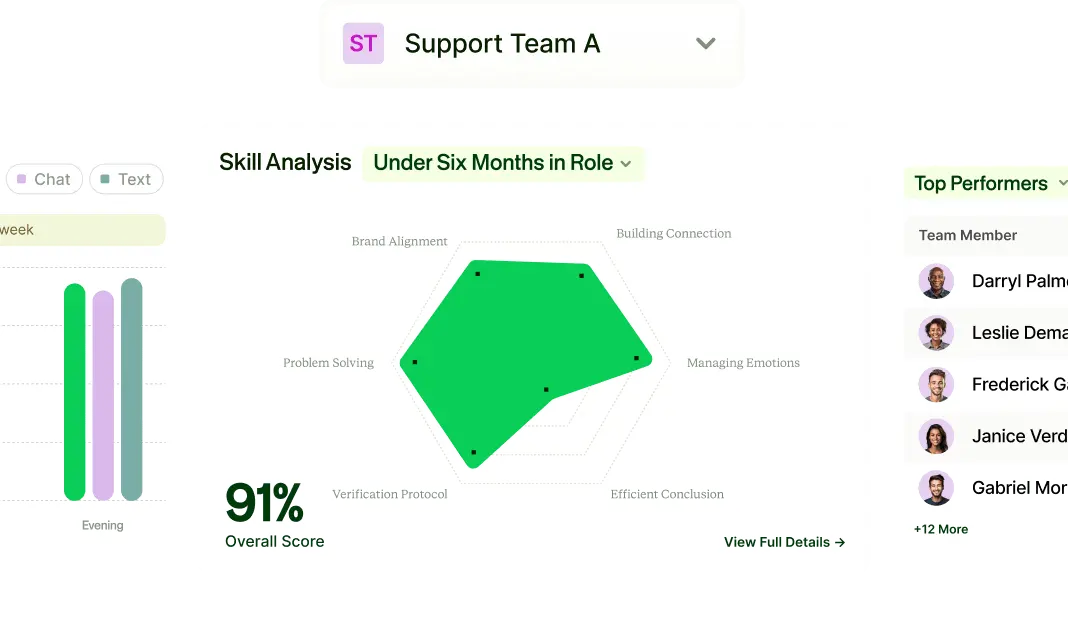
A training program that cannot answer "which agents are struggling with de-escalation?" or "how has empathy scoring changed since onboarding?" is not producing actionable data. ReflexAI's analytics provide performance dashboards that surface trends by agent, team, and scoring dimension, connecting individual session outcomes to program-level insights.
Where do DIY roleplay tools break down?
Most DIY builds fail in predictable ways. The failures are structural, and each one has a direct operational consequence that shows up in live call performance, not just in the training environment.
Let's say your team has been running ChatGPT roleplay sessions for three weeks. Agents are practicing. Supervisors are watching. After the first live call surge, escalation rates have not moved. One reason shows up before you even get to scoring: the persona agents practiced against wasn't the persona they got on the phone.
Persona drift and insufficient pushback
Persona drift is the tendency of ChatGPT and Claude to soften their character over the course of a conversation, particularly when the trainee is struggling. A frustrated customer persona that becomes accommodating after two exchanges does not prepare agents for the real version. Recent research on LLM-simulated users in service and support contexts finds that LLM-based personas are systematically too cooperative and polite, producing far fewer short, natural human turns like "yes" or "ok" and using politeness markers far more often than real human callers do.
Recent research on persona drift in long conversations has found that models measurably shift away from their assigned persona over extended exchanges, and that mitigation via prompt re-injection is only partially effective. Both models are trained and governed to be helpful and harmless, which creates what researchers call an "alignment tax" paid in realism for adversarial training. Prompting harder does not fix it. Is persona drift undermining your training outcomes?
Inconsistent scoring across trainees and sessions
Without a structured scoring engine, two trainees can produce very different conversations and receive feedback that is not meaningfully comparable. A prompt-based judge scores whatever conversation it's given, but the same underlying performance can score differently from session to session depending on how the prompt happens to handle edge cases, like a response that's close but not quite right, or a persona that derails the exchange before the trainee gets a fair shot.
Without a fixed rubric applied the same way every time, "consistent scoring" really just means the model interpreted the prompt the same way twice, which isn't something you can rely on across hundreds of sessions and multiple trainees.
Manual supervisor scoring introduces its own inconsistency, with different supervisors weighting criteria differently and applying standards with varying strictness across sessions. How consistent is your current scoring process?
Privacy and compliance exposure
Trainees in regulated industries may inadvertently include real patient names, account details, or sensitive case information in their practice sessions. Consumer ChatGPT retains chats until the user deletes them, then schedules deletion within 30 days. Anthropic's consumer Claude extends retention to five years if the user allows training, or 30 days if they do not.
HIPAA programs require contractual commitments through a Business Associate Agreement, administrative controls, and auditable security processes, not just an end-user opt-out toggle. OpenAI offers a BAA for ChatGPT Enterprise, ChatGPT for Healthcare, and API customers, though not for consumer ChatGPT Plus accounts (openai.com). SOC 2, HITRUST, and ISO 27001 compliance require independently auditable controls and centrally enforced governance, the kind of infrastructure a consumer AI subscription was never built to provide. ReflexAI meets SOC 2, HIPAA, HITRUST, GDPR, and ISO 27001 standards on every account, with a signed BAA and auditable controls as the default, not an upgrade path. Does your current training tool meet your compliance requirements?
Limited voice practice and no software simulation
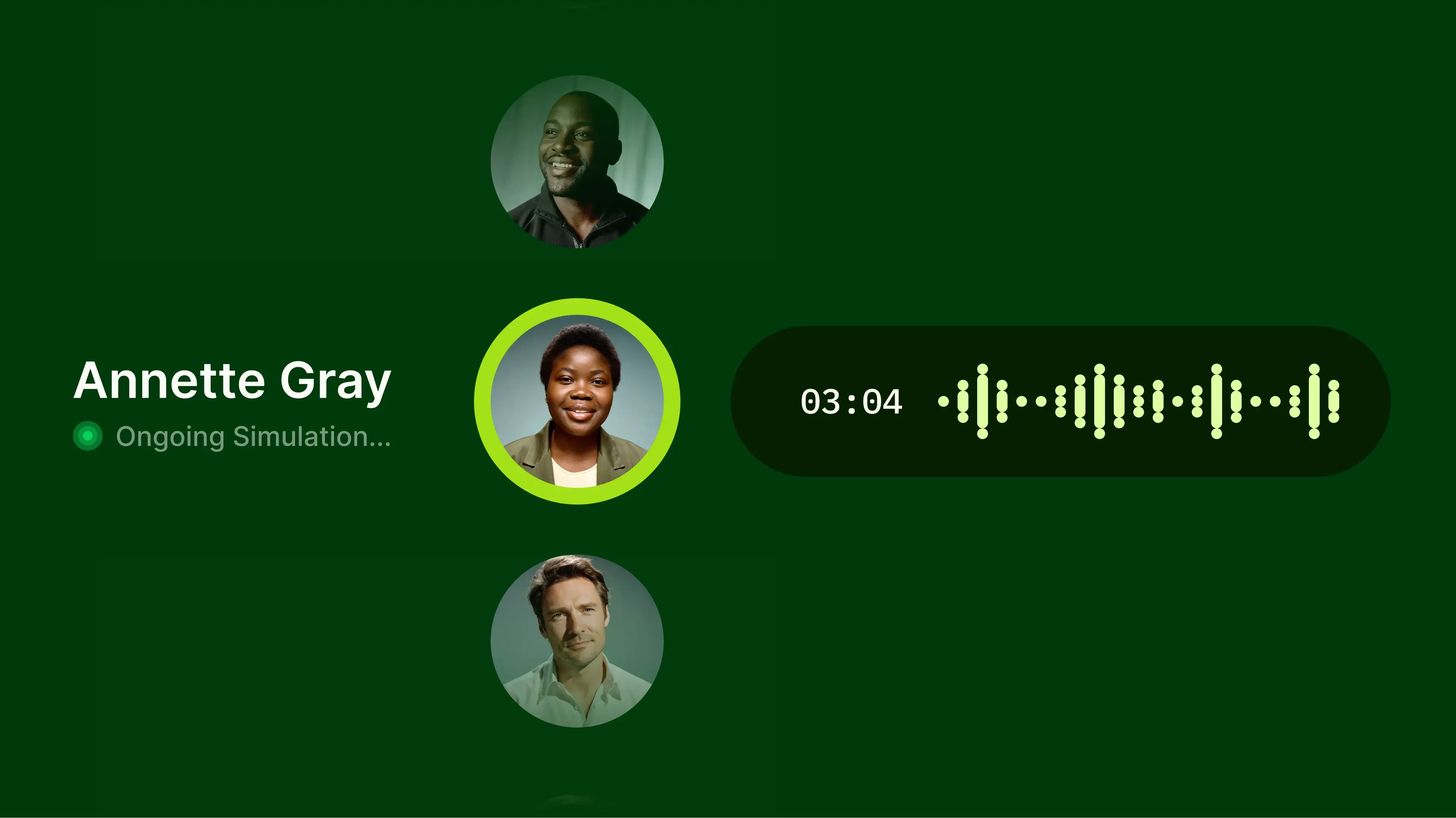
Most DIY builds are text-only, though frontline agents work primarily by voice and navigate CRMs, EMRs, and ticketing systems simultaneously while speaking with customers. A text-based roleplay tool does not train either of these skills. ReflexAI Prepare's voice-first simulations support 25+ languages and include software overlays that simulate tools like CRMs or EMRs during the conversation, bringing practice closer to the actual conditions of live work. Learn how voice-first simulations prepare agents for real calls.
How to test whether your DIY roleplay tool is working
Before rolling a DIY build out to your full team, run three concrete tests. Each one reveals whether the tool is producing training value or just producing text.
Run the same scenario with multiple trainees
Give three trainees the same scenario and compare the persona's behavior and the feedback generated. If the AI persona behaves materially differently across sessions, escalating for one trainee but not another on identical inputs, the tool is not reliable enough for standardized training. The persona's behavior should track what each trainee actually says and does, not vary session to session when the inputs are the same.
Compare AI feedback with a human supervisor's evaluation
Have a supervisor score the same session independently, then compare their evaluation to the AI's output. Actionable feedback names specific moments: "You interrupted the customer at 2:34 before they finished explaining the issue, which caused them to escalate" is actionable. "You could improve your listening skills" is not. A large mismatch between supervisor and AI evaluations, or feedback too generic to act on, means the scoring layer is not yet fit for purpose.
Track whether agent performance on live calls improves
If your team has been running DIY roleplay sessions but escalation rates, handle times, or QA scores have not shifted, the training is not transferring. Without a QA layer that monitors 100% of live interactions, it is difficult to even answer this question, which points to the broader infrastructure shortfall that DIY builds typically cannot address. Can you measure whether your training is working?
When should teams move beyond a DIY roleplay tool?
You are spending more time fixing prompts than running training. Supervisors are manually reviewing every session because the AI feedback is unreliable. Compliance requirements have escalated beyond what consumer accounts can support. These are the signals that a DIY build has reached its ceiling. Is your team seeing these signs?
Capability | DIY with ChatGPT or Claude | Purpose-built simulation platform |
Persona consistency | Variable, prone to drift | Configurable and stable across sessions |
Custom scoring rubric | Manual or prompt-based | Automated, aligned to your criteria |
Voice simulation | Text only | Voice-first with multi-language support |
Software simulation | Not available | CRM, EMR, ticketing overlays |
Compliance (HIPAA, SOC 2) | Not covered by default | Built-in certifications |
Session analytics | Manual | Dashboards by agent, cohort, skill |
QA integration | Separate process | Connected to live interaction review |
High-volume onboarding and coaching at scale
When a team is onboarding dozens of agents per quarter, a DIY tool requires a trainer to be present for every session, manually review every output, and maintain prompt libraries as scenarios evolve. The operational cost scales linearly with volume. ReflexAI Prepare's self-serve Studio lets teams build and update simulations from any script, file, or prompt without engineering support, and scale practice without scaling headcount.
Regulated or sensitive conversations
Crisis lines, behavioral health, financial services, and healthcare teams operate in environments where training fidelity is not optional. An agent who is underprepared for a crisis call creates real harm. ReflexAI meets SOC 2, HIPAA, HITRUST, GDPR, and ISO 27001 standards, and the platform's origin in crisis conversation training reflects its design for exactly these stakes. Let's talk about your compliance requirements.
Live QA connected to personalized simulations
The most significant shortcoming in a DIY build is the inability to connect training and live performance. What an agent struggles with on a real call should inform the simulations they practice next. ReflexAI's Assure product QAs 100% of interactions and surfaces the exact moments that impact scores, giving QA leaders a direct path to turn flagged interactions into personalized simulations and targeted coaching.
How ReflexAI connects roleplay training to live performance
Most training programs treat practice and live performance as separate systems. Agents practice in one environment, take live calls in another, and QA reviews happen in a third. ReflexAI closes that divide by pairing simulation-based training with automated QA, so QA leaders can connect live performance data back into practice and tie coaching to specific moments that affect outcomes.
Prepare: realistic simulations before the first live call
ReflexAI Prepare delivers AI-powered training simulations with configurable personas that maintain character consistency across sessions without drift. Custom scoring dimensions let teams align evaluation to their own rubrics. Voice-first simulations support 25+ languages, and software overlays let agents practice conversations while navigating tools like CRMs, EHRs, and ticketing systems. The self-serve Studio enables teams to build simulations from any script or prompt in minutes, without engineering resources. Learn how Prepare delivers realistic simulations at scale.
Assure: 100% QA that feeds back into training
ReflexAI Assure evaluates 100% of calls, chats, emails, and messages using customizable scoring models aligned to each organization's protocols. It surfaces the exact moments that impact scores and pairs them with recommended alternatives, giving QA leaders what they need to turn flagged interactions into personalized simulations and targeted coaching. Training becomes measurable against live outcomes, and what agents practice reflects what they actually need to improve. Learn how Assure connects QA to personalized training.
FAQ
Can you use ChatGPT or Claude for roleplay without the API?
Yes, both ChatGPT and Claude support roleplay directly in their chat interfaces using system prompts or Custom GPTs and Claude Projects. The API becomes relevant when you need to serve scenarios to multiple users, log sessions programmatically, or integrate roleplay into an existing training system.
Is ChatGPT or Claude better for AI roleplay training?
Claude tends to maintain longer context windows and follow detailed behavioral instructions more consistently, which benefits complex persona definitions, while ChatGPT's Custom GPT feature offers a more accessible no-code setup for non-technical trainers. For high-stakes training at scale, neither replaces a purpose-built simulation platform with structured scoring and compliance controls.
Do I need coding skills to build a roleplay tool with ChatGPT or Claude?
Not for basic use. Custom GPTs and Claude Projects require no code and can be set up in under an hour, though building a repeatable, multi-user tool using the API does require developer resources, as does adding session logging, scoring automation, or integration with existing LMS or CRM systems.
Can I use real customer call transcripts to build roleplay scenarios?
Yes, and this is one of the most effective ways to ground scenarios in reality, though real transcripts containing customer names, account details, or protected health information must be anonymized before use. In regulated industries, using raw transcripts in a non-compliant tool creates data privacy risk regardless of training intent.
Why do AI personas in ChatGPT and Claude lose character mid-conversation?
Both models are optimized to be helpful and cooperative, which causes them to soften adversarial or emotionally charged personas over time, particularly when the trainee is struggling. Reinforcing persona constraints mid-session through follow-up instructions can reduce drift, though it does not eliminate it.
Can a prompt-based roleplay tool replace a dedicated simulation platform?
For narrow, low-stakes use cases with a small team, a single scenario, and manual supervisor review, a well-crafted prompt can deliver genuine training value. For high-volume onboarding, regulated industries, or teams that need measurable performance data tied to live QA outcomes, a prompt-based tool reaches its ceiling quickly. What actually caps a prompt-based tool is scoring consistency, compliance, analytics, and the connection between training and live performance.