










A tax relief or debt settlement sale is won or lost in the first sixty seconds of a phone call. The prospect picking up has probably already hung up on two other companies that turned out to be scams, and the agent's entire job in that first minute is to prove they're not one of them. This piece looks at what it takes to train agents for that moment specifically, and why most sales floors in this category never do.
Debt relief and tax resolution are two different regulated businesses that happen to share a sales motion. Tax resolution runs under IRS Circular 230, the rules governing enrolled agents, CPAs, and tax attorneys who can represent a taxpayer before the IRS. Debt settlement runs under the FTC's Telemarketing Sales Rule, which bars collecting a fee before a debt is actually settled, plus state debt-adjuster licensing.
What the two sides actually share is the sales floor dynamics: high-turnover, compliance-heavy phone sales to someone who's already financially stressed and, more often than not, already skeptical, because this space attracts scammers on both sides. That's the pressure a sales manager in either vertical is managing day to day, regardless of which regulation applies to the close.
Why do tax relief and debt settlement sales calls need simulation training?
Selling tax relief and debt settlement services means selling into skepticism as the default starting condition. This is a category scammers actively target, so every prospect on the line has a reason to distrust the person calling them before the agent says a word.
Most of these teams run a two-call structure: one call to build enough trust to introduce the offer, a second call to close it. Each call demands a different skill. The first is about credibility and discovery under active suspicion. The second is about closing technique with a prospect who's had time to think of new objections. A generic sales roleplay tool built for a single-call SaaS pitch doesn't map to either one.
Can new agents build trust before it's too late?
A script can tell an agent what to say in the first thirty seconds. It can't teach the judgment call of when to slow down, when a prospect's hesitation is normal skepticism versus a signal to back off, or how to recover when an opening line falls flat. Agents who haven't practiced that specific moment tend to either rush past it, which reads as evasive, or over-explain, which reads as scripted. Both cost the call.
Can agents close without overpromising eligibility or outcomes?
Debt settlement and tax relief programs carry real eligibility requirements, and a sales conversation under pressure to hit a close rate is exactly where those requirements get softened into a promise the company can't keep. An agent who hasn't practiced the eligibility conversation specifically tends to default to optimistic framing rather than accurate framing, and that gap surfaces later as a complaint, a chargeback, or a compliance flag, not as a lost sale in the moment.
What is AI simulation training for tax relief and debt settlement sales teams?
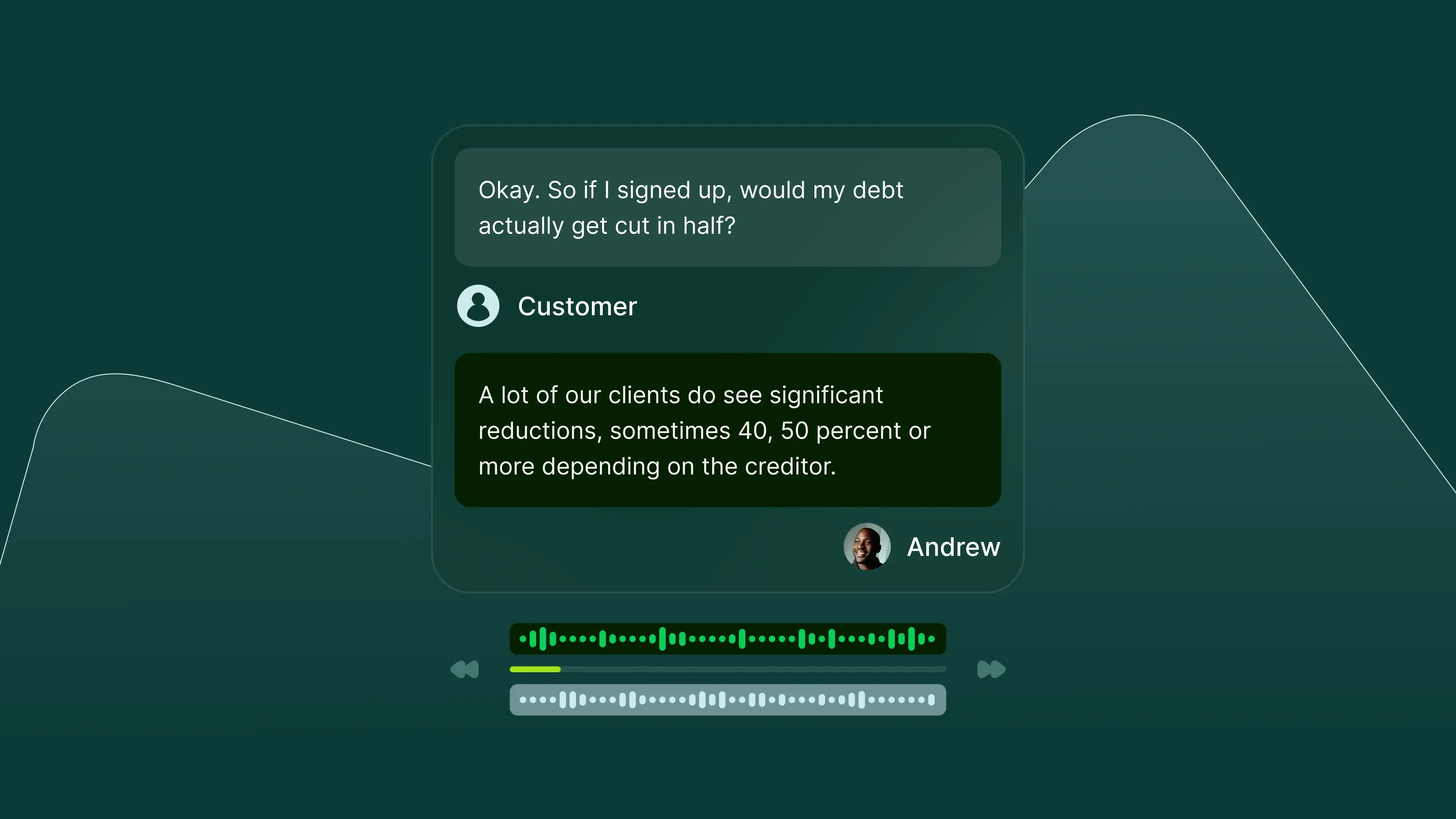
AI simulation training uses a configurable AI persona to model a real prospect conversation, including skepticism, objections, and the specific ways someone in financial distress pushes back on a sales pitch. Agents practice the call before they take one live, and the AI adapts in real time to what the agent says rather than following a fixed script.
This isn't e-learning. E-learning delivers information passively; simulation training requires the agent to build rapport, recover from a bad opening, and adjust in the moment, the actual skills a first call requires.
It also isn't a general-purpose sales roleplay tool. Most of that category is built for a single-call B2B pitch with a business buyer. Tax relief and debt settlement sales involve a two-call structure, a skeptical and often financially stressed consumer, and eligibility requirements a generic sales trainer was never built to score against.
ReflexAI's Prepare lets teams build scenarios modeled on their own scripts and objection patterns, including the specific personas their reps actually encounter, without engineering support.
Which sales scenarios should agents practice?
The first call: credibility and discovery under suspicion
The first call has one job: keep the prospect on the line long enough to have a real conversation. Agents need practice reading a skeptical opening, establishing legitimacy quickly, and asking discovery questions that a defensive prospect doesn't want to answer yet.
What a simulation should include: A persona that starts guarded and reveals information about their actual financial situation only after the agent has built enough trust to earn it, scored on whether the agent gets there and how long it takes.
The second call: the close
By the second call, the prospect has had time to talk themselves out of it, research competitors, or get pushback from a family member. Agents need to handle new objections that didn't come up on the first call and move to a close without sounding like they're reciting a checklist.
What a simulation should include: A persona that returns with fresh objections rather than picking up where the first call left off, scored separately on objection handling and closing technique.
Objection-heavy, initially resistant personas
The hardest calls in this category involve a prospect who is actively resistant, not just neutral. Practicing against an agreeable persona doesn't prepare an agent for the call that actually determines whether they're good at the job.
What a simulation should include: A persona built to be difficult by design, with information gated behind rapport-building rather than handed over on request, so the simulation actually tests the skill it claims to measure.
Selling in the language your customers actually speak
A large and fast-growing share of consumers seeking debt relief and tax resolution services are Spanish-speaking, and most training tools in this category are built English-first, if they support Spanish at all. At Community Tax, roughly half or more of total simulation practice now runs in Spanish, reflecting a bilingual sales organization that previously had no structured way to train or evaluate that half of the team. ReflexAI supports simulations in 25+ languages, including Spanish, built from the same script or prompt used for the English version rather than requiring a separate build for every language a team sells in.
The need isn't specific to tax resolution. Any debt relief floor with a bilingual team is leaving the same gap unaddressed. Teams that only build English-language scenarios are leaving half their floor to learn on live calls what the other half got to practice first.
How should sales teams launch AI simulations?
1. Build for the seasonal ramp cycle, not a one-time cohort
Hiring in this category is seasonal. Tax relief sales floors typically ramp hard in the months leading into tax season and scale back after filing deadlines pass, which forces a recurring choice: burn expensive leads on undertrained new hires, or pull tenured reps off the phones to run manual practice sessions. Simulation training removes that tradeoff, since cohort practice doesn't require a senior rep in the room.
2. Consider extending simulations into the hiring process itself
ReflexAI customers use the same simulations to screen candidates before extending an offer, running them through a realistic call scenario to see who can build trust under pressure before they're on payroll. This isn't the core use case, most teams should get cohort onboarding practice solid first, but it's a natural extension once that foundation is in place.
3. Score the first call and the second call separately
A single generic score across an entire call obscures which skill actually needs work. Teams get more out of scoring credibility and discovery on the first call separately from objection handling and closing technique on the second, since a rep who struggles with one often has no trouble with the other.
4. Make practice a daily habit, not a training-week event
Teams that treat simulation as a one-time onboarding step miss most of the value. At Community Tax, both new and tenured reps use Prepare as an ongoing practice habit, not only during onboarding, with reps who are new or working through a slump directed toward specific scenario types like objection handling or value-based selling.
What compliance considerations apply to tax relief and debt settlement sales calls?
Compliance runs on different rails depending on which side of the business a team sits on, and a simulation platform needs to reflect that rather than train to one generic standard.
For tax resolution teams: IRS Circular 230 governs what the enrolled agents, CPAs, and tax attorneys who actually represent taxpayers can say about outcomes. A sales conversation that implies a specific result before a practitioner has assessed the case creates exposure for the people who have to deliver on it. The National Association of Enrolled Agents and the American Society of Tax Problem Solvers are the standards bodies most tax resolution operations look to.
For debt relief teams: The FTC's Telemarketing Sales Rule Debt Relief Amendments are the core constraint, most notably the ban on collecting a fee before a debt is actually settled or its terms altered. State-level debt-adjuster and debt-settlement licensing requirements layer on top and vary by state. Sales reps in this category typically carry an IAPDA certification, and the Association for Consumer Debt Relief is the trade body most operators reference.
Shared across both: Outbound calling is governed by telemarketing rules like the TCPA regardless of which vertical a call belongs to. Good simulation content gives agents accurate, vertical-specific language for eligibility and fee timing to practice before they ever say it on a live call. A subject matter expert, whether compliance, legal, or a senior sales leader, should sign off on that content before it reaches a rep in training, so what agents are practicing is correct for their vertical from the start.
Training gets agents saying the right thing before the call. AI-powered live call QA, like ReflexAI Assure covers what happens after: instead of sampling a handful of calls per agent, it scores 100% of conversations, so a fee-timing slip or an overstated eligibility claim gets flagged while it's still an isolated call, before it turns into a pattern that shows up in a regulatory review.
What results can tax relief and debt settlement sales teams expect from ReflexAI?
One financial-distress resolution sales team using ReflexAI's Prepare platform saw a 2X reduction in new-hire onboarding time, a 90%+ improvement in key communications skills, and an 80%+ increase in team confidence, measured from their first week live.
At Community Tax, practice has become part of how the team operates day to day rather than a step reps complete once and move past. Reported outcomes include a consistent way to train and evaluate a remote, distributed sales team, including agents based outside the U.S. where live coaching was hard to standardize, and the ability to assess candidate fit during hiring itself rather than only after someone is already on the phones.
FAQ
Is this different from general sales roleplay software?
Yes. Most sales roleplay tools are built around a single-call B2B pitch to a business buyer. Tax relief and debt settlement sales involve a two-call structure, a skeptical and often financially distressed consumer, and eligibility requirements that a generic sales trainer isn't built to score against.
Can teams build simulations in Spanish or other languages without starting over?
Yes. ReflexAI supports simulations in 25+ languages, built from the same script or prompt used for the English version rather than requiring a separate build for each one. For a bilingual sales floor, that means the same objection library and scoring rubric apply regardless of which language a call happens in, so a Spanish-speaking rep isn't training on a thinner version of the program than the rest of the floor.
How quickly can a seasonal hiring cohort get through certification?
With a self-serve platform, a team can build a certification path from an existing script in a matter of hours and run an entire seasonal hiring cohort through the same scenarios before any of them take a live call, which matters most in the months when hiring volume is highest and time to ramp is shortest.
Learn how ReflexAI prepares tax relief and debt settlement sales teams before the first real call
The first call in this category is often the only chance a rep gets. ReflexAI gives sales teams a way to build realistic, scenario-based practice from existing scripts, with configurable personas that stay resistant until an agent earns their trust, scoring that separates discovery from closing, and language parity for teams that sell in more than English. Teams like Community Tax already use it to turn practice into a daily habit across a distributed, bilingual sales floor, and to see who's ready for the phones before they're ever on them.
The fastest way to see how it would handle your team's actual objections and fee-timing rules is to schedule a demo built around a real call your reps take today.