












Organizations have their hands full when it comes to sales personnel decisions.
Despite spending almost 20% more on each salesperson than on employees in any other function, companies are still watching deal stalls, pipelines dry up, and competitors win out on major contracts.
The problem doesn’t always lie with the sales reps themselves. Rather, it’s often the training that falls short.
Most traditional sales training programs rely on outdated methods – from pre-recorded product demos to generic scripts to and surface-level roleplays – that aren’t effective. That’s why reps in this curriculum-based training forget more than 80% of the information they’re taught within 90 days.
But with the rise of AI, sales leaders have the opportunity to completely reimagine how they approach training.
The 3 most common challenges for sales teams
There’s a fundamental disconnect between what traditional training offers and what reps actually struggle with in the field. Based on what we’ve seen and heard from sales teams, these are the three challenges that consistently rise to the top – and where more traditional training tends to break down.
1. Practicing skills under pressure
Being a sales rep means having to flex across a variety of cognitive and interpersonal skills. Some of the most important include:
- Rapid trust building. Many buyer decisions are shaped by the rep they’re speaking with and how credible, knowledgeable, and invested in their goals that person seems. Knowing this, reps have to learn to quickly build rapport with prospects – often only having the initial discovery call to make a strong first impression.
- Resilience. This is about more than just bouncing back after a ‘no,’ which is inevitable in sales. It’s also about staying composed through minor setbacks, navigating hard conversations, and maintaining momentum in the face of uncertainty.
- Objection handling. Many deals fall apart – not because of a lack of interest – but because reps don’t know how to confidently navigate questions, concerns, or pushbacks in real time. It’s a skill that requires quick thinking and the ability to reframe without sounding defensive. Without this skill, trust can erode quickly; with it win rates can increase by up to 64%.
When it comes to helping reps develop these critical skills, traditional programs fall short in a few ways:
- Offer little opportunity to apply these skills in fast-moving, emotionally charged situations.
- Front-load information instead of reinforcing over time.
- Rely on scripts that fail to capture the nuances of real human interactions.
2. Maintaining deep, evolving product knowledge
Sales reps sit in a uniquely challenging position. Even though they’re not in a technical role, they’re still expected to be product experts: explaining complex features, fielding detailed questions, and tailoring those explanations to each buyer’s specific needs.
Add to this the fact that product knowledge evolves constantly. New features roll out. Pricing changes. Competitors release updates. Reps are expected to absorb all of it and still communicate with clarity, accuracy, and confidence on every call.
Traditional training struggles here because:
- It rarely mirrors the real questions, concerns, or pushback reps hear from customers.
- There’s no consistent, structured practice to help reps weave new knowledge seamlessly into real conversations.
3. Accessing consistent, high-quality practice
According to Harvard Business Review, incorporating rigorous practice sessions into training programs is critical. That’s why many companies lean into roleplay as a core part of their sales training.
And while roleplay can be effective, there’s a major caveat: it only works when it’s done well. Meaning, the quality of practice in traditional training programs depends entirely on who’s facilitating, how prepared they are, and how effectively they can coach and share feedback. In reality, that kind of consistency is hard to achieve.
The traditional approach to roleplay falls short because it’s:
- Too rigid and predictable, failing to adapt to a rep’s skill level or introduce increasingly challenging variables.
- Unable to reliably simulate buyer behavior, including hesitation, skepticism, detailed follow-up questions.
- Difficult to scale, limiting how often reps can practice and how quickly they can improve.
How realistic AI simulations can improve sales performance
Forward-thinking organizations are abandoning static scripts in favor of intentional AI simulations. Here’s why this approach delivers where traditional methods struggle:
Realistic practice
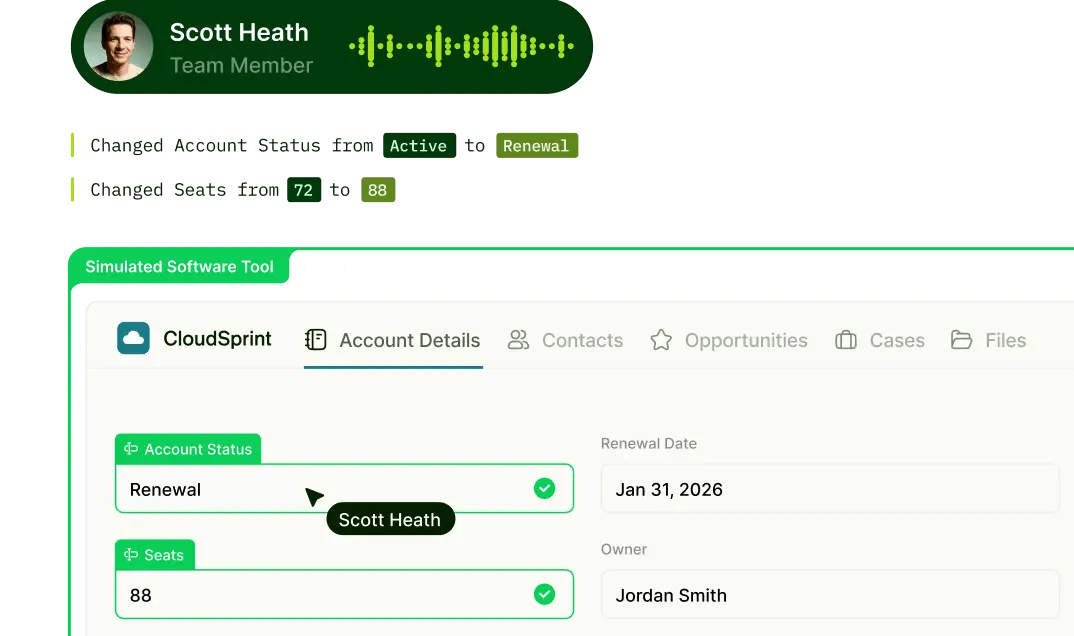
AI simulations can replicate the dynamics of a real prospect conversation in a way that traditional roleplay can’t. The best simulations feature:
- Dynamic objections that shift depending on how well the rep is building trust or explaining value.
- Varied customer personas, each with different motivations, skepticism levels, communication styles, and levels of urgency.
- Adjustable levels of complexity, from straightforward discovery calls to high-stakes negotiations.
- Simulated ‘bad’ outcomes to give reps the opportunity to build real-world resilience.
This type of deliberate practice lets reps build the same skills they need in the field under real pressure.
Actionable feedback
Reps don’t just get better by practicing. They get better by understanding how to improve. While traditional training often delivers rushed, inconsistent, or generic feedback, AI simulations provide:
- Feedback that aligns with your company’s specific sales strategies and goals.
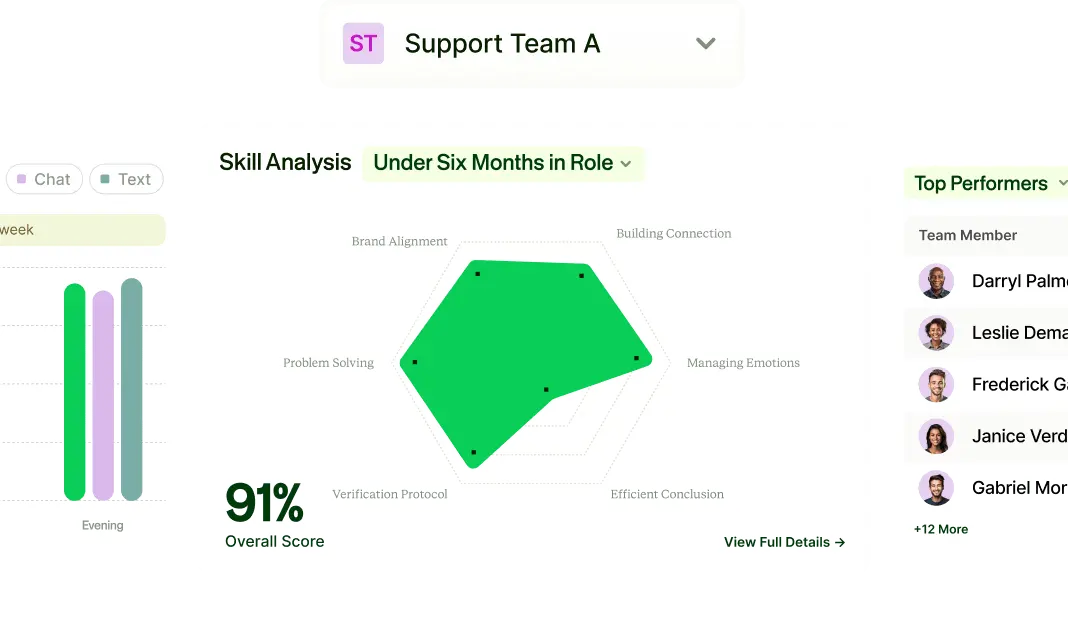
- Insights into improvement areas for both soft skills (empathy, rapport-building, etc.) and hard skills (technical knowledge, objection handling, etc.)
- Consistent scoring, independent of who oversees the training.
- A clear record of performance over time so leaders can identify trends and invest their resources more strategically
Research backs this up: using statistical techniques to forecast a salesperson’s future value can help firms allocate training resources more effectively, leading to an increase in overall sales force performance by approximately 8%.
Infinite scalability
Traditional sales training has a natural ceiling. Managers can only coach so many reps, which means that when sales teams grow quickly, training often becomes inconsistent and rushed.
AI simulations remove those constraints entirely by offering:
- Unlimited practice opportunities, available whenever reps need them.
- Consistent training quality, no matter how many reps are on the team.
- A scalable system that grows alongside the sales organization, without multiplying staffing needs.
So whether you’re onboarding a new rep or helping a veteran master complex negotiations, AI simulations grow with your sales organization – without limits.
Learn how ReflexAI’s realistic simulations can take your sales performance to the next level
With AI-powered simulations, you can sharpen the core skills that differentiate good reps from exceptional ones – from trust building to objection handling – without having to worry about hiring more staff or being constrained by resources.
ReflexAI’s hyperrealistic AI simulations are designed to prepare your sales reps for any and all prospect calls, helping them close more deals and bring more revenue to your business. Want to see how simulation-based training can transform your sales performance?