











You invested in AI call simulation so agents would be better prepared before their first live call. Completion rates are up. Scores look green. Escalations are exactly where they were six `months ago.
That pattern shows up constantly. The simulation runs, agents finish it, and nothing downstream changes - because the training was never connected to real call types, live QA standards, or the systems agents actually use on the floor.
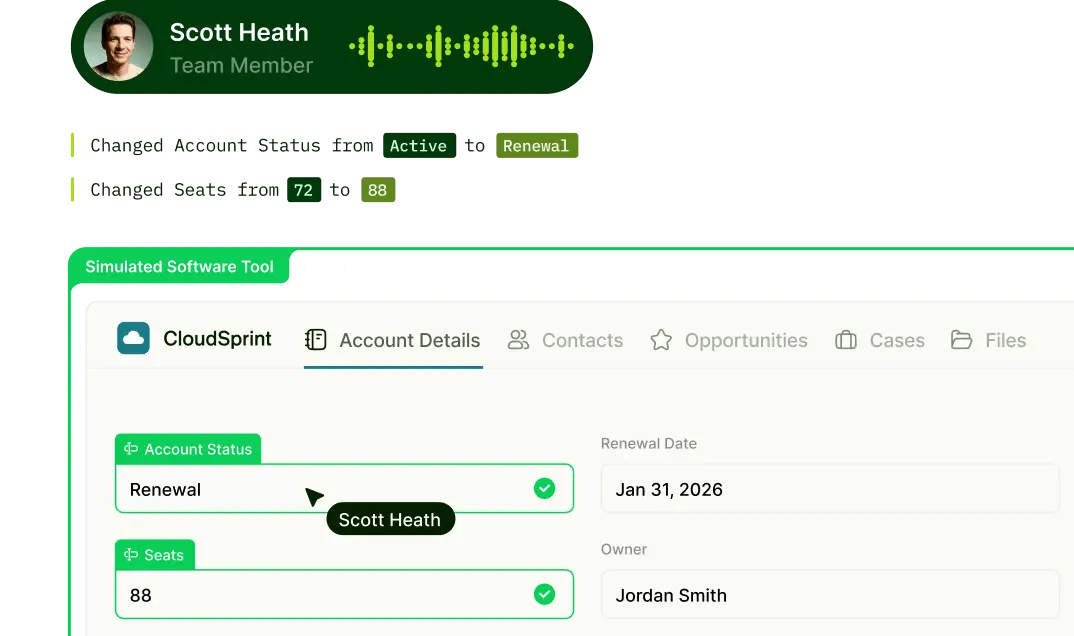
Here's a concrete version of how that disconnect costs you: agents who split attention between a conversation and a screen lose real call time to navigation friction alone, before you count errors and callbacks. If agents never practiced the talk-plus-screens reality, the simulation didn't prepare them for the job.
This article walks through seven mistakes that cause simulation rollouts to miss, and how ReflexAI Prepare and Assure are built to avoid them.
What is AI call simulation training?
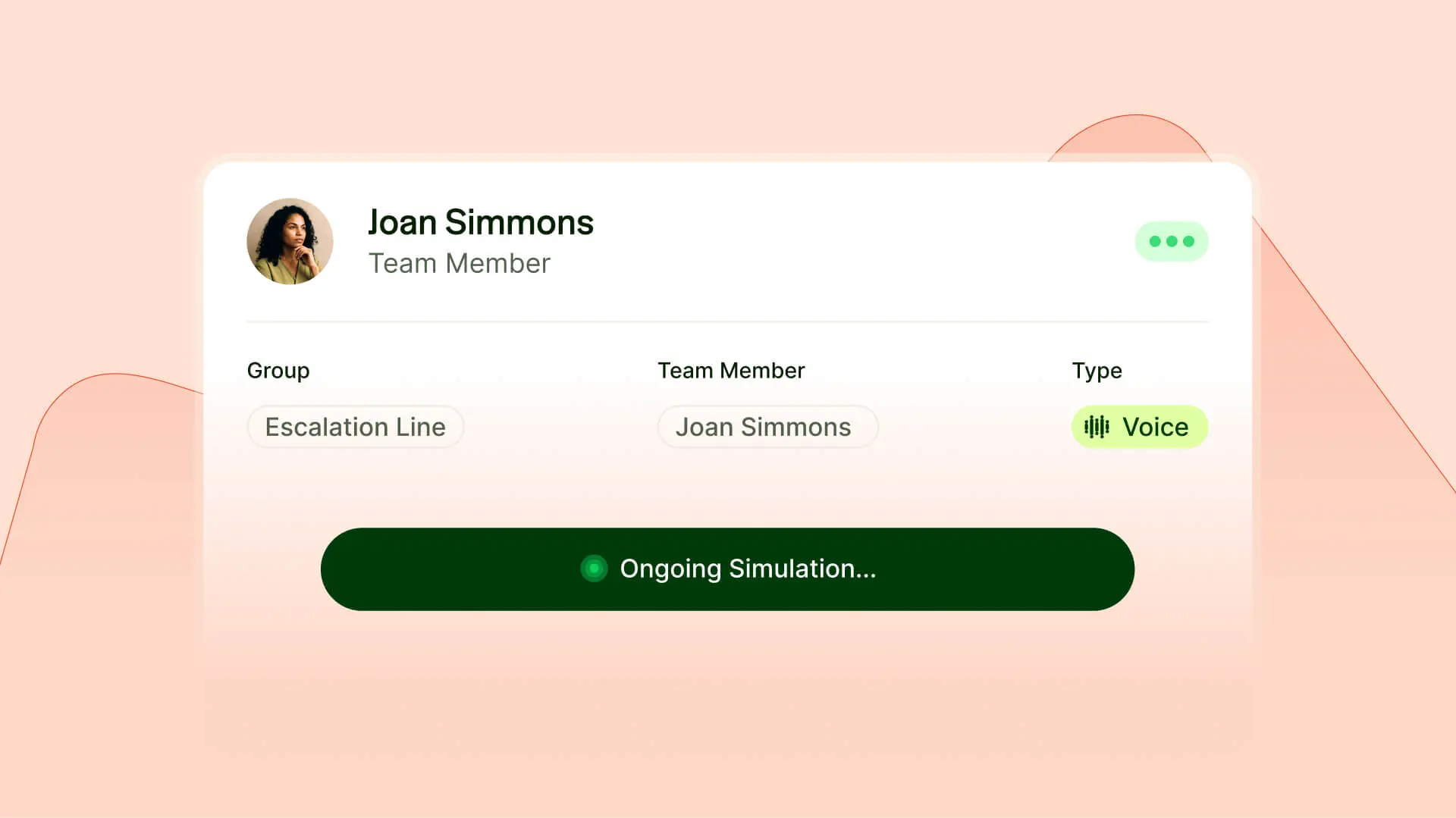
AI call simulation training lets agents practice realistic conversations with an AI-powered persona before they take a single live call. The agent speaks or types, the AI responds as a customer would, and the system scores the interaction against set criteria like protocol adherence, tone, or accuracy. Unlike e-learning modules or static scripts, it is interactive practice in a controlled environment where mistakes carry no real-world consequence.
Why do AI call simulation rollouts fail?
Your team invested in simulation expecting faster onboarding and fewer escalations. The tool is live, agents are completing sessions, and completion rates look fine on paper. Six months later, escalations haven't moved.
The most common failure point is not the technology. It is the decisions made before and after launch: who owns the scenarios, what gets measured, and whether simulation connects to anything that happens on the floor after training ends.
What mistakes cause AI call simulation training to miss the mark?
The seven mistakes below describe what each error looks like in practice and why it matters operationally. These are not edge cases. They are patterns that show up across industries when simulation is treated as a checkbox rather than a performance system.
Mistake 1: Treating simulation as an L&D or IT-only project
Scenarios built without input from QA, operations, or frontline supervisors reflect what one department thinks agents need, not what the floor actually demands. The training passes an internal review and fails on the first escalation. Cross-functional training programs tend to translate into performance more reliably than siloed initiatives, because the people validating the training are the same people who will judge the results.
Cross-functional ownership is what separates simulations that change behavior from ones that check a compliance box:
- Training builds and maintains scenarios
- QA validates that scoring aligns with live evaluation criteria
- Operations sets the readiness standard that determines when an agent is cleared for live calls
Mistake 2: Launching generic scenarios that do not match real calls
Generic out-of-the-box scenarios like "an upset customer" or "a billing question" do not prepare agents for the specific call types, customer personas, or escalation triggers that define their actual work. Agents practice the wrong conversation, and the first live call exposes gaps the simulation never addressed.
Let's say a crisis line rolls out generic complaint scenarios instead of simulating the emotionally complex, protocol-sensitive calls their agents will actually handle. The agents complete training, hit green scores, and then freeze on their first real call because nothing in practice looked like that.
Top-performing teams build scenarios from real call data: common intents, high-risk interactions, and protocol-specific language, rather than hypothetical situations.
Mistake 3: Practicing dialogue without the systems agents use live
Agents who only practice the conversation, not the simultaneous navigation of a CRM, EHR, or ticketing system, face a different environment on their first live call than what they trained in. Agents who split attention between a conversation and a screen lose real call time to navigation friction, and new agents in particular find it difficult to familiarize themselves with systems, leading to errors, sub-optimal performance, and low morale.
If the simulator can't rehearse the talk-plus-clicks-plus-fields-plus-wrap reality, you're training for an environment your agents don't work in.
Mistake 4: Using generic scoring instead of your QA rubric
Agents scored on universal criteria like "tone," "empathy," or "resolution" learn to perform for the simulation, not for the QA standard they will be held to on live calls. The disconnect between training scores and live QA scores is not a calibration problem. It is a design problem.
Custom scoring dimensions that mirror your organization's rubric are what make simulation feedback transferable to live work. COPC (Customer Operations Performance Center) benchmarking data shows only 75% of executives say their organization even tries to understand the relationship between QA accuracy and customer satisfaction. A quarter of teams are grading for compliance theater, not performance.
Mistake 5: Framing AI practice as surveillance instead of safe rehearsal
When simulation is introduced as a monitoring or evaluation tool rather than a low-stakes practice environment, agents perform defensively rather than experimenting and building real confidence - agents in surveillance-framed training environments tend to attempt fewer challenging scenarios, sticking to safe, scripted responses instead. Psychological safety is a prerequisite for skill development.
Leadership framing at rollout shapes adoption more than the technology itself: how the tool is introduced, who presents it, and what it is called all determine whether agents treat it as a practice space or a performance review. COPC data shows agent satisfaction with performance feedback rises from 45% with no formal review to 74% with weekly structured reviews, but only when feedback is perceived as developmental rather than punitive.
Mistake 6: Separating simulation results from live QA data
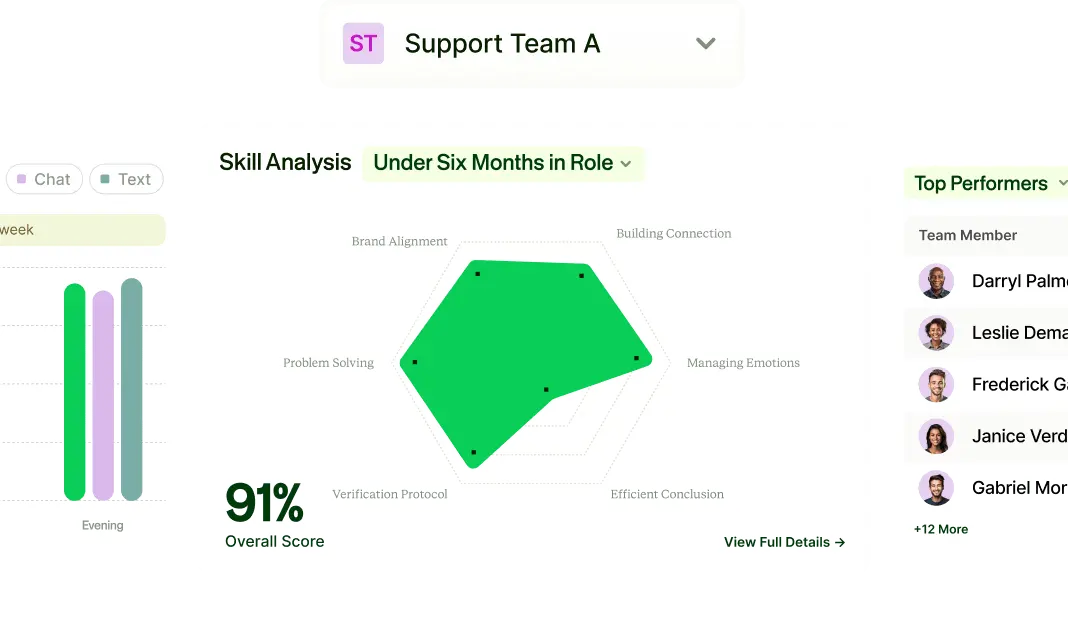
Simulation performance and live QA results managed in separate systems leave training leaders unable to see whether practice is translating to better live conversations. Without that feedback loop, there is no way to know which scenarios need updating, which agents need more reps, or whether simulation content still reflects what is happening on the floor.
The coverage gap makes this worse:
- 81% of agents say most of their conversations are never reviewed for quality
- Only 13% of contact centers review every interaction
- 73% of QA leaders say they lack time to analyze and use QA data
Any simulator disconnected from QA is structurally incapable of targeting behavior change on real failure modes, because it cannot see them at scale.
Mistake 7: Treating launch as the finish line
A simulation library that was accurate at launch can actively mislead agents within months if it is not updated. Call types evolve, protocols change, new products launch, and customer behavior shifts, while the scenario library stays frozen at the day it went live. Organizations that review training content on a regular cadence see meaningfully fewer protocol-related errors than those with static libraries.
A maintenance cadence, reviewing scenarios against live QA trends and flagging outdated content, is as important as the initial build.
How can companies avoid these mistakes?
Four decisions directly address the gaps between simulation and live performance. These are not implementation steps. They are the decisions that determine whether your simulation program changes behavior or just generates completion data. Which of these decisions is your team making today?
Start with the call types that create the most risk
Identify the three to five call types with the highest escalation rate, longest handle time, or greatest compliance exposure. These are the scenarios where simulation delivers the most immediate ROI, and the ones where a gap between training and live performance is most costly.
High-risk call type criteria to prioritize (let's say your escalation data shows billing disputes drive 40% of supervisor interventions - that's your starting point):
- Escalation frequency: calls that regularly require supervisor intervention
- Protocol complexity: interactions with mandatory scripting or compliance requirements
- Emotional intensity: calls where agent tone and empathy directly affect outcome
Build scenarios from actual call patterns and protocols
The most realistic simulations are built from language agents will actually hear, not language someone assumed they would hear. Pull scenario content from call transcripts, QA findings, and subject matter expert interviews, not from generic templates.
Teams using automated QA across 100% of calls have a significant advantage here. They can identify recurring themes, friction points, and protocol gaps at scale rather than relying on a sample.
Calibrate AI scoring before agents trust the results
Misaligned scoring, even slightly, erodes agent trust in the feedback and undermines the entire practice loop. Before rollout, QA leaders and training managers should validate that the simulation's scoring output aligns with how they would score the same interaction manually.
Run a calibration session where supervisors score the same simulated call independently, then compare to the AI score and adjust dimensions accordingly. Let's say three supervisors score a simulated billing call: if one rates empathy at 3/5 and another at 5/5, that variance needs resolution before agents see any scores. COPC data shows 89% of contact centers have a QA calibration process and 86% consider it effective, because scoring inconsistency is otherwise guaranteed.
Pilot with one cohort before scale
Launch with a single team or new-hire cohort, gather feedback on scenario realism, scoring accuracy, and agent experience, then iterate before expanding. Piloting is the fastest path to a simulation library that actually changes behavior at scale, not a delay.
Track one leading indicator during the pilot: time to first unassisted live call or supervisor-rated readiness score. ICMI (International Customer Management Institute) data shows time to proficiency after onboarding commonly lands between one and six months, with 31% of centers reporting three to six months. Any measurable reduction in that window is material.
How should teams measure AI call simulation training results?
Completion rates tell you agents finished the sessions. They do not tell you agents are ready. The goal is to connect simulation activity to live performance outcomes, which requires two distinct measurement layers.
Track readiness before live calls
Readiness metrics should be defined before launch, not after. Leading indicators tell you whether agents are prepared for live work before they take their first call:
- Simulation score trends: are scores improving across repeated attempts?
- Scenario completion rate: are agents completing the full range of assigned call types?
- Supervisor certification: has a manager reviewed and approved at least one simulation session before the agent takes live calls?
Track live QA, escalations, FCR, AHT, and CSAT after rollout
The real test of simulation effectiveness is whether live performance improves after training. Lagging indicators measure the downstream impact on customer outcomes and operational efficiency:
- First call resolution (FCR): are agents resolving more calls without escalation?
- Average handle time (AHT): are agents navigating calls more efficiently?
- CSAT and escalation rate: are customer outcomes improving for recently trained cohorts?
Isolating the effect of simulation requires comparing cohorts with and without simulation exposure, or tracking pre-post performance for the same agents.
Track performance by cohort, team, channel, and topic
Aggregate metrics can mask individual or team-level gaps. A single underperforming cohort or call type can drive most of the variance in your escalation rate while org-level averages look stable.
Filtering performance by team, channel, or topic means training leaders can identify whether a specific scenario, call type, or agent group is underperforming rather than waiting for a pattern to surface in aggregate data. What metrics is your team tracking today - and are they connected to live outcomes?
FAQ
How long should an AI call simulation pilot run before a full rollout?
Most pilots run for two to four weeks with a single cohort, long enough to gather meaningful feedback on scenario realism and scoring accuracy, but short enough to maintain rollout momentum. The pilot should end with a defined decision point: iterate, expand, or pause.
Who should own AI call simulation training within a contact center?
Ownership works best when it is shared across training, QA, and operations rather than siloed in a single team. Training builds and maintains scenarios, QA validates scoring alignment, and operations sets the readiness criteria that determine when an agent is cleared for live calls.
Will AI simulations replace human coaches in contact centers?
AI simulation handles the repetitive, scalable practice that human coaches cannot realistically provide at volume, though it does not replace the judgment, context, and relationship that effective coaching requires. The strongest programs use simulation to create more practice opportunities so that human coaching time can focus on higher-order skill development.
Can AI call simulation training support compliance requirements?
Yes, provided the simulation scenarios and scoring dimensions are built to reflect the specific compliance protocols the organization is held to, not generic best-practice criteria. Teams in regulated industries such as healthcare and financial services should involve compliance stakeholders in scenario design and scoring calibration before rollout.
What types of data should companies avoid putting into AI simulations?
Companies should avoid including real customer PII, protected health information, or sensitive case data in simulation scenarios, using anonymized or synthetic examples instead. Organizations subject to HIPAA, GDPR, or other data protection standards should verify that their simulation platform meets the relevant compliance certifications before building scenario content.
How often should AI call simulation scenarios be updated?
Scenarios should be reviewed whenever there is a meaningful change to call volume patterns, product offerings, protocols, or QA scoring criteria, and at minimum on a quarterly basis. Teams with access to automated QA across all interactions can use live performance trends to trigger scenario updates rather than relying on a fixed calendar.
Learn how ReflexAI helps teams practice before live customer impact
ReflexAI's Prepare product delivers configurable personas, custom scoring dimensions that mirror your QA rubric, and software overlays that let agents practice conversations while navigating the actual tools they use: CRMs, EHRs, and ticketing systems. Assure automatically QAs 100% of conversations and converts flagged interactions into personalized simulations, closing the loop between live performance and targeted practice. Together, Prepare and Assure connect training, measurement, and improvement into one platform so readiness starts earlier and practice happens safely before real customer impact.